
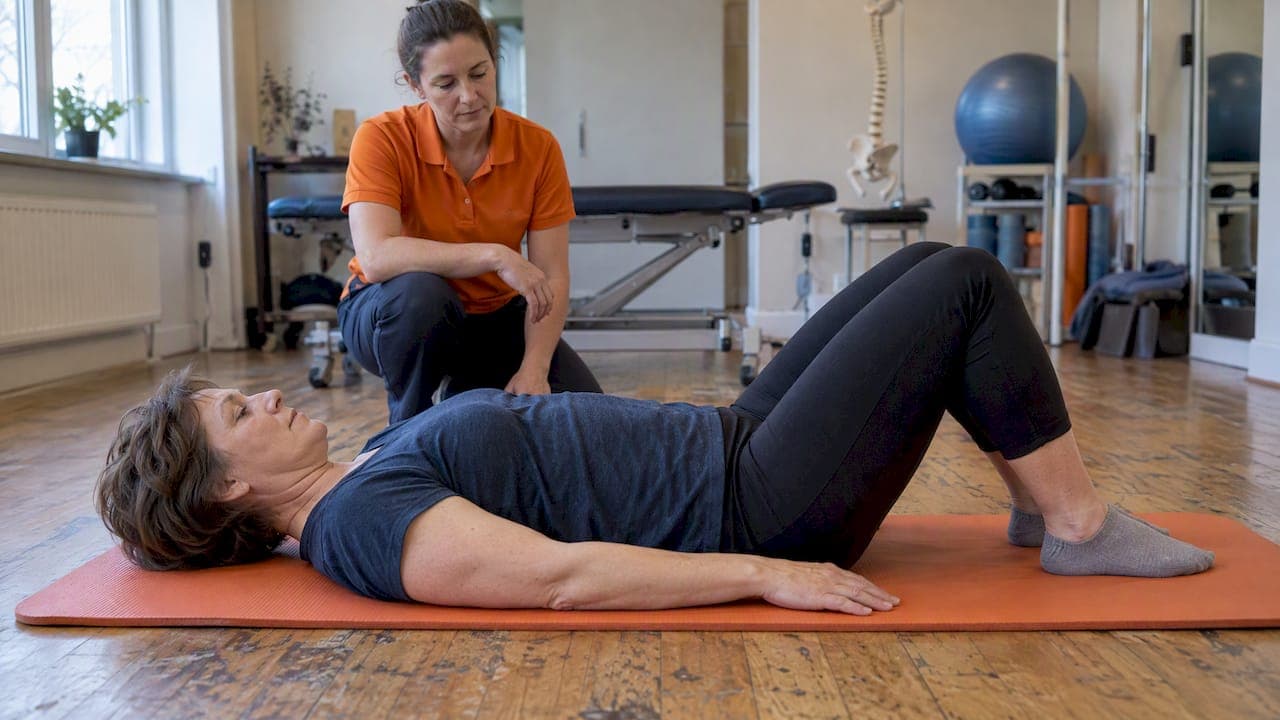
Pilates can help many adults with scoliosis feel stronger, move more easily and manage back pain. It will not straighten the spine. If you have a diagnosed curve, pain, or a history of spinal surgery, the safest way to start is with a physiotherapy assessment, so the exercises are matched to your curve rather than copied from a generic class.
This guide explains what the evidence says, which principles matter for a curved spine, how to choose between a group class and one-to-one sessions, and when to check with a clinician first.
TL;DR
- Pilates can support pain relief, core strength, posture and balance in scoliosis. Official guidance is clear that it is not a cure and is not expected to reduce the structural curve.
- For adults, the main goal is pain relief and keeping function, not a straighter spine, according to NHS advice on treatment in adults.
- Scoliosis is three-dimensional, so exercises work best when adapted to your own curve. Generic routines may miss the asymmetry.
- See a GP, physiotherapist or scoliosis specialist first if you have pain or have had spinal surgery.
- At Parks Therapy Centre, Pilates group classes cost £9 per class and one-to-one Pilates costs £50 per class.
Table of Contents
- Can Pilates help scoliosis?
- What the research actually shows
- Why a curved spine needs adapted Pilates
- Pilates principles that help with scoliosis
- Group class or one-to-one?
- When to see a clinician first
- Our perspective
- Getting started at Parks Therapy Centre
- Practical tips for your first month
- FAQ
- Sources
Can Pilates help scoliosis?
It can help with how scoliosis feels and functions. It does not change the shape of the bones in any way you should rely on.
The NHS says that back pain is one of the main problems scoliosis causes in adults, and that treatment is mainly aimed at pain relief. If the curve is not severe and causes no pain, treatment may not be needed at all. Pilates fits that picture well. It trains the deep trunk muscles, breathing control and body awareness, all of which can make a curved spine more comfortable to live with.
The NHS also publishes a 32-minute Pilates-inspired class for people with scoliosis, aimed at relieving tension and improving alignment and posture. It carries the usual advice to talk to a healthcare professional first if you have a health problem, an injury or have recently had an operation.

Can Pilates correct a curve?
Not reliably, and not in a way that replaces medical care. Guidance from the American Academy of Orthopaedic Surgeons' patient site says Pilates may help people with scoliosis-related back pain, but surgery is the only treatment that can reduce the deformity. Be wary of any class or video that promises to "fix" or "untwist" your spine.
What the research actually shows
The research is encouraging but modest, and it is worth reading with the limits in mind.
A meta-analysis of randomised controlled trials looked at Pilates for scoliosis. It reported improvements in Cobb angle (the standard measure of curve size) and in pain. The pooled result for Cobb angle was a standardised mean difference of 1.23, with a very wide confidence interval of 0.11 to 2.35. That width means the true effect could be small or large.
A later systematic review from 2024 included nine studies and 643 participants. It found potential benefits for spinal deformity, posture and quality of life, including reductions in trunk rotation and improvements in pain and trunk range of motion. The authors note that the quality of evidence is often only fair or low, so results need careful interpretation.
In plain terms:
- Studies suggest Pilates is a reasonable, low-risk way to build strength and reduce pain.
- The studies are small and vary in method, so they cannot promise a change in your curve.
- Many trial participants were adolescents, so findings do not transfer automatically to every adult.
The last point is our caution, not a finding from the papers. If you are an adult with a long-standing curve, the realistic aim is comfort, strength and confidence in movement.
Why a curved spine needs adapted Pilates
Scoliosis is not just a sideways bend. The vertebrae also rotate, so the ribcage, shoulder blades and pelvis sit differently from side to side. That is why a routine designed for symmetrical bodies can load one side more than the other.

The Royal National Orthopaedic Hospital describes outpatient scoliosis physiotherapy as based on specific principles, such as curve-specific postural retraining, rather than general exercise. Its clinicians also place movement training inside a wider plan that includes fitness advice, core strengthening and balance work.
The Scoliosis Research Society suggests a multidisciplinary approach to management. People with pain or dysfunction are encouraged to seek supervised therapy, including Physiotherapy Scoliosis Specific Exercises (PSSE), under a physician who is used to treating spinal alignment problems. Pilates is a popular and useful option, but it is not the same thing as PSSE.
Posture is dynamic, not rigid
Many adults try to "stand up straight" by clamping the shoulders back and stiffening the lower back. This tends to create tension without helping. The RNOH describes a more useful idea: organising how the ribcage sits over the pelvis, using breathing to create space, and keeping length while you move. Good Pilates teaching works on exactly this. If your instructor mainly cues you to hold a position, ask whether the class suits you.
Pilates principles that help with scoliosis
These are the ideas a well-run session should be built around. They are general principles, not a prescription for your curve.
- Breathing with the ribcage. Directing breath into the flatter or more compressed side of the ribcage can improve awareness of asymmetry. Your physiotherapist can tell you which side that is for you.
- Deep core activation. Gentle engagement of the deep abdominal muscles and pelvic floor, without bracing or holding the breath, supports the trunk. The pilates sequences ranked by Google, including the NHS video, begin with this step.
- Length before strength. Think of lengthening through the spine before you load it, rather than forcing the back flat.
- Side-specific work. Some exercises, such as a side plank, may be done on one side only or held for different times on each side, depending on the curve. This should be guided by a clinician, not by a general video.
- Pelvic and shoulder stability. Because the pelvis and shoulder girdle often sit unevenly, controlled movements of the hips and shoulders build confidence in everyday tasks.
- Small, regular practice. The NHS notes that for adults, staying active and avoiding pain-provoking activities matters more than any specific exercise type, provided you move safely and regularly.
Moves that often need modification
Deep spinal flexion, extreme twisting and end-range extension can aggravate some curves. After spinal surgery the picture changes again: Oxford University Hospitals advises that people who have had scoliosis surgery speak to their physiotherapist before trying movements such as spinal extension exercises, because some routines may need modifying or avoiding. Follow your surgeon's and physiotherapist's advice over any class instruction.
Group class or one-to-one?
Both have a place. The right choice depends on how much your curve affects you and how confident you are.
| Group Pilates | One-to-one Pilates | |
|---|---|---|
| Price at Parks Therapy Centre | £9 per class | £50 per class |
| Attention to your curve | Shared with the class | Fully focused on you |
| Best for | Mild curves, no pain, an existing movement habit | Pain, a larger curve, previous surgery, or learning the basics |
| Pace | Set by the class | Set by you |
A sensible route for many people is to start with an assessment and a few one-to-one sessions to learn which movements suit you, then move into a group class once you are confident. Tell any instructor about your scoliosis, the type of curve if you know it, and any surgery or pain before the class begins.
When to see a clinician first
See a GP, physiotherapist or scoliosis specialist before starting if any of these apply:
- You have back pain that is new, worsening or wakes you at night.
- You have had spinal surgery, or surgery is being discussed.
- You have numbness, tingling or weakness in the legs. Seek medical advice promptly.
- You are pregnant or have recently given birth. The NHS video page advises talking to a healthcare professional first in these cases.
- You also have osteoporosis or low bone density, which changes which spinal movements are safe. Our guide to Pilates for osteoporosis explains the modifications, and this posture plan written with bone health in mind is a useful companion read.
The NHS treatment page for adults states the same standard advice: get checked by a professional so that exercises are safe and your individual needs are met.
Our perspective
We have treated musculoskeletal problems in Bedfordshire and Buckinghamshire since 1986, and the pattern with scoliosis is consistent. People rarely come to us asking about the angle of their curve. They come because their back aches at the end of a working day, because they have stopped doing something they enjoyed, or because they are worried that exercise will make things worse.
Our view is that Pilates is a good tool and a poor promise. It is good because it teaches control, breathing and strength in a way that is gentle on joints and easy to scale. It is a poor promise when a class sells straightening. We would rather you leave a session with a realistic goal, such as sitting through a meeting without pain, than with an expectation the evidence does not support.
That is why we start with a physiotherapy assessment where there is pain, surgery or uncertainty. We can look at how you move, decide which Pilates exercises are suitable, and tell you which to leave out for now. Because our team covers physiotherapy, sports injury treatment, Pilates and more under one roof, your plan can include other support, such as sports massage for muscle tension, if it would help.
Start gently, stay consistent and tell us what you feel. Movement that is comfortable and regular beats an ambitious routine you abandon after a week.
— Ivan
Getting started at Parks Therapy Centre
If you want expert guidance before you begin, our published prices are:
- Physiotherapy Assessment: £76
- Physiotherapy Treatment: £67
- Pilates Group Sessions: £9 per class
- Pilates One-to-One: £50 per class
- Sports Massage: £60 per hour
If your clinician thinks imaging would help, we also offer an Image Assessment at £76 and an Image Referral Letter at £10. You can see every price and book online on our prices page. We accept private payment and health insurance.
For more on how Pilates fits into rehabilitation, read our guides on Pilates for back care, Pilates posture tips and why Pilates suits back pain.
Practical tips for your first month
- Pick one or two sessions a week. Consistency matters more than length. Short, regular sessions are easier to keep up than a single long workout.
- Stop when pain sharpens. Mild muscle effort is normal. Sharp, pulling or radiating pain is a signal to stop and ask your physiotherapist.
- Use mirrors and cues sparingly. Check your alignment, but avoid chasing a perfectly symmetrical position, which your skeleton may not allow.
- Keep breathing. Holding your breath to brace usually increases tension. Slow breathing is part of the exercise.
- Review after four to six weeks. Note what feels easier, what still hurts and what you avoid. Share this with your instructor or physiotherapist so the programme can change.
- Mix in other activity. Walking, swimming and strength work all count. The NHS point that staying active matters more than the exact exercise type applies here.
FAQ
Does Pilates help with scoliosis?
Yes, for many adults it helps with pain, core strength, posture and balance. The evidence is promising but of fair to low quality, so treat it as supportive care rather than a treatment for the curve itself. Check with a physiotherapist first if you have pain or have had surgery.
Can scoliosis be corrected with Pilates?
No. Pilates is not expected to reduce the structural curve, and surgery is the only treatment that can reduce the deformity. What Pilates can do is improve how your body moves and feels around the curve.
What is the best exercise for scoliosis?
There is no single best exercise. For adults, regular, comfortable movement that builds strength and avoids pain matters most. Specific scoliosis exercises taught by a physiotherapist are the most tailored option, and Pilates can sit alongside them.
Is Pilates or yoga better for scoliosis?
Neither is clearly better. Both appear in guidance as options that may help scoliosis-related back pain. Choose the one you will practise regularly, with a qualified instructor who knows about your curve and adapts poses that twist or bend your spine to the extreme.
Sources
- Nonsurgical Treatment Options for Scoliosis, OrthoInfo (AAOS)
- Scoliosis: treatment in adults, NHS
- Scoliosis Pilates video workout, NHS
- Pilates exercise training for scoliosis: meta-analysis of randomised controlled trials, PubMed
- Effects of Pilates exercises on spine deformities and posture: a systematic review, PMC
- Outpatient Scoliosis Physiotherapy, Royal National Orthopaedic Hospital
- Sagittal Spinal Alignment, Scoliosis Research Society
- Exercise videos, Optimise, Oxford University Hospitals