
TL;DR:
- Pilates is an evidence-backed, low-impact exercise that effectively reduces back pain by strengthening spinal stabilizers. It targets core muscles, improves posture, and promotes movement efficiency, making it suitable for chronic back pain management. Proper instruction and integration with physiotherapy enhance safety and long-term results.
Pilates is a clinically supported, low-impact exercise method that relieves back pain by strengthening deep spinal stabilisers and correcting posture. If you live with persistent lower back discomfort, the question of why choose Pilates for back pain has a clear, evidence-based answer: it targets the root causes of pain rather than masking symptoms. A 2026 meta-analysis of 23 studies covering 1,179 participants confirmed that Pilates produces significant pain reduction and improved function in people with chronic non-specific low back pain. That finding places Pilates firmly alongside physiotherapy as a first-line exercise option for adults managing back pain.
Why choose Pilates for back pain: the physiological case
Pilates works on back pain by engaging muscles that most people never consciously activate. The multifidus and transversus abdominis, two deep spinal stabilisers, are the primary targets. These muscles support the lumbar spine during every movement you make, yet they weaken rapidly after injury or prolonged sitting.
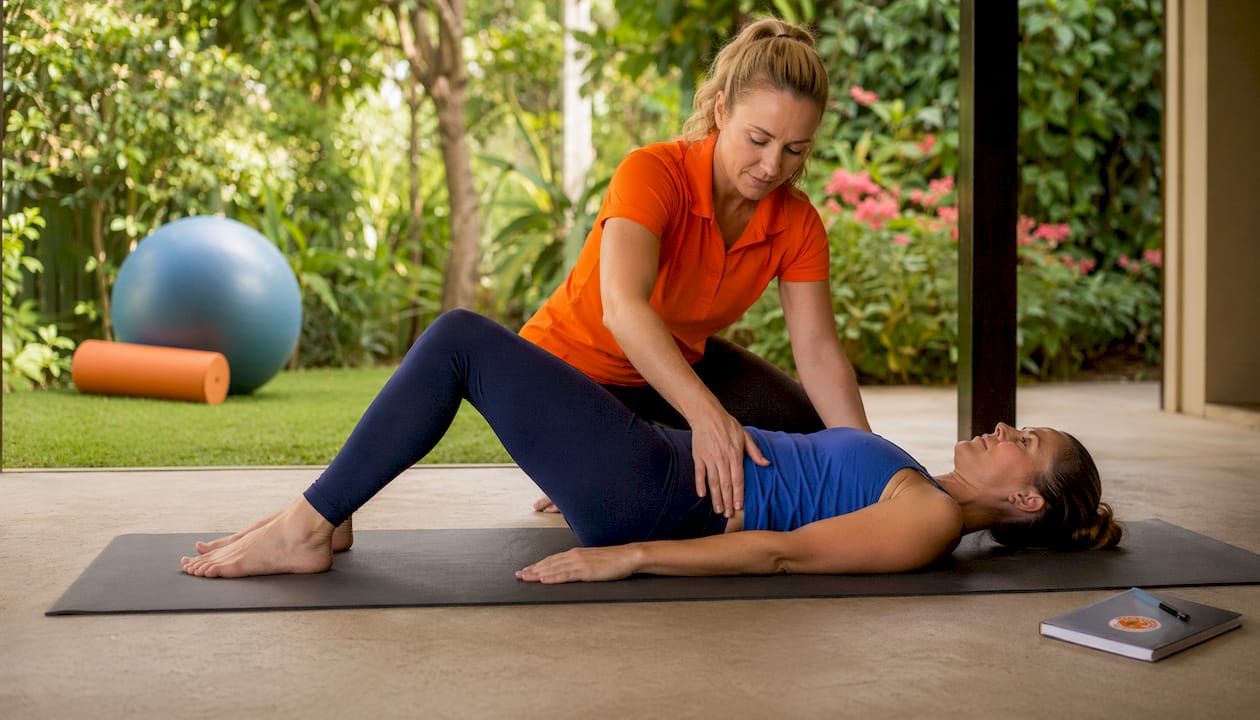
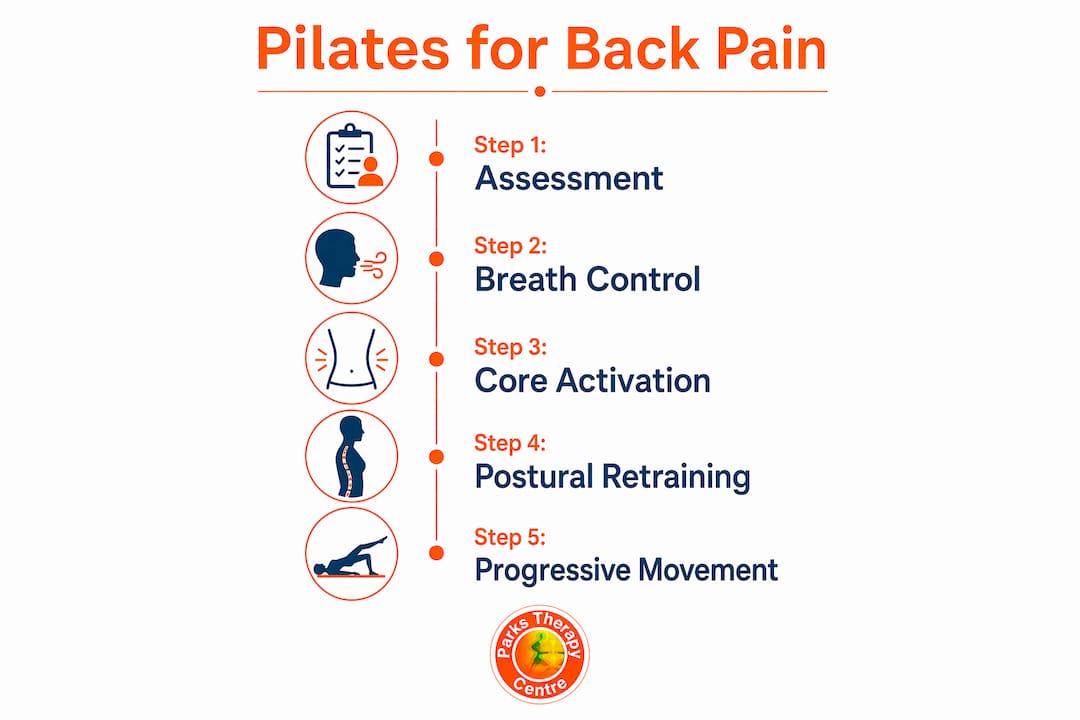
A progressive 8-week structure is the standard clinical approach. The first two weeks focus on breath control and neutral spine awareness. Weeks three to five introduce controlled limb movements while maintaining spinal position. The final phase builds core endurance under load. This sequencing matters because rushing to strength work before mastering stability creates compensatory patterns that worsen pain.
Pilates also lengthens the hip flexors, which tighten from prolonged sitting and pull the lumbar spine into excessive extension. Rebalancing the posterior chain, including the glutes and hamstrings, reduces the compressive load on lumbar discs. The result is a body that moves more efficiently, not just a core that feels stronger.
Low-impact, controlled movements are central to how Pilates helps back pain. Unlike high-intensity exercise, Pilates keeps spinal loading within safe limits throughout each session. This makes it accessible on days when pain levels are higher, which is a critical advantage for people managing chronic conditions.
Key mechanisms at a glance:
- Activation of the multifidus and transversus abdominis for spinal support
- Neutral spine training to correct postural habits that drive pain
- Hip flexor lengthening to reduce lumbar compression
- Posterior chain rebalancing to distribute load away from the lower back
- Breath-led movement to reduce muscular tension and improve body awareness
Pro Tip: Before your first Pilates session, ask your instructor to assess your neutral spine position. Most beginners either flatten or over-arch the lower back, and correcting this from day one prevents weeks of reinforcing the wrong pattern.
What does the research say about Pilates for back pain?
The clinical evidence for Pilates is now substantial. A 2026 meta-analysis of 438 participants found that Pilates produces a significantly greater reduction in pain intensity compared to control groups, with a standardised mean difference of SMD = -1.48 (P = 0.007). An SMD above 0.8 is considered a large effect in clinical research. This result places Pilates among the most effective exercise interventions for chronic low back pain.
A randomised controlled trial comparing Pilates directly with yoga and self-care education found that Pilates three times per week for six weeks produced superior reductions in both pain and functional disability. The trial included 45 participants aged 18–45. Yoga produced meaningful improvements, but Pilates outperformed it on both pain intensity and disability measures at the six-week mark.
Older adults also benefit. A 12-week machine-based programme showed statistically significant improvements in pain and physical quality of life with twice-weekly sessions. The psychosocial benefits, including reduced anxiety about movement, were an additional finding. This matters because fear of movement is a major barrier to recovery in chronic back pain.
| Intervention | Pain reduction | Functional improvement | Evidence quality |
|---|---|---|---|
| Pilates | Large (SMD -1.48) | Significant | Meta-analysis, RCTs |
| Yoga | Moderate | Moderate | RCT comparison |
| Self-care education | Minimal | Minimal | RCT comparison |
| Machine-based Pilates | Significant | Significant | Pilot study, older adults |
Research heterogeneity remains a limitation. Studies vary in session frequency, instructor qualification, and participant baseline. This means results are not uniform across all populations, and an individualised approach remains the most reliable path to back pain relief with Pilates.
How does Pilates complement physical therapy for back pain?
Pilates and physical therapy address back pain from different angles, and they work best together. Physical therapy corrects structural dysfunctions through diagnosis, manual therapy, and targeted rehabilitation. Pilates then builds on that foundation by retraining movement patterns and improving long-term stability.
"Pilates focuses on body movement efficiency and stability training, while physical therapy diagnoses and corrects structural dysfunctions. The two are complementary, not interchangeable. For acute or undiagnosed back pain, physical therapy assessment should come first."
This sequencing is the standard clinical recommendation. A physiotherapist identifies the source of pain and rules out serious pathology. Pilates then provides the neurological retraining that prevents recurrence. Skipping the assessment phase and going straight to Pilates carries risk, particularly for people with disc herniation, spinal stenosis, or nerve involvement.
Pilates therapy for musculoskeletal recovery works precisely because it trains the nervous system to recruit stabilising muscles automatically. This is different from building muscle bulk. The goal is movement efficiency, not size. Patients who complete a physiotherapy programme and then continue with Pilates consistently report lower rates of pain recurrence than those who stop at discharge.
Proper instruction is non-negotiable. Compensatory movements, where the body uses superficial muscles to substitute for weak deep stabilisers, are the most common reason Pilates fails to help. A qualified instructor spots these patterns immediately. Self-directed Pilates from online videos carries a higher risk of reinforcing the very habits that caused pain in the first place.
Pro Tip: If you are currently under physiotherapy care, ask your physiotherapist to communicate directly with your Pilates instructor. Shared clinical notes allow the instructor to modify exercises around your specific diagnosis.
Which Pilates exercises work best for lower back pain?
The most effective Pilates exercises for lower back pain build stability before they build strength. This principle separates Pilates from general gym training and explains why the bird dog exercise is consistently recommended by instructors as the starting point for back pain sufferers.
A beginner routine for back pain
- Pelvic curl. Lie on your back with knees bent. Slowly peel the spine off the mat one vertebra at a time, then lower with control. This mobilises the lumbar spine and activates the glutes without loading the discs.
- Bird dog. From a four-point kneeling position, extend one arm and the opposite leg while keeping the spine completely still. This builds lower back stability by coordinating the deep abdominals and glutes in a neutral-spine pattern.
- Knee folds. Lie on your back and lift one knee to a 90-degree angle while keeping the pelvis still. This isolates the hip flexors and trains the transversus abdominis to stabilise under load.
- Swimming (modified). Lie face down and lift alternate arm and leg combinations with small, controlled movements. This strengthens the posterior chain without compressive spinal loading.
- Spine stretch forward. Sit tall and reach forward with a lengthened spine. This decompresses the lumbar vertebrae and stretches the posterior chain after strengthening work.
Equipment options for back pain sufferers
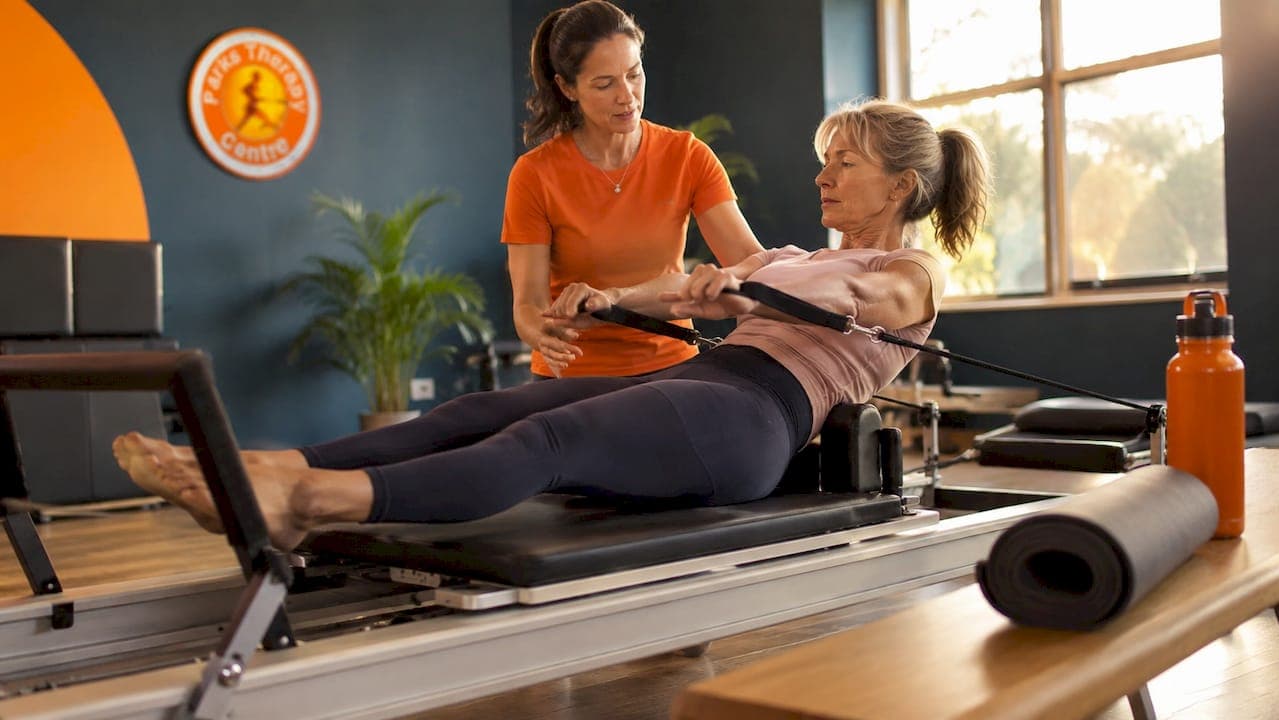
The reformer machine is the safest entry point for people with chronic back pain. Adjustable spring resistance means the machine can assist or challenge movement depending on your pain level on any given day. The carriage provides immediate feedback on spinal stability because any loss of control shows up as unwanted movement. This makes the reformer particularly useful during flare-up periods when mat work feels too demanding.
Mat-based Pilates is accessible and effective for mild to moderate back pain. The limitation is that it offers no resistance calibration. If you are new to Pilates and your pain is significant, reformer sessions with a qualified instructor are the better starting point.
Common pitfalls to avoid:
- Holding your breath during exercises, which increases intra-abdominal pressure and spinal load
- Allowing the lower back to flatten or arch away from neutral during leg movements
- Progressing too quickly to advanced exercises before mastering foundational stability
- Pushing through sharp or radiating pain rather than modifying or stopping
You can find a structured exercise selection covering nine clinically informed movements for back care, which gives a practical framework for building a safe routine.
Key takeaways
Pilates reduces chronic back pain through targeted deep core activation, postural retraining, and progressive movement sequencing, making it one of the most evidence-supported exercise choices available.
| Point | Details |
|---|---|
| Clinical evidence is strong | A 2026 meta-analysis found an SMD of -1.48, a large effect, for Pilates versus control groups. |
| Mechanism targets root causes | Pilates activates the multifidus and transversus abdominis, the muscles most responsible for spinal stability. |
| Pilates outperforms yoga | A six-week RCT showed Pilates produced greater pain and disability reductions than yoga or self-care education. |
| Reformer is safest for beginners | Adjustable resistance allows safe training even on high-pain days, with immediate spinal feedback. |
| Professional guidance is essential | Compensatory movements are the primary reason Pilates fails; qualified instruction prevents them from the start. |
Precision over power: what I have learned about Pilates and back pain
Most people arrive at Pilates expecting it to feel like a workout. They leave the first session surprised by how much concentration it demands and how little they actually moved. That gap between expectation and experience is where the real value lies.
The phrase that stays with me from years of working with back pain patients is precision over power. Pilates is neurological retraining disguised as exercise. The goal is not to fatigue a muscle. The goal is to teach the nervous system to recruit the right muscles, in the right sequence, without conscious effort. That takes weeks of deliberate practice, not days.
The patients I have seen make the fastest progress are not the fittest. They are the most patient. They spend the first two weeks doing almost nothing except learning to breathe correctly and find neutral spine. It looks unimpressive. The results at eight weeks are not.
The biggest misconception I encounter is that Pilates is a gentle option for people who cannot manage "real" exercise. That framing is wrong and it leads people to underestimate the commitment required. Pilates is precise, demanding work. The low-impact nature protects the spine. It does not make the method easy.
My honest advice: seek a qualified instructor for your first six sessions before attempting any home practice. The evidence on lower back problems consistently shows that supervised Pilates outperforms unsupervised practice. That gap exists because technique matters more than effort in this method.
— Ivan
Parkstherapycentre: Pilates and back pain support in Bedfordshire and Buckinghamshire
Parkstherapycentre has provided physiotherapy and rehabilitation services since 1986, and Pilates for back pain sits at the centre of its clinical offering.
If you are managing persistent back pain and want a structured, professionally guided approach, Parkstherapycentre offers personalised Pilates programmes designed around your specific condition and pain history. Assessment appointments are available across multiple locations in Bedfordshire and Buckinghamshire. The team integrates physiotherapy assessment with Pilates instruction, so your programme is built on a clear clinical picture from the start. You can also read more about how Pilates supports injury recovery across a range of musculoskeletal conditions.
FAQ
Can Pilates improve back pain in the long term?
Yes. Clinical studies show that Pilates produces significant reductions in pain and disability, with benefits maintained beyond the active intervention period when practice continues regularly.
How quickly does Pilates help back pain?
Clinical improvements are observable within 8 weeks in most participants. A structured programme practised three times per week produces the most consistent results.
Is Pilates better than yoga for back pain?
A randomised controlled trial found that Pilates outperformed yoga on both pain intensity and functional disability after six weeks. Both methods help, but Pilates produces larger reductions in this comparison.
Should I see a physiotherapist before starting Pilates?
Yes, particularly if your pain is acute, undiagnosed, or involves radiating symptoms. A physiotherapist rules out serious pathology and provides a clinical baseline that allows your Pilates instructor to programme safely.
Is reformer Pilates better than mat Pilates for back pain?
The reformer is the safer starting point for chronic back pain because adjustable spring resistance allows calibrated loading on high-pain days. Mat Pilates is effective for mild to moderate pain once foundational technique is established.