
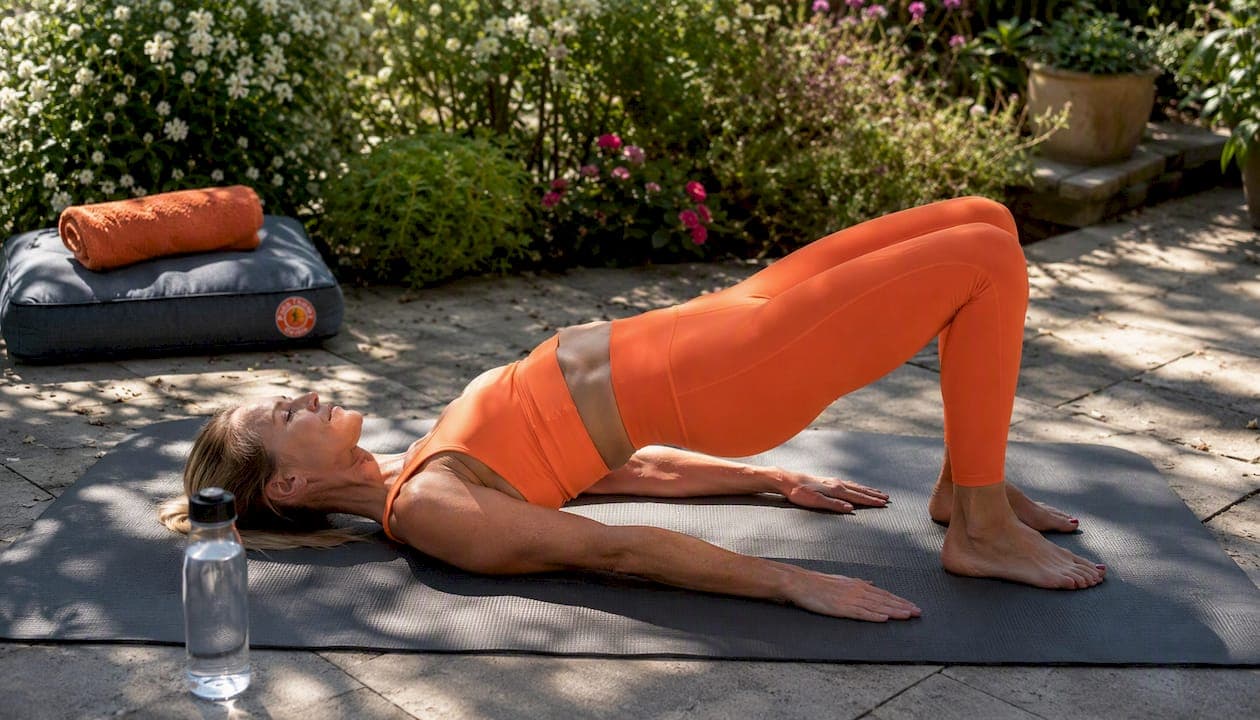
Yes, Pilates improves posture. It does so by strengthening the deep 'powerhouse' muscles (transversus abdominis, multifidus, pelvic floor) and reactivating the posterior chain, which together restore the spinal alignment that prolonged sitting and screen use gradually erode. Systematic reviews confirm that targeted Pilates programmes produce measurable improvements in thoracic kyphosis, craniovertebral angle, and trunk alignment.
Three things you can do today:
- Practise 2–3 times per week. Sessions of 15–20 minutes, done consistently, produce better postural adaptation than longer, infrequent workouts. Frequency matters more than duration.
- Try an at-desk micro-reset. Sit tall, feet flat on the floor. Breathe in to lengthen your spine, breathe out to gently draw your lower abdomen in. Hold for three seconds, release, and repeat three times. Do this every hour.
- Use the neutral-pelvis cue. Before any exercise or long sit, find a neutral pelvis (neither tucked nor arched), then let your ribcage and head stack naturally above it. This single cue reduces compensatory tension across the whole spine.
If you have persistent pain, neurological symptoms, or a long-standing postural problem, book a physiotherapy assessment with Parkstherapycentre before starting a self-directed programme.
Table of Contents
- How does Pilates actually improve your posture?
- Which posture problems can Pilates help you correct?
- The best Pilates exercises for posture: how-to, reps and progressions
- How often should you practise, and when will you see results?
- Common mistakes, safety pointers, and when to see a physiotherapist
- Three ready-to-use routines for posture improvement
- Key takeaways
- A clinician's perspective on posture and Pilates
- Parkstherapycentre: clinician-led Pilates and physiotherapy assessments
- Useful sources and further reading
How does Pilates actually improve your posture?
Pilates produces postural change through three overlapping mechanisms: muscular strength, motor control, and proprioception. The deep core muscles, often called the 'powerhouse' in Pilates practice, include the transversus abdominis, multifidus, diaphragm, and pelvic floor. When these muscles are weak or poorly coordinated, the spine loses its stable base and compensates by adopting habitual, load-bearing positions such as forward head or lumbar hyperextension.
Controlled studies and systematic reviews report improved craniovertebral angle, reduced thoracic kyphosis, and better trunk alignment following Pilates programmes. The posterior chain (glutes, erector spinae, mid-trapezius, rhomboids) is equally important. Reactivating these muscles is often what resolves upper-body slouching, because isolated chest stretches alone rarely hold the correction.
A practical three-phase framework underpins most Pilates posture work:
- Stable base: feet hip-width apart, weight evenly distributed, knees soft rather than locked.
- Neutral pelvis: neither anteriorly tilted nor posteriorly tucked. Once the pelvis is balanced, the ribcage and head tend to stack more naturally above it.
- Spinal lengthening with diaphragmatic breathing: inhale to create length, exhale to engage the deep abdominals and stabilise.
One clinician note worth keeping in mind: avoid the common overcorrection of pinning the shoulders back and puffing the chest which can create muscular imbalances. Forced 'military posture' creates its own muscular imbalances. The goal is a relaxed, supported upright position, not a rigid one.
Which posture problems can Pilates help you correct?
Pilates addresses several common postural patterns. Recognising your own pattern is the first step in a practical postural correction guide.
- Forward head posture (tech neck): the head drifts forward of the shoulders, increasing load on the cervical spine. Caused by weak deep neck flexors and tight suboccipitals, often combined with a weak posterior chain. Self-check: stand against a wall. If the back of your head does not touch without straining, forward head posture is likely present.
- Rounded shoulders: the shoulder blades wing forward and the chest tightens. Weak mid-trapezius and rhomboids combined with tight pectorals are the usual drivers. Check: arms hanging at rest, do your palms face backwards? That rotation suggests rounded shoulders.
- Thoracic kyphosis (upper-back slouching): excessive rounding of the mid-spine, common in desk workers and those who spend long periods looking at screens. Pilates thoracic extension and rotation exercises directly target this pattern.
- Anterior pelvic tilt: the pelvis tips forward, increasing lumbar lordosis and switching off the glutes. Targeted Pilates programmes reduce anterior pelvic tilt by strengthening the deep abdominals and hip flexor antagonists. Self-check: lie on your back. If there is a large gap between your lower back and the floor, anterior tilt is likely.
- Flat back or hyperextended knees: the lumbar curve is reduced and the knees lock back. Less common but equally important to address; Pilates knee-soft cues and hamstring work help restore natural curvature.
Of these, anterior pelvic tilt and thoracic kyphosis tend to respond most readily to Pilates because the exercises directly target the muscle groups involved. Forward head posture also improves, though it often requires the addition of specific deep neck flexor work and desk ergonomic adjustments alongside mat practice.
The best Pilates exercises for posture: how-to, reps and progressions
The following exercises form a step-by-step Pilates posture correction guide. Work through them in order for a complete session, or select two or three for a shorter routine.
1. Pelvic curl (bridge)
Purpose: activates glutes and hamstrings, teaches neutral-to-posterior pelvic control, and decompresses the lumbar spine.
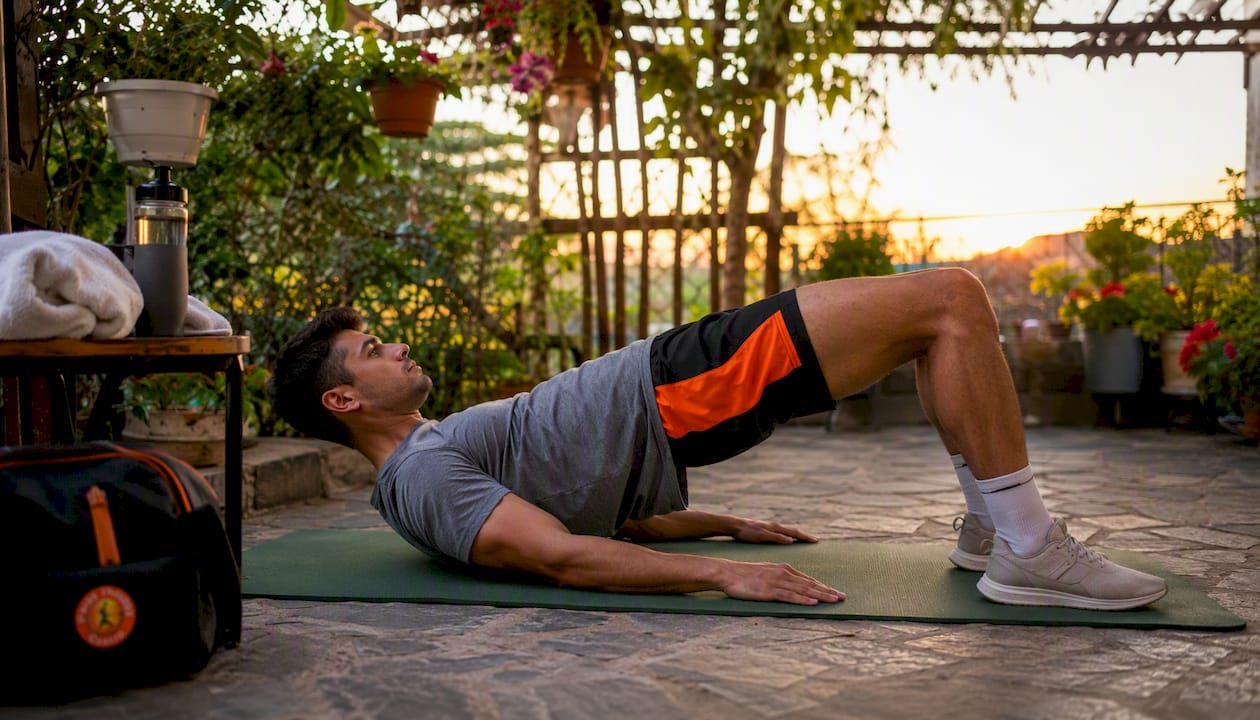
How to perform: lie on your back, knees bent, feet hip-width apart. Inhale to prepare. Exhale and slowly peel the spine off the mat one vertebra at a time, from the tailbone upward, until the hips form a straight line with the knees and shoulders. Inhale at the top. Exhale to roll back down, placing the spine on the mat from the thoracic region downward.
Reps/sets: 8–10 repetitions, 2 sets.
Regression: reduce the height of the bridge; focus on the peel rather than the height.
Progression: single-leg bridge, or add a resistance band around the thighs to increase glute demand.
Pro Tip: Do not squeeze the glutes so hard that you lose the neutral pelvis at the top. The goal is length, not compression.
2. Shoulder bridge with leg extension
Purpose: builds on the pelvic curl, adding posterior chain challenge and scapular stability.
How to perform: from the top of a bridge, inhale. Exhale and extend one leg to hip height, keeping the pelvis level. Inhale to return. Alternate sides.
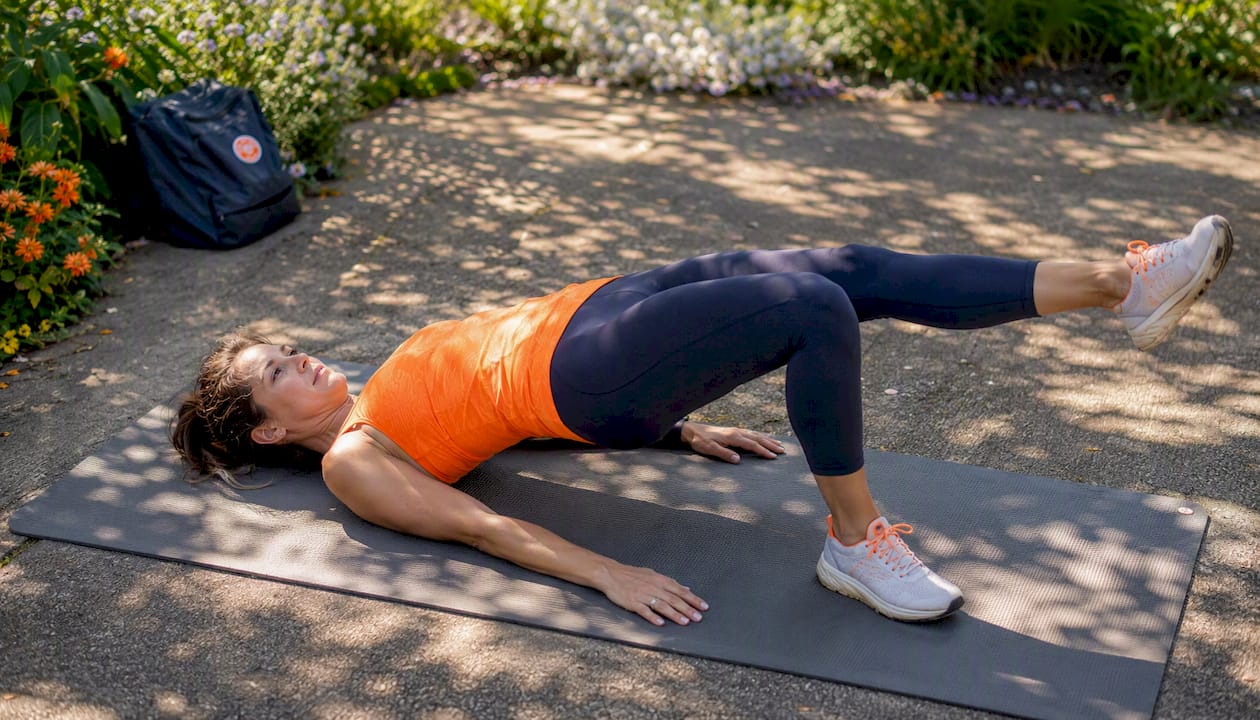
Reps/sets: 6 per side, 2 sets.
Regression: keep both feet on the mat and hold the bridge position for five breaths.
Progression: add a slow leg circle at the top.
3. Wall roll-down
Purpose: mobilises the thoracic spine, teaches spinal segmentation, and releases paraspinal tension.
How to perform: stand with your back against a wall, feet positioned near the baseboard. Inhale tall. Exhale and nod the chin, then peel the spine away from the wall vertebra by vertebra, letting the arms hang. Inhale at the bottom. Exhale to rebuild the spine back onto the wall from the lumbar region upward.
Reps/sets: 5–6 repetitions.
Regression: reduce the range; only peel to mid-back.
Progression: perform free-standing without the wall support.
4. Chest opener (wall angels)
Purpose: stretches the pectorals and anterior shoulder, activates mid-trapezius and rhomboids, directly addresses rounded shoulders.
How to perform: stand with your back against a wall, arms at 90 degrees (goalpost position), elbows and wrists touching the wall. Inhale. Exhale and slide the arms overhead, keeping contact with the wall throughout. Inhale to return.
Reps/sets: 8–10 repetitions.
Regression: reduce the range of the slide if the lower back arches.
Progression: hold a light resistance band between the hands for added mid-back activation.
Pro Tip: If your lower back peels away from the wall as the arms rise, your thoracic mobility is the limiting factor. Work within the range you can maintain contact.
5. Swimming (opposite arm and leg reach)
Purpose: strengthens the posterior chain (erector spinae, glutes, mid-trapezius) and trains spinal extension without compression.
How to perform: lie prone, arms extended overhead. Inhale to prepare. Exhale and lift the right arm and left leg simultaneously, keeping the neck long. Inhale to lower. Alternate sides in a controlled, rhythmic pattern.
Reps/sets: 10 alternating repetitions, 2 sets.
Regression: lift only the arms, keeping the legs on the mat.
Progression: increase tempo to a flutter pattern for 20–30 seconds.
6. Plank (forearm variation)
Purpose: builds deep core endurance and scapular stability, which support upright posture throughout the day.
How to perform: forearms on the mat, elbows under shoulders, body in a straight line from head to heels. Breathe steadily. Hold without letting the hips sag or rise.
Duration: 20–30 seconds, 2–3 sets.
Regression: knees on the mat.
Progression: extend hold to 45–60 seconds, or add a slow alternating leg lift.
7. Thoracic rotation (saw or seated rotation)
Purpose: restores thoracic mobility, which is often the missing link in posture correction for desk workers.
How to perform: sit tall on the mat, legs extended or crossed. Inhale to lengthen. Exhale and rotate the ribcage to the right, reaching the left hand toward the right foot. Inhale to centre. Repeat to the left.
Reps/sets: 6 per side.
Regression: perform seated in a chair, hands on shoulders.
Progression: add a light resistance band for rotational resistance.
8. Scapular stabilisation (prone Y and T)
Purpose: directly targets the lower and mid-trapezius, the muscles most responsible for holding the shoulder blades in a healthy position.
How to perform: lie prone, forehead resting on a folded towel. For Y: raise both arms diagonally overhead (thumbs up). For T: raise both arms to the side at shoulder height. Exhale to lift, inhale to lower.
Reps/sets: 8–10 per shape, 2 sets.
Regression: perform seated with light dumbbells or no weight.
Progression: add a 1–2 second hold at the top of each lift.
For further Pilates exercises for injury recovery and structured progressions, the Parkstherapycentre resource library covers clinical rehabilitation applications in detail.
How often should you practise, and when will you see results?
Short sessions of moderate length, practiced regularly each week, produce better postural adaptation than long, infrequent workouts. Frequent, moderate practice allows the nervous system to consolidate new movement patterns without the compensatory fatigue that comes from overdoing it.
In terms of timeline, most people notice improved body awareness shortly after starting consistent practice. Measurable alignment changes typically appear within several weeks with regular effort. Several factors influence how quickly progress arrives: baseline fitness, age, how long the postural pattern has been present, and whether ergonomic habits at work and home are also being addressed.
Combining two or three structured sessions per week with daily micro-resets is the most practical approach. A micro-reset takes under two minutes and can be done at a desk, in a queue, or between meetings. Brief, intentional alignment shifts repeated throughout the day are more sustainable than attempting to hold rigid posture for hours, and they reinforce the motor patterns built during formal practice.
If you are also attending physiotherapy or a clinician-led Pilates class, those sessions count toward your weekly total. Home practice between appointments accelerates progress considerably.
Common mistakes, safety pointers, and when to see a physiotherapist
Technique errors are the most common reason postural Pilates practice stalls or causes discomfort. The following are the mistakes clinicians see most often, along with their corrections.
- Pinning the shoulders back forcefully. This creates tension in the upper trapezius and does not address the underlying weakness. Instead, think of drawing the shoulder blades gently down and together, without gripping.
- Locking the knees. Hyperextended knees shift the pelvis anteriorly and increase lumbar load. Keep a soft bend in the knees during standing exercises.
- Breath-holding during effort. Holding the breath increases intra-abdominal pressure and reduces core stability. Exhale on the effort phase of every exercise.
- Over-arching the lumbar spine in prone exercises. In swimming or prone extensions, the lower back should remain neutral, not compressed. If you feel pinching in the lumbar spine, reduce the range of motion.
- Rushing through repetitions. Speed masks poor control. Slow the movement down until you can maintain neutral pelvis and steady breathing throughout.
For improving Pilates technique more broadly, paying attention to breathing integration is the single most effective change most people can make.
Stop and seek a clinical assessment if you experience any of the following:
- Sudden or sharp pain during or after exercise
- Numbness, pins and needles, or weakness in the arms or legs
- Pain that radiates from the spine into a limb
- Symptoms that worsen with rest or at night
- A postural problem that has been present for years without improvement
These are red flags that require physiotherapy assessment before continuing self-directed practice. Complex or long-standing postural problems often involve compensatory movement patterns that are difficult to identify without clinical observation. A physiotherapist can assess which muscles are genuinely weak versus which are simply overworking to compensate, and build a programme accordingly.
Three ready-to-use routines for posture improvement
At-desk micro-reset (2 minutes)
Repeat every hour at your workstation. For additional desk-based posture strategies, including forward head posture relief, a structured desk routine can complement your mat practice.
- Seated spine lengthening: inhale to grow tall, exhale to draw the lower abdomen gently in. Hold 3 seconds. Repeat 3 times.
- Chin tuck: gently draw the chin back (not down) to restore cervical alignment. Hold 5 seconds. Repeat 5 times.
- Seated chest opener: interlace fingers behind the head, elbows wide. Inhale and open the elbows back. Exhale to return. Repeat 5 times.
- Shoulder blade squeeze: draw the shoulder blades gently toward the spine. Hold 5 seconds, release. Repeat 5 times.
10-minute morning sequence
Perform on waking, before sitting at a desk.
- Pelvic curl: 8 repetitions, slow tempo (3 seconds up, 3 seconds down).
- Supine knee folds (alternating): 8 per side, exhale to lift, inhale to lower.
- Wall roll-down: 5 repetitions.
- Chest opener (wall angels): 8 repetitions.
- Prone Y and T: 8 repetitions each shape.
- Cat-cow (spinal flexion and extension on all fours): 8 cycles, coordinated with breath.
Modification for limited mobility or pain: perform all exercises within a pain-free range. Reduce repetitions to 4–5 and prioritise breathing over range of motion.
20-minute weekly session
This session combines strength and mobility for a more complete postural workout.
- Warm-up: cat-cow and seated rotation (2 minutes).
- Pelvic curl: 10 repetitions, 2 sets.
- Shoulder bridge with leg extension: 6 per side, 2 sets.
- Swimming: 10 alternating repetitions, 2 sets.
- Forearm plank: 3 × 30 seconds.
- Thoracic rotation (saw): 6 per side.
- Scapular stabilisation (prone Y and T): 8 per shape, 2 sets.
- Wall roll-down: 5 repetitions to close.
Progression: once all exercises feel controlled and comfortable across three consecutive sessions, add one set to each exercise or introduce the progressions listed in the exercise descriptions above.
Key takeaways
Consistent, short Pilates sessions practiced regularly each week, combined with daily micro-resets and ergonomic adjustments, produce measurable postural improvements within several weeks.
| Point | Details |
|---|---|
| Consistency over intensity | Sessions of 15–20 minutes, 2–3 times per week, outperform infrequent long workouts for postural change. |
| Neutral pelvis first | Establishing a neutral pelvis before any exercise allows the ribcage and head to stack naturally, reducing compensatory tension. |
| Daily micro-resets matter | Brief alignment checks repeated throughout the day transfer mat gains into everyday posture more effectively than exercise alone. |
| Combine strength and mobility | Posterior chain strength (glutes, mid-trapezius) and thoracic mobility must both be addressed; isolated stretching is rarely sufficient. |
| Parkstherapycentre assessment | For persistent or complex postural problems, a physiotherapy assessment at Parkstherapycentre provides a tailored, clinician-led programme. |
A clinician's perspective on posture and Pilates
The most common mistake people make with postural Pilates is treating it as a corrective checklist rather than a process of building body awareness. Patients arrive having read that they need to "strengthen their core" and proceed to do dozens of crunches, which does very little for spinal alignment and can worsen anterior pelvic tilt. The exercises matter, but the quality of attention brought to each repetition matters more.
What the evidence consistently shows, and what clinical practice confirms, is that posture is not a fixed position to be achieved and held. It is a dynamic state of muscular balance. The goal of assessment-led Pilates at Parkstherapycentre is to identify which muscles are underworking and which are compensating, then build a progressive programme that addresses both. That distinction is not something a generic routine can make.
For patients with long-standing postural problems, particularly those involving neurological symptoms or significant pain, Pilates is one tool within a broader rehabilitation plan. It works best when integrated with physiotherapy assessment, manual therapy where indicated, and ergonomic guidance. The role of Pilates in rehabilitation is well-established, but it is most effective when the programme is built around the individual rather than applied generically.
Parkstherapycentre: clinician-led Pilates and physiotherapy assessments
For adults dealing with persistent postural pain, tech neck, or long-standing alignment problems, a self-directed routine is a strong starting point, but a clinician-supervised programme is where lasting change happens. Parkstherapycentre offers physiotherapy assessments, Pilates classes, and tailored home programmes across multiple locations in Bedfordshire and Buckinghamshire, delivered by a multidisciplinary team with decades of clinical experience.
The difference between a generic class and a clinician-led session is the assessment that precedes it. At Parkstherapycentre, a physiotherapist identifies your specific postural pattern, rules out any underlying structural issues, and builds a programme with appropriate progressions from the outset. Sessions are available for private pay and through most major health insurance providers. For patients with lower back problems alongside postural concerns, the integrated physiotherapy and Pilates pathway is particularly well-suited.
Book a physiotherapy assessment or Pilates class online at Parkstherapycentre and take the first step toward a structured, safe postural improvement programme.
Useful sources and further reading
The following sources underpin the clinical and practical guidance in this article. Each is worth consulting for greater depth on the evidence or specific techniques.
| Source | Why it is worth reading |
|---|---|
| Effects of Pilates on Body Posture: A Systematic Review (PMC) | Highest-level evidence review; summarises controlled studies on Pilates and spinal alignment outcomes including thoracic kyphosis and craniovertebral angle. |
| 3 Surprising Risks of Poor Posture (Harvard Health) | Accessible clinical summary of the systemic effects of poor posture, including breathing and musculoskeletal consequences. |
| PubMed: Pilates and Postural Outcomes | Peer-reviewed study on Pilates intervention outcomes; useful for understanding study design and measured postural variables. |
| PubMed: Pilates and Trunk Posture | Controlled trial examining trunk posture changes following a structured Pilates programme. |
| Guide to Good Posture (MedlinePlus) | Authoritative patient-facing guidance from the US National Library of Medicine covering alignment, ergonomics, and daily habits. |
| Pilates for Anterior Pelvic Tilt (Mind Flow Pilates) | Practitioner-level explanation of how Pilates targets pelvic tilt and posterior chain weakness; useful for exercise selection rationale. |
| Pilates for Tech Neck (Living Well Magazine) | Practical guidance on addressing forward head posture with Pilates, including posterior chain activation strategies. |
| Transform Your Posture with Pilates (iKore Pilates) | Evidence-informed frequency and consistency guidance; supports the 15–20 minute, 2–3 times per week recommendation. |