
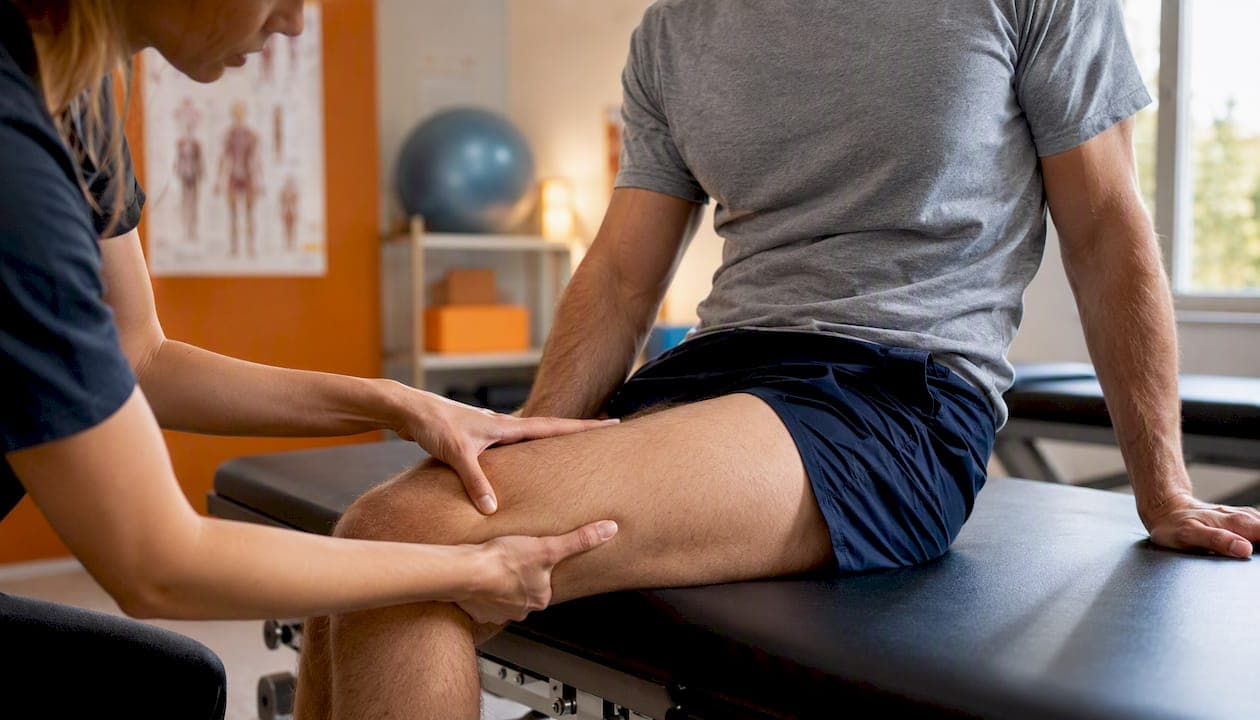
Physiotherapy is the first-line treatment for iliotibial band syndrome, and most people recover within 6 to 8 weeks when they follow a structured, criterion-based rehabilitation programme rather than relying on rest alone. The approach that works combines hip abductor strengthening, gait retraining and a graded return to activity, not passive stretching or waiting it out.
Three things to do today, before you read further:
- Stop, don't fully rest. Reduce running volume and cut hills or cambered routes, but keep moving within a pain-free range.
- Control the pain sensibly. Ice after activity, use simple analgesia if needed, and avoid anything that spikes lateral knee pain above a mild, short-lived level.
- Book a physiotherapy assessment. A proper diagnosis rules out other causes of lateral knee pain and gives you a starting point for structured rehab.
Recovery typically runs through three phases: an acute settling period in weeks 1 to 2, targeted hip and glute strengthening from around week 2 to 6, and a return-to-running phase from week 4 through week 8 or beyond, depending on your starting fitness. Research on multi-modal physiotherapy combining hip abductor strengthening with gait retraining shows meaningful improvement within 4 to 6 weeks for many patients. If pain persists beyond that window despite consistent effort, it's time for a follow-up review rather than pushing through.
Key Takeaways
Physiotherapy combining hip abductor strengthening with gait retraining resolves iliotibial band syndrome for most patients within 6 to 8 weeks, provided rehab is criterion-based rather than time-based.
| Point | Details |
|---|---|
| Physiotherapy is first-line | Nonoperative, structured rehab resolves most cases within 6 to 8 weeks; surgery is reserved for symptoms lasting beyond 6 months. |
| Strengthen, don't just stretch | Hip abductor exercises like clamshells, band walks and single-leg bridges address the mechanical cause more effectively than passive stretching. |
| Progress by function, not the calendar | Advance phases only once pain-free palpation, single-leg squat control and tolerated running intervals are met. |
| Pair strengthening with gait retraining | Combining the two produces measurable improvement within 4 to 6 weeks in several reviewed studies. |
| Get a supervised assessment | Parks Therapy Centre offers phased, criterion-based physiotherapy with objective progress tracking across its Bedfordshire and Buckinghamshire clinics. |
Table of Contents
- What is IT band physiotherapy and why does the IT band hurt?
- What causes IT band syndrome and who is at risk?
- What are the symptoms and how is ITBS diagnosed?
- Why does physiotherapy work as the first-line treatment?
- What exercises help IT band syndrome recover?
- How does gait retraining reduce IT band load when running?
- Do foam rolling and manual therapy actually help ITBS?
- When should you consider injections, imaging or surgery?
- How do you prevent IT band syndrome from coming back?
- What happens during a physiotherapy session for ITBS?
- What does the evidence say about physiotherapy outcomes for ITBS?
- A clinical note from Parks Therapy Centre
- How Parks Therapy Centre supports your IT band recovery
- Frequently asked questions
- Sources
What is IT band physiotherapy and why does the IT band hurt?
The iliotibial band, or ITB, is a thick strip of fibrous connective tissue running down the outside of your thigh, from the hip to just below the knee. It originates at the iliac crest and blends with the tensor fasciae latae and gluteus maximus at the top, then runs down to attach at the lateral tibial condyle, just below the knee joint.
Think of it less as a muscle and more as a tension cable. The tensor fasciae latae and gluteus maximus pull on it from above, and it stabilises the outside of your knee during walking and running. When those hip muscles are weak or fatigued, the band takes on load it wasn't built to manage alone.
Iliotibial band syndrome, or ITBS, causes pain at the outside of the knee, near a bony bump called the lateral femoral epicondyle. The tissue underneath this area is compressed and irritated with repeated knee bending, particularly during running, rather than "rubbing" back and forth as older explanations suggested. That distinction matters for treatment: interventions that reduce compressive load at the knee, like hip strengthening and stride adjustments, tend to help more than stretching the band itself, which is largely inextensible.
Pro Tip: Picture the ITB as a rope anchored at your hip and knee. You can't stretch a rope longer, but you can strengthen the muscles pulling on it so it sits under less tension during each stride.
A labelled diagram showing the ITB's path from the iliac crest, through the tensor fasciae latae and gluteus maximus attachment, down to the lateral femoral condyle helps most patients understand their own scans and assessment findings. Ask your physiotherapist to sketch this on your first visit if one isn't already on the clinic wall.
What causes IT band syndrome and who is at risk?
ITBS rarely comes from one single mistake. It usually builds from a combination of training habits and body mechanics that overload the lateral knee structures faster than they can adapt.
The most common contributors include:
- Sudden increases in running volume, intensity, or hill work
- Running repeatedly on cambered or uneven surfaces
- Worn or unsuitable footwear that no longer supports your gait
- Overstriding, which increases knee flexion angle at footstrike
- Weak hip abductors, particularly gluteus medius, allowing the pelvis to drop on the stance leg
- Leg-length discrepancy or excessive foot pronation
Some of these you can change; others you simply need to work around. Modifiable factors include training load, running technique, footwear age, and hip and glute strength, all of which respond well to physiotherapy input. Non-modifiable factors include your underlying bone structure, natural leg-length differences, and any prior injury history, though even these can often be managed with the right strengthening strategy.
The BMJ notes that ITBS affects roughly 7 to 14% of runners, making it one of the more common overuse injuries in that population, and one where activity modification and physiotherapy are recommended first, well before anything more invasive is considered.
Pro Tip: If you've been foam rolling and stretching for weeks with no change, that's a sign to prioritise hip-strengthening work instead. Passive stretching does very little for a structure that isn't designed to lengthen, whereas correcting hip control addresses the actual mechanical overload.
What are the symptoms and how is ITBS diagnosed?
Iliotibial band syndrome has a fairly distinctive pattern once you know what to look for, which makes it easier to describe accurately to a physiotherapist or GP.
Typical symptoms include:
- Sharp or aching pain on the outside of the knee, usually worse during or after running
- Pain that eases noticeably with rest, then returns predictably at a similar distance or time into a run
- Tenderness directly over the lateral femoral epicondyle
- Occasional tightness or discomfort felt higher up, around the hip or outer thigh
- Pain that worsens going downhill or downstairs, where knee flexion angles increase
Clinicians typically use a short set of simple tests to confirm the diagnosis:
- Noble compression test. Pressure over the lateral femoral epicondyle while the knee bends and straightens reproduces the familiar pain around 30 degrees of flexion.
- Ober test. Assesses tightness in the ITB and tensor fasciae latae complex, though a positive result is common even in people without symptoms, so it's used alongside other findings.
- Single-leg squat observation. Watching for hip drop or knee collapse inward reveals the hip-control deficits that usually drive the condition.
Most cases are straightforward, but a few signs warrant prompt review rather than a standard rehab pathway: persistent pain at night, swelling that doesn't settle, fever or other systemic symptoms, or pain that worsens rapidly despite rest. Any of those point towards a different diagnosis and deserve urgent assessment rather than a home exercise programme.
Why does physiotherapy work as the first-line treatment?
Physiotherapy succeeds where rest alone fails because it addresses the mechanical cause, not just the symptom. Nonoperative physiotherapy management is considered the first-line treatment for the vast majority of patients, and surgery is reserved for the small number whose symptoms persist beyond six months of genuine conservative effort.
The approach that gets results combines several elements at once: hip abductor strengthening to correct the pelvic drop that overloads the lateral knee, manual therapy to manage acute irritation, gait retraining to change how load is distributed through each stride, and patient education so you understand why gradual progression matters more than pushing through pain.
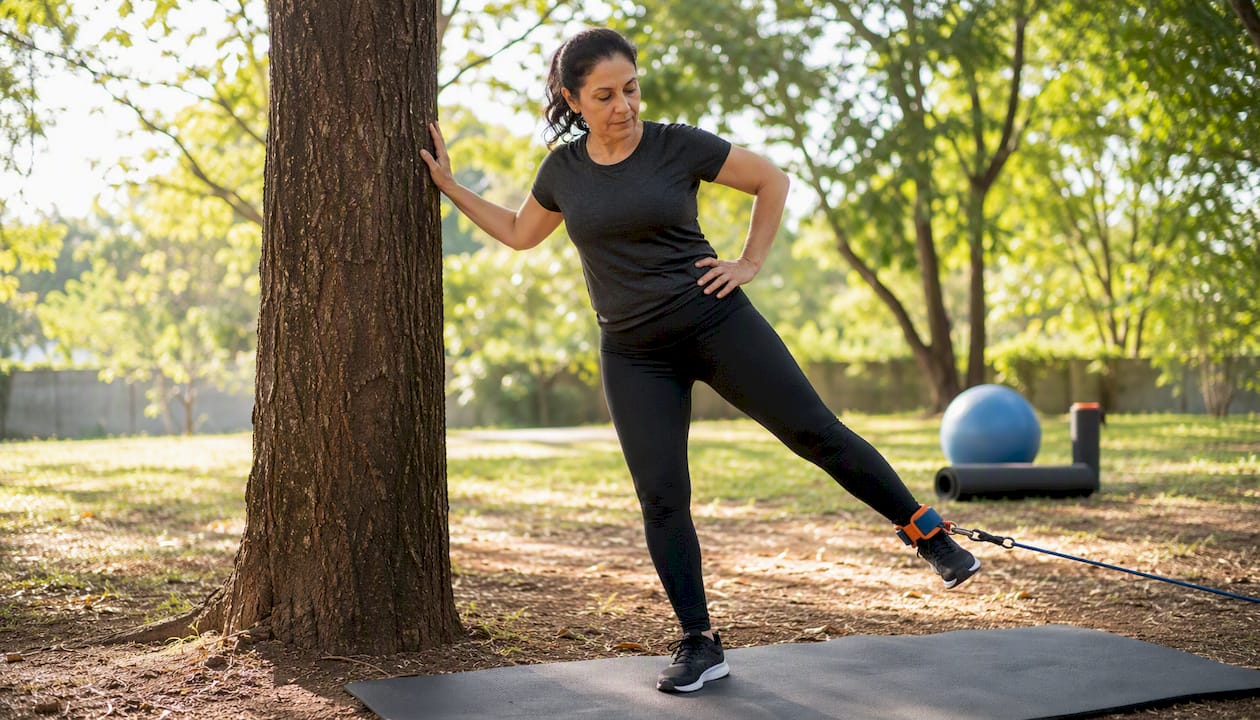
Recovery moves through three broad phases, each with its own goal and rough timeframe:
| Phase | Timeframe | Primary goal |
|---|---|---|
| Acute | 0 to 2 weeks | Settle irritation, maintain gentle activity, begin isometric hip work |
| Strength | 2 to 6 weeks | Build hip abductor and glute strength, correct movement faults |
| Return to sport | 4 to 8+ weeks | Reintroduce running, add sport-specific loading, confirm control under fatigue |
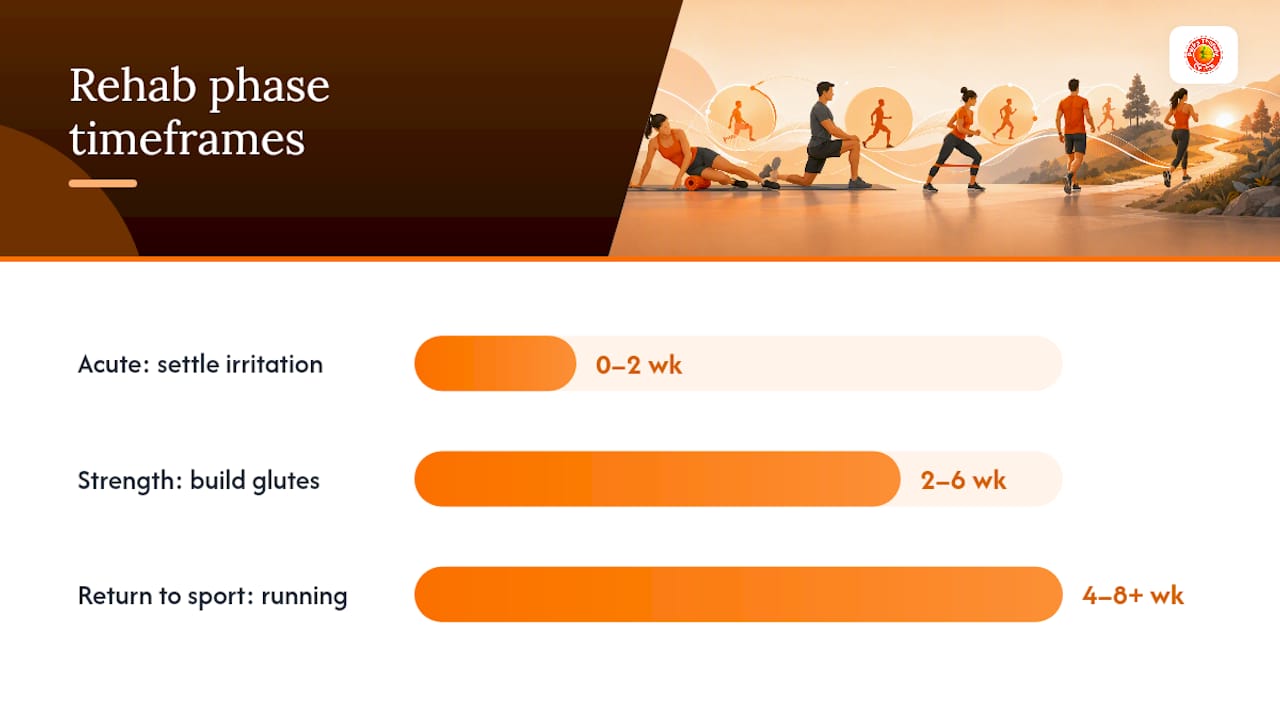
These phases overlap rather than switching abruptly, and progression is judged by function, not the calendar. A physiotherapist typically checks for pain-free palpation over the lateral knee, pain-free activity at your current training level, good single-leg squat control without hip drop, and comfortable tolerance of running intervals before advancing you to the next stage. A small prospective study found hip abductor strength differences between the injured and uninjured side had largely resolved by six weeks, with strength closely linked to functional recovery, which is a reasonable benchmark to expect from consistent effort over that period.
What exercises help IT band syndrome recover?
A phased exercise programme gives you a clear map from painful, guarded movement back to full training load. Each phase has a purpose, and skipping ahead before you meet the criteria tends to prolong symptoms rather than speed things up.
Phase 1: early control (roughly weeks 1 to 2)
The goal here is calming irritation while starting to activate the muscles that will eventually take the load off the ITB. Everything is low-intensity and non-weight-bearing or very lightly loaded.
- Isometric hip abduction. Lie on your back with a resistance band around both knees, push outward and hold for 30 to 45 seconds, 4 to 5 repetitions, twice daily.
- Clamshells. Side-lying, knees bent, lift the top knee while keeping feet together. Aim for 2 to 3 sets of 12 to 15 repetitions, focusing on slow control rather than speed.
- Side-lying hip abduction. Straight-leg lift from side-lying, 2 to 3 sets of 10 to 12 reps per side, keeping the pelvis still throughout.
Activity modification runs alongside these exercises. Reduce or pause running, but continue low-impact cardio like cycling or swimming if it doesn't provoke symptoms.
Phase 2: strength and motor control (roughly weeks 2 to 6)
Once isometric work is pain-free, load progresses to standing and functional positions that mimic running demands.
- Band walks. Side steps and monster walks with a resistance band above the knees, 3 sets of 10 steps each direction, 3 to 4 times weekly.
- Single-leg bridges. 3 sets of 8 to 10 reps per side, progressing from double-leg bridges as tolerated.
- Lateral step-downs. Standing on a low step, control the descent of the opposite leg without letting the pelvis drop, 3 sets of 8 reps per side.
- Single-leg squats. Introduced once step-downs are comfortable, building towards 3 sets of 8 to 10 with good hip alignment.
A typical week 4 schedule might run strength sessions on Monday, Wednesday and Friday, with light cross-training on the remaining days and one easy walk-jog session if tolerated.
Phase 3: power and sport specificity (roughly week 4 to 8 and beyond)
This phase reintroduces the demands of running and sport, layering plyometric and running-specific work onto the strength base built in phase 2.
- Lateral bounds and step-ups with hop. Building reactive hip control, 2 to 3 sets of 6 to 8 reps.
- Progressive running reintroduction. Starting with short walk-run intervals on flat, even ground.
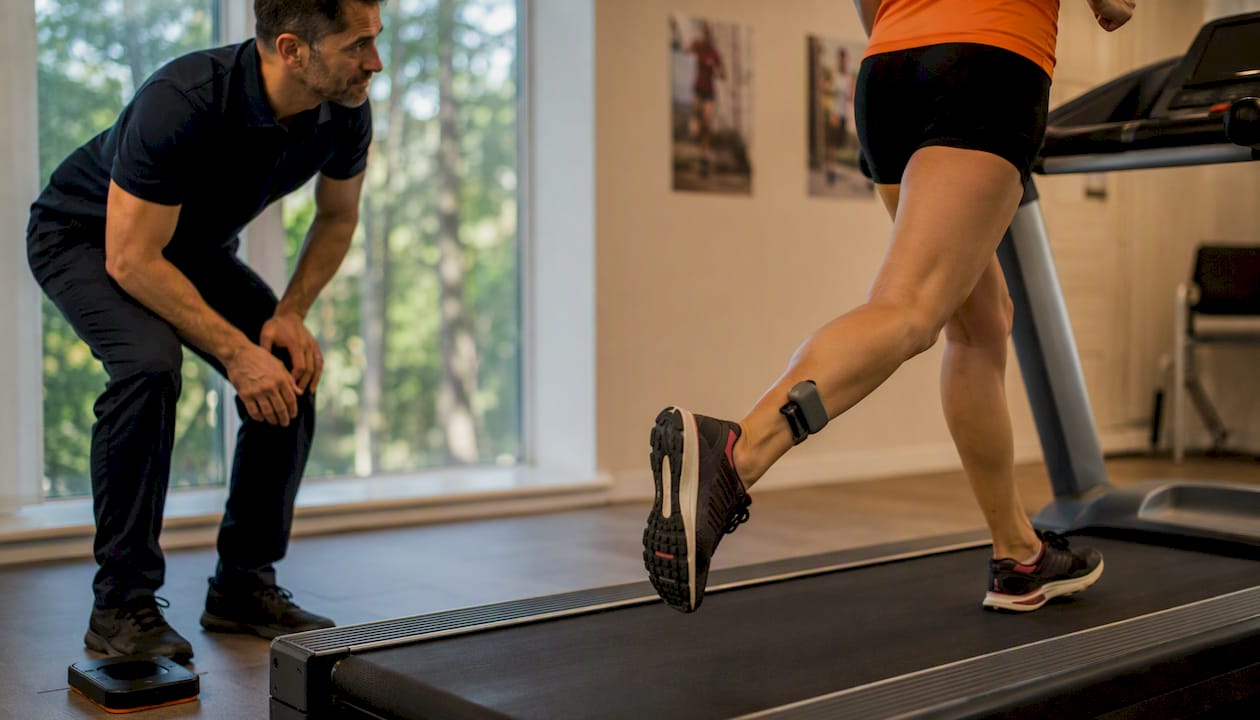
- Cadence drills. Short treadmill sessions focused on a slightly quicker, shorter stride to reduce knee flexion angle at footstrike.
- Sport-specific drills. Cutting, change of direction, or hill work only once flat running is fully pain-free.
A sample week in this phase might look like: Monday strength maintenance, Tuesday walk-run intervals, Thursday cadence drill session, Saturday a slightly longer easy run if the previous sessions were symptom-free, with rest or cross-training filling the gaps.
Progress from one phase to the next only when you meet these criteria:
- No pain on palpation of the lateral femoral epicondyle
- No pain during or after your current activity level
- Good single-leg squat control with no visible hip drop
- Comfortable completion of the previous phase's running or loading intervals
If irritability is high, meaning pain flares easily or lingers after sessions, drop back to fewer repetitions, reduce range of motion, or return to isometric holds for a few extra days before progressing again.
Pro Tip: A useful rule for regressing or advancing: if an exercise produces pain that lasts more than a couple of hours afterwards, or scores above mild on a 0 to 10 scale during the exercise itself, step back to the previous level. If it's pain-free for two consecutive sessions, move forward.
How does gait retraining reduce IT band load when running?
Small technique adjustments change how much compressive load reaches the lateral knee with every stride, which is why gait retraining pairs so well with hip strengthening rather than replacing it.
The changes with the best evidence behind them include:
- Increasing cadence modestly, by around 5 to 10%, which shortens stride length and reduces knee flexion angle at footstrike
- Reducing overstriding by aiming to land with the foot closer to underneath the body
- Shortening ground-contact time through a lighter, quicker foot strike
- Running on flatter surfaces initially, avoiding steep cambers that load one hip more than the other
- Avoiding downhill running until symptoms have settled, since it increases knee flexion demand
A sample reintroduction plan for someone who's been pain-free through phase 2 strength work might start with 10 minutes of walk-run intervals (1 minute running, 2 minutes walking) three times in the first week, progressing to continuous easy running of 15 to 20 minutes by week 3 or 4, provided each session stays pain-free during and for 24 hours afterwards. If lateral knee pain returns at any stage, drop back to the previous week's volume rather than pushing through.
Gait retraining works best alongside continued hip abductor strengthening, not instead of it. Systematic review evidence identifies gait retraining as a promising adjunct to hip abductor work rather than a standalone fix. Partners specialising in running mechanics, such as Roberts Neurotraining's running programme, can offer additional gait analysis if your physiotherapist recommends it. Stop progressing volume the moment pain returns above a mild level, and hold at that stage until it settles again.
Do foam rolling and manual therapy actually help ITBS?
Manual therapy has a role in ITBS management, but not the role most people expect. Rolling directly over the tender band itself is often painful and rarely the most useful strategy, because the tissue is dense and largely non-contractile.
More benefit tends to come from targeting the muscles that pull on the band rather than the band itself:
- Do roll the tensor fasciae latae, gluteal muscles and outer quadriceps, where soft tissue work can genuinely reduce tension and tenderness.
- Don't spend extended time grinding directly over the lateral knee where the band inserts; this usually just increases irritation.
- Do use a foam roller or massage ball for 60 to 90 seconds per area, 3 to 4 times weekly, alongside your strengthening programme rather than instead of it.
- Don't expect foam rolling alone to resolve symptoms without addressing hip strength and training load.
For acute flares, ice for 10 to 15 minutes after activity can take the edge off inflammation and pain. Modalities like TENS or ultrasound are sometimes used in clinic for short-term symptom relief, but they work best as a bridge to reduce pain enough to tolerate strengthening exercises, not as a treatment in their own right.
When should you consider injections, imaging or surgery?
Most people never need to go beyond physiotherapy and activity modification. A small number of adjuncts exist for cases that respond slowly or plateau despite consistent rehab effort.
Options a physiotherapist or GP might discuss include:
- NSAIDs for short-term pain relief during flare-ups, used sparingly rather than long-term
- Corticosteroid injections, sometimes used both to confirm the diagnosis and to calm a stubborn flare, though they don't address the underlying strength deficits
- Shockwave therapy, occasionally trialled for persistent, localised tenderness
- Orthoses, where significant foot pronation or leg-length discrepancy is contributing to symptoms
Imaging or specialist referral becomes worth considering when symptoms persist despite genuinely appropriate conservative care lasting more than six months, which reflects the NCBI clinical threshold for surgical consideration. Surgical options such as ITB release or bursectomy exist for this refractory group, though outcomes vary and comparative evidence between techniques remains limited.
Any injection or surgical decision should involve a proper discussion of risks and realistic expected benefit with a qualified clinician. These aren't first-choice options, and shared decision-making matters more here than with most standard rehab progressions.
How do you prevent IT band syndrome from coming back?
The strength and technique gains you build during rehab only protect you if you maintain them. Most relapses happen when training load creeps back up faster than the supporting muscles have adapted.
Before returning to full training, check off each of these:
- Pain-free during your normal daily activity and current training load
- Good single-leg squat control with no hip drop, mirrored on both sides
- Progressive increase in training volume, not a sudden jump back to pre-injury mileage
- Footwear checked for wear and replaced if worn down unevenly
- Cadence and running form feel stable, without reverting to old overstriding patterns
Beyond that checklist, a few habits keep symptoms from resurfacing:
- Keep a light hip-strengthening routine going even once you feel fully recovered
- Track training load increases in small steps, generally no more than 10% week on week
- Replace running shoes every 500 to 800 kilometres or when tread wear becomes visible
- Book periodic gait checks, particularly before a big increase in mileage or a new event
Watch for warning signs that mean you've progressed too fast: increased lateral knee pain returning during or after runs, any swelling that persists, or difficulty completing single-leg tasks you'd previously mastered. Any of these means stepping back a phase rather than pushing on, and a structured post-injury training plan can help you rebuild volume without repeating the same mistake.
What happens during a physiotherapy session for ITBS?
Knowing what to expect from an appointment helps you get more out of it, and gives you a framework for asking the right questions.
A typical session moves through several stages:
- Subjective history. Your physiotherapist asks about training patterns, when pain started, what makes it better or worse, and any previous injuries.
- Movement assessment and gait analysis. Watching how you walk, run, and perform a single-leg squat reveals the mechanical faults driving your symptoms.
- Strength testing. Hip abductor strength, often compared side to side, identifies specific deficits to target.
- Manual therapy. Hands-on work to the surrounding muscles, used where it genuinely reduces tension and improves movement quality.
- Home exercise prescription. A tailored set of exercises matched to your current phase, with clear instructions on sets, reps and progression triggers.
Worthwhile questions to ask include: What are the specific criteria for me to progress to the next phase? What measurable goals are we tracking? What does my home programme look like this week, and how will it change? What's a realistic timeline given my starting point?
Physiotherapists typically track progress using objective measures rather than guesswork, including single-leg squat control, hip abductor strength testing and functional run tests, alongside a simple pain rating during activity. These measures give both you and your clinician a clear, shared sense of whether the current phase is working or whether adjustments are needed.
What does the evidence say about physiotherapy outcomes for ITBS?
The clinical consensus on ITBS management is consistent across major sources: physiotherapy-led, non-operative treatment works for most people, and surgery is a last resort rather than a default option.
Key findings worth knowing:
- Nonoperative physiotherapy achieves complete symptom relief and full return to activity within 6 to 8 weeks for the vast majority of patients who follow a structured, criterion-based programme.
- A systematic review found that combining hip abductor strengthening with gait retraining produced pain reductions ranging from 27 to 100% and functional improvements of 10 to 57% across the included studies, typically within 2 to 8 weeks.
- Gait retraining combined with hip strengthening improved symptoms within a 4 to 6 week window in several of the reviewed trials, with benefits often maintained at longer follow-up.
- Conservative measures including activity modification, icing, and physiotherapy-led strengthening resolve symptoms for the overwhelming majority, with surgery reserved for those who remain symptomatic after months of genuine conservative effort.
Put together, this points to a consistent recovery window: most people notice real improvement within 4 to 6 weeks and regain full activity by 6 to 8 weeks, provided the programme includes actual strengthening rather than rest and stretching alone. Surgery only enters the conversation for the minority whose symptoms haven't shifted after six months of properly structured conservative care, a threshold worth remembering if you ever feel pressured to skip ahead.
A clinical note from Parks Therapy Centre
Parks Therapy Centre treats iliotibial band syndrome the way the evidence supports: through a multidisciplinary, phased approach that prioritises hip abductor strength, movement correction and clear, measurable progression, rather than generic rest-and-stretch advice.
In clinic, a recurring pattern shows up: patients who've tried foam rolling and stretching for weeks with no change, and who improve quickly once hip strengthening and gait adjustments are introduced properly. High-irritability cases, where pain flares easily or lingers, need progression slowed down and isometric work extended a little longer before moving to loaded exercises. That patience early on tends to shorten the overall timeline rather than lengthen it.
If your symptoms have lasted more than a couple of weeks, or you're unsure whether your current exercises are helping, a supervised assessment removes the guesswork. Structured progression, checked against objective markers rather than how you feel on a given day, is what actually gets people back to running reliably.
How Parks Therapy Centre supports your IT band recovery
Parks Therapy Centre delivers exactly the phased, criterion-based programme described throughout this guide, in person, with a physiotherapist tracking your progression rather than leaving you to interpret exercise sheets alone. That's the practical difference between reading about hip abductor strengthening and actually having someone check your single-leg squat control, adjust your loading week by week, and catch a stalled recovery before it drags on for months.
A first appointment typically includes:
- A full assessment covering history, movement patterns and gait analysis
- Hip and lower limb strength testing to identify your specific deficits
- A personalised exercise plan matched to your current phase, not a generic handout
- Supervised rehab sessions with clear progression criteria at each stage
Parks Therapy Centre accepts private pay and most major health insurance, and appointments can be booked online across its Bedfordshire and Buckinghamshire locations. Bring any recent scan reports or GP letters if you have them, along with the footwear you train in, since that often informs the assessment. If lateral knee pain has been holding back your running for more than a couple of weeks, book a physiotherapy assessment to get a proper diagnosis and a structured plan rather than continuing to guess.
Frequently asked questions
How long does IT band physiotherapy take to work? Most people notice meaningful improvement within 4 to 6 weeks of starting a structured hip-strengthening and gait-retraining programme, with full return to running typically achieved by 6 to 8 weeks.
Can I keep running while doing IT band physiotherapy? Light, pain-free activity is usually fine, but full running volume typically needs to reduce or pause during the early acute phase, then reintroduce gradually once strength exercises are progressing well.
Does foam rolling cure IT band syndrome? No. Foam rolling can ease tension in the surrounding muscles but rarely resolves ITBS on its own; it works best alongside hip abductor strengthening, not as a standalone treatment.
When should I see a specialist about IT band syndrome? Consider specialist referral or imaging if symptoms persist despite consistent, properly structured physiotherapy for more than six months, or sooner if red-flag symptoms like night pain or systemic illness appear.
What's the difference between IT band syndrome and other causes of lateral knee pain? ITBS causes pain specifically at the lateral femoral epicondyle that eases with rest and returns predictably with activity; other causes like fat pad irritation or meniscal issues present differently and warrant separate assessment.
This article is general information, not a substitute for advice from a qualified doctor. Consult a qualified healthcare professional about your own circumstances before acting on anything here.
Sources
- Iliotibial Band Syndrome - StatPearls - NCBI Bookshelf
- Effects of conservative treatment strategies for iliotibial band syndrome on pain and function in runners: a systematic review | Frontiers
- Effects of Multi-modal Physiotherapy, Including Hip Abductor Strengthening, in Patients with Iliotibial Band Friction Syndrome
- Iliotibial band syndrome | The BMJ
- Iliotibial Band Syndrome | Johns Hopkins Medicine