
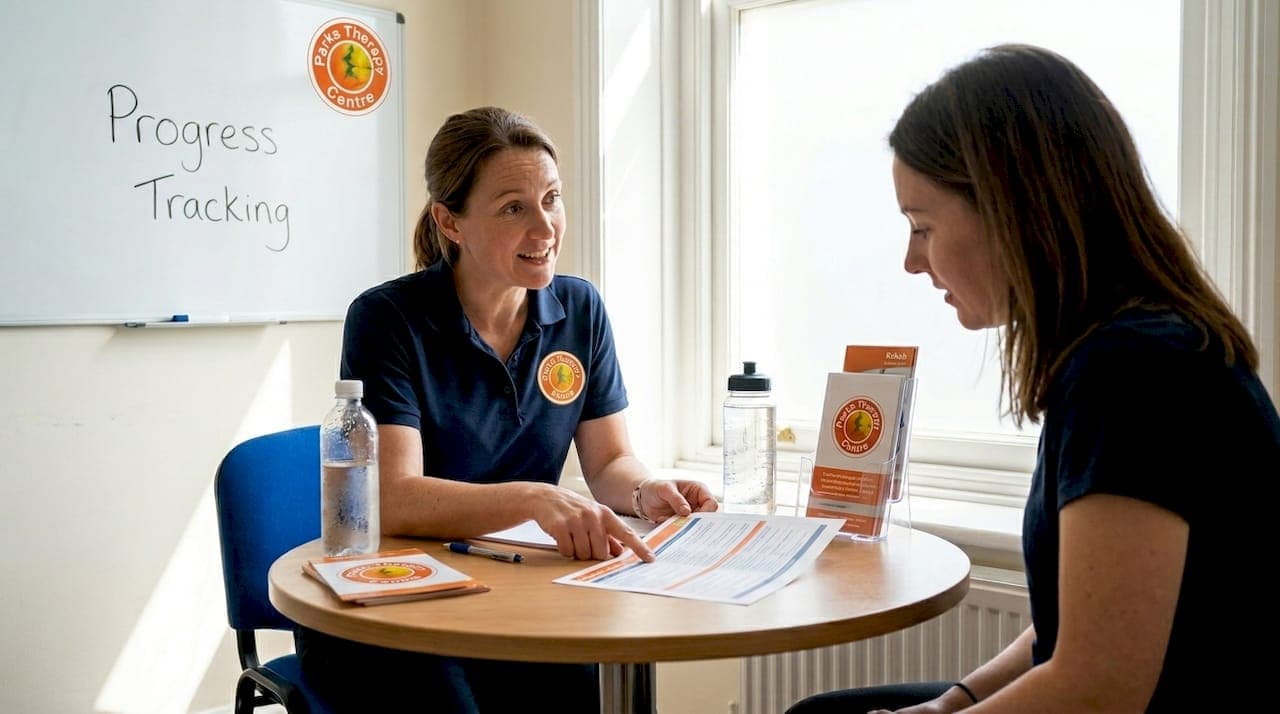
TL;DR:
- Returning to activity after injury requires a carefully structured, symptom-guided plan to avoid setbacks and ensure full recovery. An initial assessment and measurable benchmarks are essential for safe progression through protection, rebuilding, and sport-specific phases. Professional guidance and adaptive training that respond to your body's daily feedback significantly improve outcomes and reduce re-injury risk.
Returning to training after an injury is one of the most frustrating experiences an active person can face. Do too much too soon and you risk a setback. Do too little and you lose fitness, confidence, and momentum. Most people either rush back because they feel "fine," or they wait so long that fear itself becomes the barrier. Neither approach serves you well. A structured, symptom-guided post-injury training plan removes the guesswork, replaces anxiety with clear decision rules, and gives your body the progressive challenge it needs to recover fully and stay strong.
Table of Contents
- What you need before you start: assessment and planning tools
- Structuring your plan: phases, entry criteria, and symptom monitoring
- Managing load and movement: the symptom-guided approach
- Returning to running and high-impact sport: a graduated protocol
- Why clinician support is crucial for your plan
- What most miss: why real-time adaptation trumps rigid schedules
- Get expert support for your rehabilitation journey
- Frequently asked questions
Key Takeaways
| Point | Details |
|---|---|
| Progress by symptoms, not time | Use pain and function markers, rather than fixed timelines, to guide your recovery stages. |
| Monitor and adapt daily | Record pain and swelling, and adjust your plan if symptoms worsen or re-appear. |
| Phase your training steps | Break recovery into clear phases with entry and progression benchmarks for each. |
| Involve a clinician | Consult a qualified physiotherapist for complex injuries, setbacks, or tailored planning. |
What you need before you start: assessment and planning tools
Before you write a single session into your plan, you need a clear picture of where you are right now. This starting point is not simply "sore" or "a bit better." It needs to be specific, measurable, and documented.
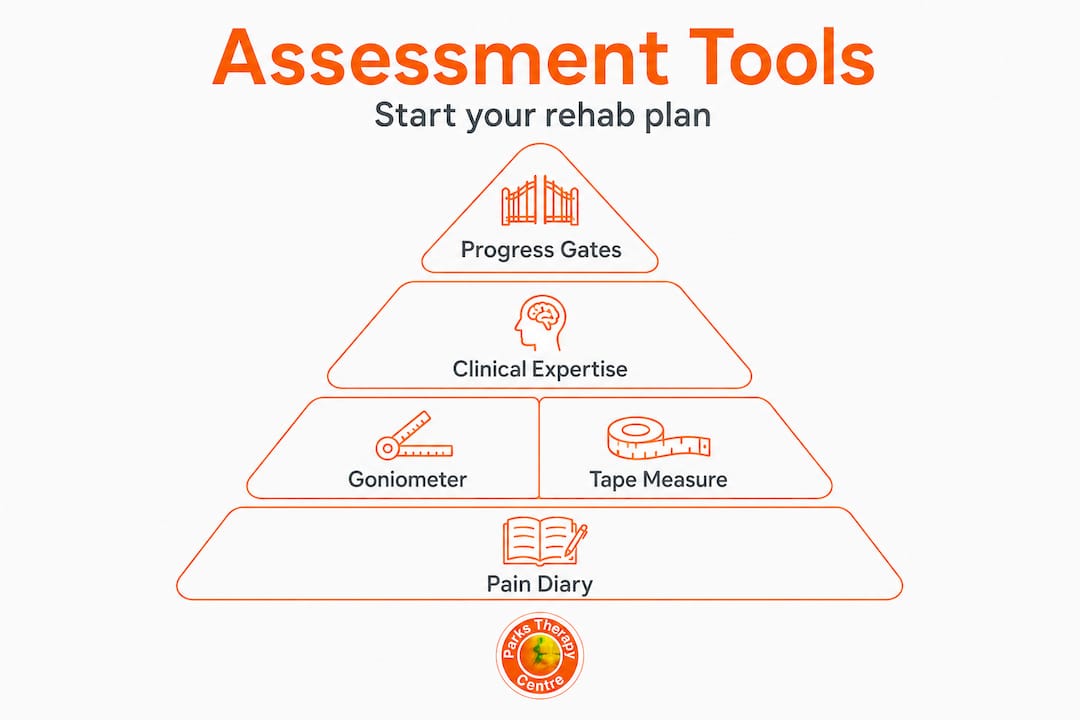
A clinical assessment with a physiotherapist or sports medicine professional is the single most important first step. This identifies the exact tissue involved, the severity of the injury, and any biomechanical factors that may have contributed. Without this, you are building on guesswork. Your step-by-step recovery guide starts here, not in the gym.
Once assessed, you need to record your baseline measurements. These are the benchmarks you will use throughout your plan to judge readiness and progress.
Key measurements to document at the start:
- Range of motion (ROM) in the affected joint, measured in degrees
- Strength comparison between injured and uninjured limb (as a percentage)
- Resting pain level on a 0 to 10 scale
- Swelling or puffiness around the joint (measured in centimetres if possible)
- Gait quality: can you walk without a limp?
- Functional tolerance: how many minutes can you stand, walk, or perform a specific movement before symptoms appear?
These are not just numbers. They are your progression gates. The CDC guidance on returning to sport confirms that you should set objective benchmarks such as ROM, strength, gait quality, and functional tolerance, and use them as the criteria for advancing to higher-impact work. Without them, you are guessing.
| Measurement | Baseline (day 1) | Target for phase 2 | Notes |
|---|---|---|---|
| Knee flexion (ROM) | 85° | 120° | Compare to uninjured side |
| Strength (quad) | 60% of uninjured | 75% | Use bodyweight squat assessment |
| Morning pain (0-10) | 4/10 | 1/10 or less | Recorded on waking |
| Walking gait | Visible limp | No limp | Observe over 50 metres |
Your essential tools include a daily pain and symptom diary, a tape measure for swelling, a basic goniometer (a device that measures joint angle) if ROM is being tracked, and access to appropriate physiotherapy recovery aids to support soft tissue work at home.
Pro Tip: Take a short video of your walking gait on day one. Revisit it every two weeks. Gait changes that are invisible to the naked eye become obvious on replay, and this honest feedback often saves people from advancing too early.
Structuring your plan: phases, entry criteria, and symptom monitoring
With your starting point and assessment tools in hand, you can now build a plan structure that adapts to your progress.
A phased plan is not about counting days. It is about achieving specific markers before moving forward. The sports therapy phase definitions used in clinical practice organise recovery into four clear stages, each with its own purpose and entry conditions.
Research supports this model clearly: build your plan using phases with explicit entry and progression criteria, not time, and only advance when symptoms at the current stage are controlled. Phases should move from protection and restorative loading, through rebuilding strength and control, and on to higher intensity work only when functional markers and symptom stability are confirmed.
The four phases in practice:
-
Phase 1: Protection and rest. Reduce load on the injured tissue while maintaining general conditioning. Entry criteria: acute inflammation is settling. Goal: pain and swelling are reducing daily.
-
Phase 2: Strength and control. Begin targeted strengthening and neuromuscular control (the brain-to-muscle communication that improves joint stability). Entry criteria: walking without limp, morning pain at 2/10 or less. Goal: restore at least 75% symmetry in strength.
-
Phase 3: Progressive loading. Introduce moderate-impact activities such as cycling, light jogging, or sport-specific drills at low intensity. Entry criteria: full ROM restored, no swelling after phase 2 sessions. Goal: tolerate 20 to 30 minutes of moderate activity without symptom flare.
-
Phase 4: Sport-specific return. Replicate match or training conditions progressively. Entry criteria: strength at 90% of uninjured side, no pain or limp during phase 3 work. Goal: full training participation and competition readiness.
"Progressing before you meet phase criteria is one of the leading causes of re-injury. It is not a shortcut. It is a detour that adds weeks or months to your recovery."
Use the morning pain rule as a daily check-in. Rate your pain on waking before you get out of bed. If your score is higher than the previous morning, that day calls for reduced load or active rest, not a new challenge.
| Symptom marker | Objective marker | Ready to progress? |
|---|---|---|
| Morning pain 0-1/10 | ROM within 10% of other side | Yes, if both are met |
| Morning pain 2-3/10 | ROM restored but strength at 65% | No, hold current phase |
| Swelling present | Any | No, regardless of other markers |
| No limp on walking | Strength at 80%+ | Likely yes, review with clinician |
Pro Tip: Write your criteria on a card and put it on your kit bag. Before every session, ask: "Do I meet the criteria for today's plan?" If the answer is no, swap to the lower-intensity option you prepared in advance.
Managing load and movement: the symptom-guided approach
Now that you are tracking phase progress, let us focus on managing your daily training load safely, step by step.
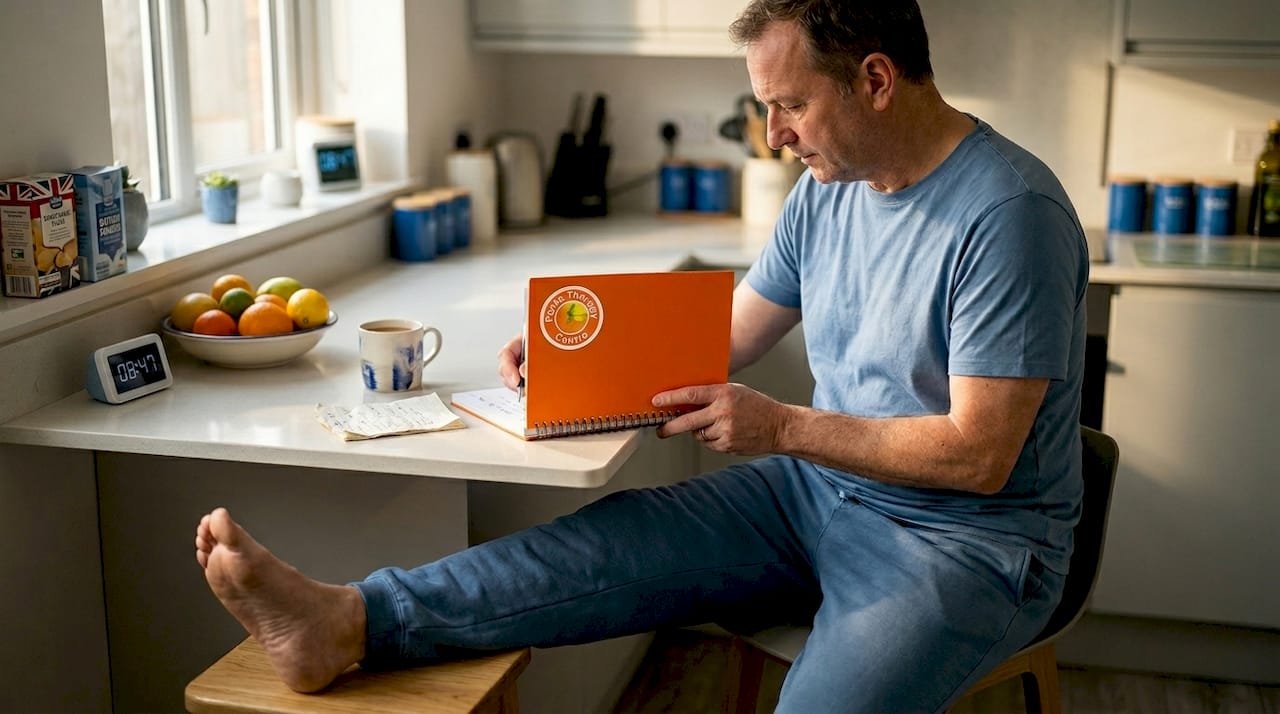
The symptom-guided approach treats your body's feedback as real data, not as weakness or complaint. Research in rehabilitation science shows that tracking pain and swelling and reducing training stress when morning pain increases or when swelling persists is an essential safety mechanism, particularly in the earlier phases of recovery.
Your home physiotherapy exercises form the backbone of load management. These are controllable, measurable, and easy to modify.
Daily symptom monitoring checklist:
- Record morning pain score (0 to 10) before rising
- Note any overnight swelling or stiffness
- Rate pain during and after each training session
- Log whether you completed the session as planned or modified it
- Record next-morning score to assess your body's response to the previous day
The +2 rule is a practical tool. If your pain score rises by 2 or more points during or after a session compared to your starting score that day, the load was too high. Reduce intensity immediately or regress to the previous phase. Evidence confirms that for joint and soft tissue injuries, pain and limp are signals that the current load exceeds the tissue's capacity.
If symptoms flare, follow this sequence: apply ice for 15 minutes, elevate the limb where possible, rest from loading activity for 24 to 48 hours, and contact your clinician if pain or swelling does not settle within 48 hours. This is not failure. It is intelligent management.
The most common and costly mistake people make is continuing to train when a limp is present. A limp means your body is compensating. Compensation loads adjacent tissues abnormally and dramatically increases the risk of secondary injury. Check out the beginner recovery tips for more detail on safe training habits during early rehabilitation.
Returning to running and high-impact sport: a graduated protocol
Applying these monitoring principles becomes even more important as you return to higher-impact activities.
Running is not a simple yes or no decision. It is a graduated exposure that begins with walking, progresses through a walk-run protocol, and advances to continuous running only when your body has demonstrated it can tolerate each step. Progress gradually using walk-run protocols and let the next-day response determine whether to move forward.
A safe walk-run return protocol:
- Confirm you can walk for 30 minutes with no pain, no limp, and no swelling the following morning.
- Begin with alternating 1 minute of light jogging and 3 minutes of walking for 20 minutes total.
- After each session, record next-morning pain and swelling. If both are at baseline (your starting score for that phase), repeat the same session before progressing.
- Progress by increasing the jogging interval by 30 seconds when two consecutive sessions produce no increase in symptoms.
- Reduce jogging time if any session produces a +2 pain increase or any return of swelling.
- Continue until you achieve 20 to 25 minutes of continuous jogging with normal gait and no symptom flare.
"The next morning tells you more about whether yesterday's run was appropriate than how you felt during it."
Common pitfalls to avoid during return to running include skipping the walk phase because you "feel fine," ignoring mild soreness as unimportant, increasing both duration and intensity in the same week, and failing to account for cumulative fatigue across a training week. For athletes preparing for a race, the post-marathon recovery tips section covers the additional considerations for high-volume return.
Why clinician support is crucial for your plan
No matter how tailored your plan is, professional guidance vastly enhances your chances of full recovery.
A qualified physiotherapist or sports doctor provides three things a self-directed plan cannot: accurate diagnosis, objective progress checks, and the ability to adapt your plan based on how your specific tissue responds. The CDC is clear that you should coordinate with a qualified clinician and tailor progression criteria to the specific tissue injury and sport demands.
Reasons to involve a clinician from the start:
- Correct diagnosis prevents wasted weeks treating the wrong structure
- Hands-on assessment detects issues like muscle imbalance or movement dysfunction you cannot self-identify
- A clinician can adapt your plan if progress stalls or if a new issue emerges
- Professional review at each phase transition confirms your readiness objectively
"Self-directed recovery is valuable, but it has a ceiling. The clinician's role is to raise that ceiling."
Warning signs that require prompt professional review include pain that is not improving after two weeks of appropriate loading, new swelling that was not present before, a return of limping after it had resolved, sharp or stabbing pain during any movement, and unexpected setbacks after previously smooth progress. These are not minor inconveniences. They are signals that the plan needs adjustment, not willpower.
Building a personalised physiotherapy plan with clinical input also allows you to incorporate adjuncts like Pilates or targeted mobility work. Understanding the role of Pilates in rehabilitation can help you see how movement-based therapies complement structured loading and accelerate your return. The physiotherapist's support in rehab adds a layer of confidence that is difficult to replicate on your own.
What most miss: why real-time adaptation trumps rigid schedules
Here is something worth sitting with. Most injury programmes are built around time. "Week 3: begin jogging." "Week 6: return to full training." These timelines come from population averages, not from you. And averages, by definition, do not describe most individuals.
At Parks Therapy Centre, we see the consequences of calendar-based thinking regularly. Someone completes their four-week "rest phase" and begins strength work because the calendar says so, despite still having morning pain and swelling. Two weeks later, they are back to square one, often with more damage and considerably more anxiety about their recovery.
Function and symptom response are far more reliable guides than any timeline. Your tissue does not heal on a schedule. It heals based on load, recovery, nutrition, sleep, and many factors that vary day to day. A symptom-monitored, adaptive plan captures that reality. A rigid calendar ignores it.
The shift in mindset is this: instead of asking "what week am I in?", ask "what can my body do today, and what does it need to do next?" That question leads to faster, more sustainable recovery. Clients who self-monitor daily and adjust accordingly consistently progress through their phases more smoothly than those who follow a fixed timetable. Supporting injury prevention through physiotherapy is not just about what happens in the clinic. It is about teaching you to listen intelligently to your own body every single day.
Adaptive planning is not the soft option. It is the smarter one. And it is the approach that the evidence, and our clinical experience since 1986, consistently supports.
Get expert support for your rehabilitation journey
Knowing the framework is one thing. Applying it correctly to your specific injury, your sport, and your body is another. At Parks Therapy Centre, our qualified physiotherapy and sports injury team builds personalised rehabilitation plans grounded in the same principles outlined in this article. Whether you are recovering from a ligament sprain, a stress fracture, or a complex soft tissue injury, we create structured plans that protect you from setbacks and keep your recovery moving forward.
We have been supporting patients across Bedfordshire and Buckinghamshire since 1986, with award-winning care and a multidisciplinary team that includes physiotherapists, sports therapists, podiatrists, and acupuncturists. You can book an initial assessment online, and many of our services are covered by private health insurance. If you are ready to move from uncertainty to a clear, safe, expertly guided plan, book your consultation today and take the guesswork out of your recovery.
Frequently asked questions
How soon after an injury can I start active rehabilitation?
You can usually begin gentle movement once acute pain and swelling are controlled, though you should always follow clinical advice specific to your injury. Objective benchmarks like ROM and gait quality determine readiness, not simply the passage of time.
What is the most important sign to reduce or stop training after injury?
New or worsening pain, swelling, or a return of limping indicates you should reduce intensity and review your plan immediately. Tracking pain and swelling daily gives you the early warning signals you need before damage is done.
When is it safe to return to running after a leg injury?
It is appropriate to begin a walk-run protocol only when you can walk for 30 minutes pain-free with normal gait and no swelling the following morning. Gradual walk-run exposure with next-day monitoring is the safest method for most lower limb injuries.
Do I need to see a physiotherapist to make a post-injury plan?
A physiotherapist's input ensures your plan is matched to your specific injury, tissue type, and sport, and it allows problems to be caught early. The guidance is clear that coordinating with a qualified clinician significantly improves both the safety and effectiveness of your return to training.