
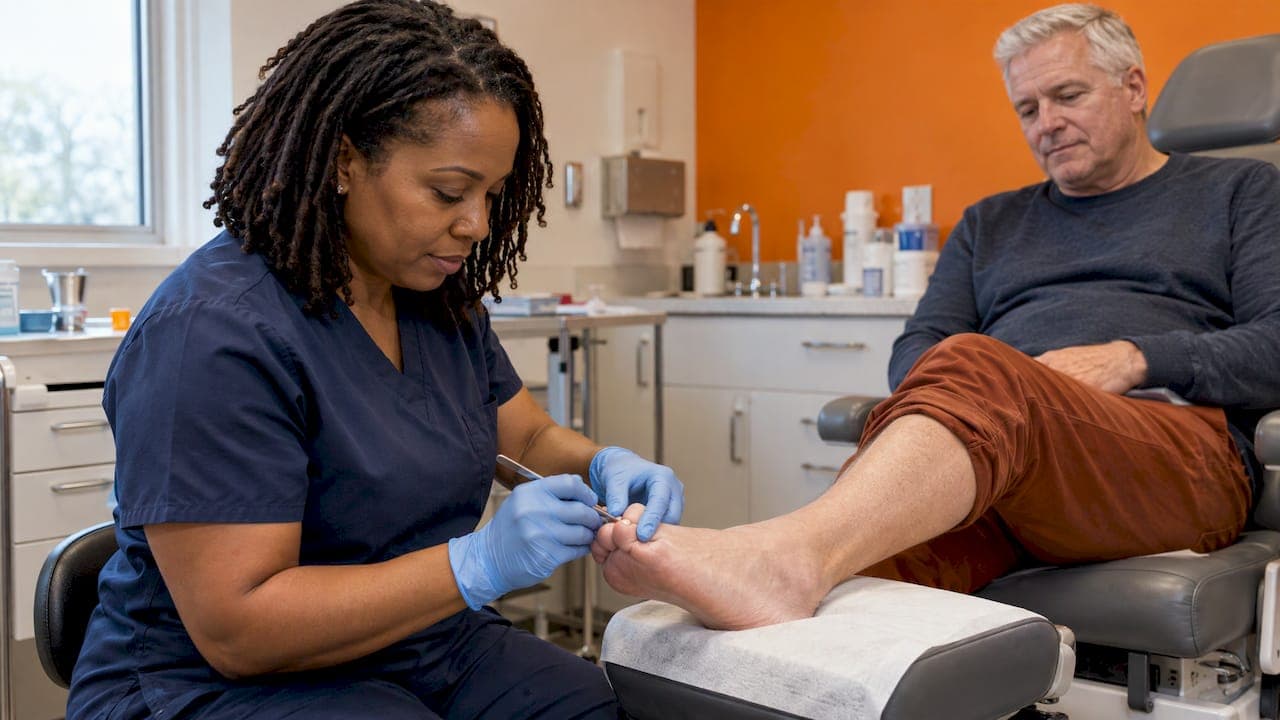
Most corns can be treated with a few weeks of consistent home care: softening the skin, gently filing it, and removing the pressure that caused it. If the corn is very painful, keeps returning, or you have diabetes or circulation problems, the safest option is to have it treated by a podiatrist. This guide explains how to identify a corn, what you can do yourself, what professional removal involves and how to stop it coming back.
TL;DR
- A corn is a small, sharply defined area of thickened skin with a hard, often painful core. It is caused by pressure or rubbing, so treatment only lasts if the pressure is dealt with.
- At home, the NHS advises wide, well-fitting shoes, cushioned socks, soft insoles, warm-water soaks and regular use of a pumice stone or foot file.
- Never cut a corn yourself with a razor, scissors or other sharp tool.
- If you have diabetes, circulation problems or signs of infection, or home care has not helped after three weeks, see a GP or podiatrist.
- Professional treatment by a podiatrist can include cutting away the corn and providing pads or insoles to offload the area.
Table of Contents
- What a corn is, and how it differs from a callus
- Corn, callus or wart: how to tell them apart
- How to treat a corn at home
- Corn pads and salicylic acid products
- When to see a GP or podiatrist
- What professional corn removal involves
- Perspective: why we treat the cause, not just the corn
- Can a corn grow back?
- Corn removal at Parks Therapy Centre
- Other foot problems that can be mistaken for a corn
- FAQ
- Sources
What a corn is, and how it differs from a callus
A corn and a callus are close relatives. According to the Primary Care Dermatology Society, a callosity is a plaque of thickened skin, and a corn is a sharply demarcated callosity with a central, often painful, keratin core. In plain terms: a callus is a broad, flat area of hard skin, while a corn is smaller, more focused, and has a dense centre that presses into the tissue beneath.
Both are the skin's response to repeated pressure or friction. The NHS lists uncomfortable or wrong-size shoes and problems with the bones in the feet among the causes. That is why the same corn can reappear in the same place for years if nothing changes in the way the foot is loaded.
The difference matters for treatment in one practical way. A callus is usually spread over a larger area and is often not painful. A corn concentrates pressure on one point, so it hurts when you walk or press on it. Both can be managed with proper footwear, orthoses (insoles made or chosen to change how pressure is spread) and, if necessary, regular paring, as the PCDS guidance describes.
Corn, callus or wart: how to tell them apart
Many people searching for corn treatment are actually looking at a plantar wart (often called a verruca). The two look similar on the sole of the foot but are treated very differently. Warts are caused by a virus. Corns and calluses are caused by pressure.
| Feature | Corn | Callus | Plantar wart (verruca) |
|---|---|---|---|
| Appearance | Small, sharply defined, hard central core | Wider plaque of thickened skin | Often rough, may interrupt the skin's normal lines |
| Skin markings | Present over the surface | Present over the surface | Skin lines typically disrupted |
| Pain pattern | Tender with direct pressure | Often little or no pain | Tender when squeezed from side to side |
| Under the surface | Keratin core | Uniform thickened skin | Small black dots (thrombosed capillaries) once pared |
| Underlying cause | Pressure or rubbing | Pressure or rubbing | Viral infection |
The PCDS guidance gives the clinical clues behind this table: callosities keep the skin's markings, warts show black thrombosed capillaries after paring, and warts are tender with side-to-side pressure while corns and callosities are tender with direct pressure.
A simple check at home is to squeeze the lesion from the sides, then press straight down on it. Pain mainly from the squeeze points towards a wart. Pain mainly from direct pressure points towards a corn or callus. This is only a pointer. Paring the skin to look for those black dots is something a trained clinician should do, so if you are unsure, have it examined rather than treating it as a corn and hoping for the best.
If it does turn out to be a wart, our guide to verruca treatment options explains the patient-led routes and what to expect.
How to treat a corn at home
Home treatment suits a corn in an otherwise healthy foot, with no diabetes, circulation problem or infection. The NHS approach has three parts: reduce the pressure, soften the skin, and gently remove the hard surface.

Step 1: take the pressure off
The NHS recommends wide, well-fitting, supportive shoes and thick cushioned socks, plus soft insoles. If the corn sits on a toe, check whether the toe box is squeezing or rubbing. A shoe that feels fine in the shop can press on a particular toe after a few hours of walking, so check your usual work or exercise shoes too, not only your best pair.
Step 2: soak the skin
Soaking the corn in warm water softens it. Do it regularly, not once. Pat the foot dry carefully afterwards, including between the toes.

Step 3: file gently
After soaking, use a pumice stone or foot file on the corn, as the NHS advises. Use light strokes and stop if the area feels sore. The aim is to reduce the hard surface gradually, not to remove the corn in one session.
Step 4: keep the skin moisturised
The NHS also advises moisturising to keep the skin supple. Hard, dry skin cracks more easily, and cracks can become painful.
What not to do
The NHS is clear that cutting your own corns or calluses with sharp instruments such as razors or scissors is dangerous and should be avoided. A slip can cause bleeding and infection, and a deeper cut is more serious in feet with reduced sensation or poor circulation. If a corn is too hard and painful to manage with a file, that is a reason to book a professional, not to reach for a blade.
Corn pads and salicylic acid products
Pharmacies sell corn plasters and cushioning pads. Cushions can help by spreading pressure around the corn. Medicated plasters are a different matter, because they act on the skin chemically. The NHS suggests asking a pharmacist for advice on corn plasters and other products, which is sensible: a pharmacist can look at your foot, ask about your health and recommend something suitable.
The key safety point is who should not self-treat. According to the NHS, people with diabetes or circulation problems should not treat corns themselves and should ask a GP or foot specialist. If you have either condition, do not use medicated plasters, files or any home removal method on your feet without that advice first.
If you do use a product, follow the instructions on the packet, apply it only to the corn, and stop if the surrounding skin becomes red, sore or broken.
When to see a GP or podiatrist
Home care is a reasonable first step, but it has limits. Seek professional help when:
- you have diabetes, circulation problems or a weakened immune system
- the area shows signs of infection, such as pus, bleeding or discharge
- home care has shown no improvement after three weeks (the NHS suggests consulting a GP at this point)
- the corn is so painful that it changes how you walk
- you are not sure whether it is a corn or a wart
The change in how you walk is worth taking seriously. Protecting a painful foot often shifts load onto the other foot, the knee, the hip or the lower back. Our article on how podiatry helps with foot and lower-limb pain explains how foot problems can affect the rest of the leg.
What professional corn removal involves
The NHS says a foot specialist such as a podiatrist may cut away a corn or callus and offer specially made pads or insoles to take pressure off. That sums up the two parts of good professional care.
Removing the corn. A podiatrist has the training and instruments to reduce the hard skin, including the central core, safely and with control. This is the part you should not attempt at home with a blade.
Offloading the area. Removing the corn deals with the symptom. Pads, insoles or changes to footwear deal with the cause, which is the pressure. Without this step, a corn is likely to return.
Sometimes the cause is structural. The PCDS guidance notes that surgical correction by a podiatric or orthopaedic surgeon is sometimes required for underlying bony deformities that cause persistent corns. If your corns keep coming back on the same toe or the same part of the foot despite good footwear, ask for the shape and alignment of the foot to be assessed.
Foot problems often come in groups. If you also have bunion pain, our guide to easing bunion pain without surgery may be relevant, because a bunion can press the big toe against its neighbour and create corns between or on top of the toes.
Perspective: why we treat the cause, not just the corn
Patients often come to us having filed, soaked and plastered the same corn for months, and each time it returns. In our experience, that pattern means something is still pressing on that spot.
This is where a multidisciplinary team helps. Because we work across physiotherapy, podiatry and sports injury care, we can look at the whole picture: the shoe, the way the foot moves, and how the rest of the leg is working. Our clinics in Bedfordshire and Buckinghamshire have been caring for local patients since 1986, and we aim to give treatment that makes sense for how you live and what you do on your feet.
Our advice is simple. If a corn is painful, keeps coming back, or you have diabetes or circulation problems, book an assessment and let a qualified professional deal with it safely. Removing it is the start. Finding out why it formed is what keeps your feet comfortable.
Ivan
Can a corn grow back?
Yes, if the cause is still there. Corns come from pressure or rubbing, so removing one without changing that pressure leaves the conditions for it to form again. The NHS advice for preventing corns and calluses returning is to wear wide, well-fitting, supportive shoes and to use soft insoles or heel pads.
A practical prevention routine:
- Check your shoes. Look at the inside of your most-worn pair for wear patterns or rough seams where the corn forms.
- Choose width and depth, not just length. A shoe can be the right length and still squeeze the toes.
- Wear cushioned socks where you walk or stand a lot.
- Use soft insoles or heel pads if recommended.
- Keep the skin soft with regular moisturising and gentle filing after soaking.
- Review your footwear for activity. Runners, walkers and people on their feet at work should make sure their shoes suit the job and are replaced when worn.
If a corn returns despite all this, that is the moment to ask a podiatrist whether orthoses or a bone problem is involved.
Corn removal at Parks Therapy Centre
We offer podiatry alongside physiotherapy, sports massage, acupuncture, Pilates and shockwave therapy, so foot problems can be looked at as part of your wider musculoskeletal health. We accept private payment and health insurance, and we can arrange diagnostic imaging referrals where an assessment suggests they are needed. You can see our published prices for physiotherapy, imaging, shockwave and other services on our prices page, and you can book online through our site at parkstherapycentre.co.uk.

If your foot or leg pain is linked to training, our piece on why podiatry matters for sports injuries shows how foot assessment fits into recovery and prevention.
Other foot problems that can be mistaken for a corn
Not every sore spot on the forefoot is a corn. Pain under the ball of the foot, particularly when it feels like standing on a pebble or a bunched sock, can have other causes. Our guide to Morton's neuroma symptoms describes what to look for, and if the foot arch is part of the picture, these flat feet exercises may help. A proper assessment is the way to tell which of these you have, since treatments differ.
FAQ
How do I remove a corn from my foot?
Soak it in warm water, then gently use a pumice stone or foot file, and moisturise the skin. Alongside this, wear wide, well-fitting shoes and soft insoles to reduce pressure. Do not cut the corn yourself. If you have diabetes or circulation problems, see a GP or foot specialist instead of treating it at home.
What is the difference between a corn and a callus?
A callus is a plaque of thickened skin, while a corn is a sharply defined callosity with a central, often painful, keratin core. Corns tend to hurt under direct pressure. Calluses are broader and often less painful. Both are caused by pressure or rubbing.
How can I tell a corn from a plantar wart?
A wart is tender when squeezed from side to side, while a corn or callus is tender with direct pressure. After paring, warts show small black dots, which are thrombosed capillaries. Because this needs a clinician's examination, have an uncertain lesion looked at before you treat it.
Does a corn come back after removal?
It can, if the pressure or rubbing that caused it continues. Wearing wide, supportive shoes and using soft insoles or heel pads helps prevent a return. If a corn keeps recurring on the same spot, a podiatrist can check for an underlying bone or foot-shape problem.
When should I see a professional about a corn?
See a GP or podiatrist if you have diabetes, circulation problems or a weakened immune system, or if there is pus, bleeding or discharge. Also seek advice if three weeks of home care have not helped, or if the corn is making walking painful.