

TL;DR:
- Whiplash is a neck injury caused by rapid forward and backward movement, often from car accidents.
- Early, guided movement and strengthening exercises improve recovery and prevent long-term issues.
Whiplash is defined as a soft tissue injury to the neck caused by rapid forward and backward movement, most commonly from road traffic collisions. Step by step whiplash rehabilitation, known clinically as cervical sprain rehabilitation, gives you a structured path to restore neck mobility and reduce pain without guesswork. Most whiplash injuries improve within days to a few weeks, though severe cases can take months. The key is starting the right movements early, progressing carefully, and knowing when to seek professional support from a physiotherapist.
What do you need before starting whiplash rehabilitation?
Safe rehabilitation begins with medical clearance. Before you attempt any exercise, a clinician must rule out fractures, disc injuries, or nerve damage. This is non-negotiable, particularly after a road collision or a high-impact fall.
Once cleared, your home setup matters more than most people realise. You do not need expensive equipment. A firm chair with good back support, a timer, a mirror for posture feedback, and heat or cold packs cover the basics. Hot or cold packs applied for 15 minutes every three hours are a standard recommendation in the first 7–10 days after injury. That simple routine reduces muscle spasm and makes early movement more tolerable.
| Tool or resource | Purpose |
|---|---|
| Heat or cold packs | Reduce muscle spasm and manage pain in early recovery |
| Firm, supportive chair | Maintains neutral posture during seated exercises |
| Mirror | Provides real-time posture feedback during movements |
| Timer or phone | Tracks hold durations and rest intervals accurately |
| Physiotherapist guidance | Ensures exercises are safe, progressive, and personalised |
A physiotherapist from a centre like Parkstherapycentre can assess your specific injury pattern and build a plan around your pain levels, not a generic template. That personalised oversight significantly reduces the risk of setbacks.
Pro Tip: Set up your exercise space before your first session. Remove distractions, position a mirror at eye level, and keep your heat pack warm and ready. A prepared environment removes barriers and makes it easier to stay consistent.
What are the step-by-step exercises to begin whiplash rehabilitation safely?
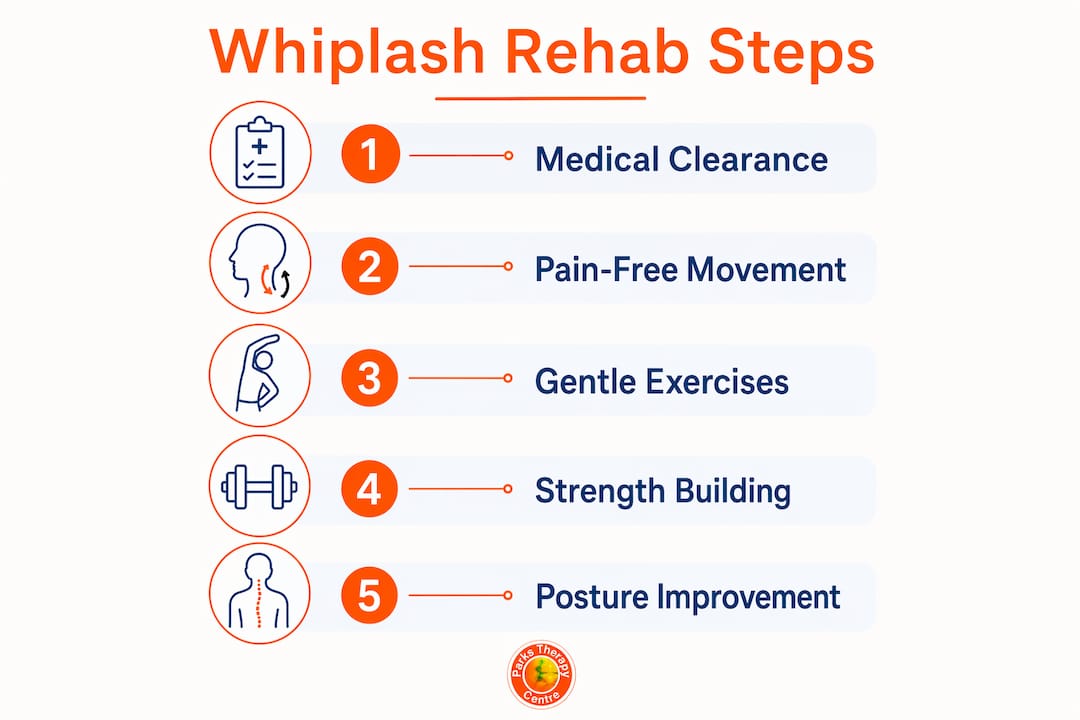
Early active cervical range of motion within a pain-free range is the foundation of safe whiplash recovery. The goal in the first phase is not to push through pain. It is to maintain movement, prevent stiffness, and signal to your nervous system that your neck is safe to use.
Start with these four early-stage exercises:
- Cervical rotation. Turn your head slowly to the right as far as comfortable. Hold for 2–3 seconds. Return to centre. Repeat to the left. Perform 5 repetitions per side, 3–4 times daily.
- Cervical flexion. Lower your chin gently toward your chest. Hold for 2–3 seconds. Return to neutral. Perform 5 repetitions, 3–4 times daily.
- Cervical extension. Tilt your head back slowly, keeping the movement controlled. Hold briefly. Return to neutral. Perform 5 repetitions, 3–4 times daily.
- Lateral flexion. Tilt your right ear toward your right shoulder without raising the shoulder. Hold for 2–3 seconds. Repeat to the left. Perform 5 repetitions per side, 3–4 times daily.
Each movement should stay within a pain-free range. If you feel a sharp increase in pain or symptoms spreading into your arm, stop and contact your physiotherapist. As your comfort improves over days, you can introduce gentle overpressure: use one hand to add a small, controlled additional stretch at the end of range. Never force the movement.
Pro Tip: Move slowly and breathe throughout each repetition. Holding your breath creates muscle tension that works against you. Exhale as you move into the stretch.
Common mistakes to avoid in this phase:
- Jerking or bouncing at the end of range
- Pushing through sharp or radiating pain
- Performing exercises too infrequently and losing momentum
- Using a soft collar as a substitute for movement
- Skipping the mirror check and allowing poor head posture
Prolonged collar use leads to stiffness, deconditioning, and increased chronic pain risk. Guidelines actively discourage immobilisation once a serious injury has been excluded. Movement, not rest, is the treatment.
You can find a broader set of physiotherapy home exercises that complement this early phase and support continued progress between clinical appointments.
How do you progress rehabilitation with strengthening and posture exercises?
Once you can move through a full, pain-free range of motion consistently, the next phase focuses on building endurance and strength in the deep neck muscles. These muscles, particularly the deep cervical flexors, stabilise the spine and are often weakened after whiplash injury.
The deep cervical flexor activation exercise is the cornerstone of this phase. Lie on your back with a small rolled towel under your neck. Gently nod your head as if saying "yes" in a very small movement. Hold for 10 seconds. Rest. Repeat 10 times. This targets the longus colli and longus capitis muscles without loading the superficial muscles that are already overworking to compensate.

| Exercise type | Goal | Stage |
|---|---|---|
| Active range of motion | Restore pain-free movement | Early (days 1–14) |
| Deep cervical flexor activation | Rebuild deep stabiliser endurance | Mid (weeks 2–6) |
| Shoulder and upper back strengthening | Support neck posture and reduce load | Mid to late (weeks 4–12) |
| Postural endurance training | Maintain alignment during daily tasks | Late and ongoing |
Shoulder and upper back strengthening plays a supporting role that many patients overlook. Exercises like scapular retractions, rows using a resistance band, and prone Y and T lifts reduce the load on the cervical spine by improving the surrounding muscular framework. Research into neck-specific exercises shows that targeting the trapezius and surrounding muscles improves function in chronic whiplash cases. Starting this work early prevents those muscles from becoming a long-term problem.
Supervised physiotherapy exercise programmes reduce pain and disability more effectively than unsupervised rest. A physiotherapist monitors your form, adjusts load, and catches compensatory patterns before they become habits.
Pro Tip: Consistency beats intensity at this stage. Three short sessions of 15 minutes daily produce better results than one long session every few days. Your nervous system adapts through repetition, not volume.
For a broader overview of how rehabilitation protocols are structured across different injury types, the recovery guide at Parkstherapycentre provides useful clinical context.
What additional therapies support whiplash recovery?
Exercise is the primary driver of recovery, but complementary therapies reduce pain enough to make exercise possible, particularly in the early weeks. Manual therapy combined with exercise improves outcomes more than either approach alone. That combination is the standard of care at multidisciplinary centres like Parkstherapycentre.
Self-care strategies that genuinely help:
- Apply heat before exercise to relax muscle tension and improve tissue extensibility
- Apply cold after exercise or during flare-ups to reduce local inflammation
- Gentle massage to the upper trapezius and suboccipital muscles eases referred headache pain
- Sleep with a supportive pillow that keeps the cervical spine in a neutral position
- Avoid prolonged screen time in a forward head posture, which loads the neck significantly
Pain medications and muscle relaxants have a limited role. They can reduce symptoms enough to allow movement, but they do not treat the underlying injury. Use them as a short-term bridge to exercise, not as a substitute for it. Always follow your GP's guidance on dosage and duration.
Stress management and biofeedback added to physical rehabilitation reduce disability after whiplash. Chronic stress elevates muscle tension and amplifies pain perception. Techniques like diaphragmatic breathing, progressive muscle relaxation, and guided mindfulness are not optional extras for severe cases. They are practical tools that accelerate recovery.
Pro Tip: If pain spikes after a session, it does not always mean you have done damage. A mild increase that settles within 24 hours is a normal response to new loading. An increase that persists beyond 24 hours signals you need to reduce intensity.
The soft tissue care checklist from Thrival offers a practical framework for managing minor whiplash symptoms at home between physiotherapy appointments.
What are common challenges during whiplash rehabilitation?
Setbacks are normal. Knowing how to recognise and respond to them prevents a temporary flare-up from becoming a prolonged delay.
Warning signs that require medical review:
- Pain or tingling spreading into the arm or hand
- Severe headache that is new or worsening
- Dizziness, visual disturbance, or difficulty swallowing
- Significant increase in pain that does not settle within 48 hours
If none of these are present and you experience a general increase in neck soreness, the most likely cause is a temporary overload. Reduce your exercise volume by 30–40%, maintain gentle movement, and rebuild gradually over the following week.
Fear avoidance is one of the most significant barriers to recovery. Patients who avoid movement due to fear of pain develop worse long-term outcomes. The brain interprets prolonged avoidance as confirmation that the neck is fragile, which amplifies pain signals even when the tissue has healed. Education is the antidote. Understanding that movement is safe and necessary changes behaviour.
Practical strategies for maintaining momentum:
- Keep a simple exercise diary to track progress and identify patterns
- Set small, measurable goals each week rather than focusing on full recovery
- Communicate openly with your physiotherapist when something is not working
- Acknowledge that recovery is not linear and that good days and difficult days are both part of the process
Early activation strategies prevent chronic pain by maintaining mobility throughout the healing process. Patients who stay active, even at reduced intensity, consistently recover faster than those who wait for pain to disappear before moving.
Key takeaways
Effective whiplash rehabilitation requires early active movement, progressive strengthening, and consistent engagement with both physical and psychological recovery strategies.
| Point | Details |
|---|---|
| Start with medical clearance | Rule out fractures and nerve injury before beginning any exercise programme. |
| Begin movement early | Gentle range of motion exercises within pain-free limits prevent stiffness and chronic pain. |
| Progress to strengthening | Deep cervical flexor and upper back exercises rebuild stability from week two onwards. |
| Add complementary therapies | Manual therapy, heat, cold, and stress management improve outcomes alongside exercise. |
| Manage setbacks actively | Reduce volume temporarily during flare-ups rather than stopping exercise entirely. |
What I have learned from years of whiplash rehabilitation
The single most common mistake I see is patients waiting too long to move. They arrive having spent the first two weeks in a soft collar, barely turning their head, convinced that rest is healing them. In reality, that period of immobilisation has already begun to work against them. Muscle deconditioning sets in quickly, and the nervous system starts to treat normal neck movement as a threat.
Early mobilisation is not reckless. It is the evidence-based standard. What matters is how you mobilise, not whether you do. Gentle, controlled, pain-free movement in the first 48–72 hours after injury, once serious pathology is excluded, produces measurably better outcomes than rest.
The second thing I would tell every patient is that recovery is not a straight line. I have worked with patients who felt almost normal at week three and then had a difficult week four after returning to desk work. That is not a failure. That is a normal part of the healing process. The patients who recover best are the ones who stay curious about their symptoms rather than frightened by them.
Multidisciplinary care makes a real difference in complex cases. When physiotherapy, pain management, and psychological support work together, patients recover faster and with less risk of chronic symptoms. If your recovery feels stalled after six weeks of consistent effort, that is the signal to seek a more structured clinical assessment rather than push harder on your own.
— Ivan
Professional whiplash rehabilitation at Parkstherapycentre
Parkstherapycentre has provided physiotherapy and musculoskeletal care across Bedfordshire and Buckinghamshire since 1986. The team specialises in structured rehabilitation for whiplash and neck injuries, offering personalised assessment, guided exercise programmes, and manual therapy under one roof.

If you are ready to move from pain management to genuine recovery, Parkstherapycentre offers online booking and accepts most insurance providers. Whether you are in the early days after injury or managing symptoms that have persisted for weeks, a clinical assessment gives you a clear, personalised plan. Visit Parkstherapycentre to book your appointment and get started with a rehabilitation programme built around your recovery.
FAQ
How long does whiplash rehabilitation take?
Most whiplash injuries improve within days to a few weeks. Severe cases can take several months, and a small proportion of patients develop chronic symptoms requiring longer-term management.
When should I start exercising after a whiplash injury?
Gentle range of motion exercises can begin within the first 48–72 hours once serious injury has been excluded by a clinician. Early movement produces better outcomes than prolonged rest.
Is a neck collar helpful for whiplash recovery?
Prolonged collar use increases the risk of stiffness and chronic pain by preventing the movement your neck needs to heal. Collars are rarely recommended beyond the very short term.
What exercises are best for whiplash rehabilitation?
Early exercises focus on gentle cervical rotation, flexion, extension, and lateral flexion within a pain-free range. Later stages add deep cervical flexor activation and upper back strengthening for long-term stability.
When should I see a physiotherapist for whiplash?
See a physiotherapist if pain is not improving after two weeks, if symptoms spread into your arm or hand, or if you are unsure how to progress your exercises safely. A structured, supervised exercise programme reduces pain and disability more effectively than self-management alone.