
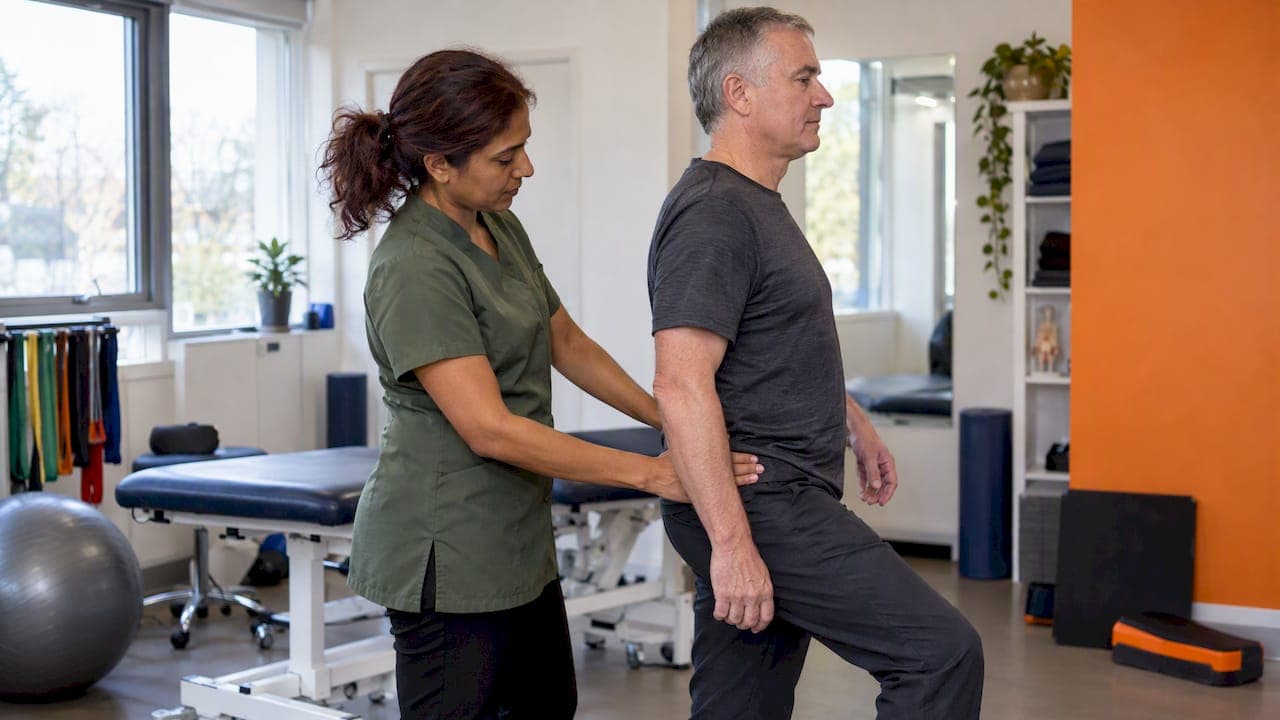
Sciatica is a symptom: pain, numbness or tingling along the path of the sciatic nerve. Piriformis syndrome is one possible cause, in which a deep buttock muscle irritates that nerve. Most sciatica starts in the lower back, usually from a nerve root being compressed, while piriformis syndrome starts in the buttock. The two can feel almost identical, which is why a hands-on assessment matters more than any online checklist.
This guide explains the differences in where the pain sits, what aggravates it, how clinicians separate the two, and what treatment looks like. It also covers the warning signs that mean you should not wait for an appointment.
TL;DR
- Sciatica describes leg pain along the sciatic nerve. Piriformis syndrome is one of its less common causes, centred in the buttock.
- Back pain, pain that spreads below the knee and pain on coughing point towards the spine. Buttock-dominant pain that builds with sitting points towards the piriformis.
- Piriformis syndrome is often over-diagnosed, so a physiotherapist rules out the spine and other causes first.
- Most cases improve with staying active, changing how long you sit and targeted physiotherapy. Scans are rarely needed first.
- Loss of bladder or bowel control, numbness around the genitals or back passage, or rapidly worsening leg weakness needs urgent medical help.
Table of Contents
- What sciatica actually is
- What piriformis syndrome is
- Sciatica vs piriformis syndrome: the main differences
- Why piriformis syndrome is often over-diagnosed
- How a physiotherapist tells them apart
- Red flags: when not to wait
- Treatment for piriformis syndrome
- Treatment for sciatica from the spine
- What about iliotibial band pain?
- Sciatica in pregnancy
- Our perspective
- Booking an assessment with us
- What to do while you wait for your appointment
- FAQ
- Sources
What sciatica actually is
The sciatic nerve is the largest nerve in the body. According to the Cleveland Clinic, it runs from the spine, through the buttock and down the back of the leg. "Sciatica" is the name for pain, numbness or tingling anywhere along that route. It is not a diagnosis in itself, in the same way that "headache" is not.
The most common cause is compression or irritation of a nerve root in the lower back, often from a disc herniation. That is why true sciatica frequently comes with some back pain, and why the leg symptoms can travel well below the knee into the calf or foot.
The outlook is generally good. NICE's clinical knowledge summary notes that sciatica symptoms typically settle within a few weeks to a few months for most people. NHS Inform says it usually improves within 12 weeks, though some people take up to a year and symptoms can come and go.
What piriformis syndrome is
The piriformis is a small muscle deep in the buttock that helps rotate and stabilise the hip. The sciatic nerve passes close to it, and in some people through or beneath it. In piriformis syndrome, the muscle is thought to irritate or compress the nerve through injury, swelling, spasm or scar tissue, as the Cleveland Clinic describes.

The result is pain or numbness in the buttock, hip or upper leg. Some people also feel sciatica-like symptoms further down the leg, which is where the confusion starts. A 2017 paper comparing piriformis syndrome with true sciatica describes piriformis syndrome as an often misdiagnosed cause of sciatica rather than a separate condition.
Sciatica vs piriformis syndrome: the main differences
No single feature settles it. The table shows the pattern clinicians weigh up.
| Feature | Sciatica from the lower back | Piriformis syndrome |
|---|---|---|
| Where it starts | Lower back, spreading to buttock and leg | Buttock, sometimes the back of the hip |
| Back pain | Often present | Less likely |
| Leg symptoms | Can travel below the knee to the calf or foot | Usually upper leg, sometimes further |
| Sitting | Can be worse, can also be eased | Typically builds the longer you sit |
| Coughing or sneezing | May provoke leg pain | Does not usually provoke it |
| Leg weakness | Possible, for example lifting the foot | Unusual |
| Typical cause | Disc herniation or nerve root irritation | Muscle spasm, injury, scar tissue or overload |
Two caveats apply. First, the overlap is large: a disc problem can cause buttock-dominant pain, and a tight piriformis can cause leg symptoms. Second, the same symptoms can come from the sacroiliac joint or from deep gluteal problems, so the buttock is a crowded area for diagnosis.
Why piriformis syndrome is often over-diagnosed
Piriformis syndrome is a diagnosis of exclusion. Clinicians first look for lumbar causes, then consider the sacroiliac joint and other deep gluteal conditions. Only if those do not explain the picture does the piriformis become the leading suspect.

One test in isolation does not settle it either. The FAIR test, which puts the hip in a position that stretches the piriformis, can reproduce buttock pain in people whose problem lies elsewhere. A UK physio guide on piriformis stretching makes the same point: single tests are not diagnostic, and the likelihood of a piriformis origin rises when several features line up. Those features include buttock-dominant symptoms, pain provoked by sitting for more than 20 minutes and no obvious lumbar nerve pattern.
This is why we do not recommend self-diagnosing from a symptom list. If you have had buttock and leg pain for more than a couple of weeks, the most useful step is a proper assessment.
How a physiotherapist tells them apart
An assessment normally takes in four things.
- Your history. Where the pain started, what eases or aggravates it, whether coughing or sneezing affects it, and how long you sit at work or while driving.
- Movement testing. How your spine, hips and pelvis move, and which positions reproduce your symptoms.
- Nerve and strength checks. Reflexes, skin sensation and muscle strength in the leg. Weakness lifting the foot, for example, suggests a lumbar nerve root rather than the piriformis.
- Provocation tests. Hip rotation and stretch tests, interpreted together rather than alone.
Imaging is rarely the first step. NICE's guidance says imaging is not routinely offered in non-specialist settings for sciatica or non-specific low back pain because it seldom changes initial management. An NHS musculoskeletal service makes a related point: despite advances in scanning, it is often hard to pin most spinal pain to one exact structure. Scans become relevant when symptoms are severe, not improving or point to something more serious. At our clinic, if your physiotherapist feels imaging is justified, we can issue an image referral letter (£10) and review the results with you.
Red flags: when not to wait
Rarely, sciatica is a sign of cauda equina syndrome, a serious condition that can cause permanent damage without urgent treatment. NHS Inform advises phoning 111 if you notice any of the following:
- numbness or pins and needles between your inner thighs or genitals, or around the back passage
- increasing difficulty passing urine, controlling the flow or knowing when your bladder is full
- leaking urine, or inability to control a bowel movement
- loss of sensation when you pass urine or a bowel motion
NICE says that where red flag symptoms suggest a serious cause, people should be referred urgently for specialist assessment, with emergency referral for suspected cauda equina. If these symptoms appear, call 111 or go to A&E. Do not book a routine physiotherapy appointment. The same applies during and after pregnancy.
Treatment for piriformis syndrome
First-line care is conservative. According to PhysioHub, the standard approach is activity modification, especially breaking up long periods of sitting, plus physiotherapy that strengthens the gluteal muscles. Surgery is a last resort, and where injections are used they are best done under image guidance rather than "blind".
A typical programme includes:
- Sitting changes. Stand or walk briefly every 20 to 30 minutes. Prolonged sitting is the main aggravator, more so than any single exercise.
- Gluteal strengthening. Building strength in the muscles around the hip so the piriformis is not overworking to stabilise the pelvis.
- Manual therapy. Soft tissue work to the buttock and hip to ease muscle tension.
- Graded return to activity. Stairs, hills and running may flare symptoms early on. The aim is to stay moving in a comfortable range rather than stop altogether.
On stretching, be careful. A common UK physio saying is to stretch what is tight, not what is painful. If the nerve itself is irritated, aggressive stretching can make symptoms worse. Many people are surprised that changing how they sit helps more than a complicated stretching routine.
Treatment for sciatica from the spine
NICE advises self-management first: stay active, modify activities and keep moving normally. If pain persists or is severe after 2 to 6 weeks, it supports referral for physiotherapy that includes exercise and manual therapy, or specialist assessment.
Physiotherapy for lumbar sciatica usually combines graded exercise, movement advice, hands-on treatment to the spine and hip, and a plan for returning to work or sport. We explain this in more detail in our guide on how physiotherapy helps with sciatica pain and recovery.
The same NICE guidance also lists treatments with no evidence of benefit and potential for harm in low back pain and sciatica: belts, corsets, traction, acupuncture, ultrasound, PENS, TENS and interferential therapy. We offer acupuncture for other conditions, but we will tell you honestly that it is not what the guidance supports for sciatica. A good clinician will steer you away from paying for treatments that are unlikely to help.
If you are unsure whether your pain needs a physio, a GP or a specialist, this overview of allied health help for back pain sets out when persistent or severe symptoms justify professional assessment.
What about iliotibial band pain?
People with buttock, hip and thigh pain often wonder whether the iliotibial band (ITB) is involved. ITB pain is usually felt on the outer thigh or outer knee, especially during running or cycling, rather than deep in the buttock with symptoms running down the back of the leg. That location difference is a useful clue, but it is not conclusive: hip and gluteal weakness can contribute to both problems, and the same assessment will tell them apart. If your pain is on the outside of the leg, tell your physiotherapist so it can be examined specifically.
Sciatica in pregnancy
Back and leg pain are common in pregnancy. The Newcastle Hospitals physiotherapy leaflet explains that as your baby grows, abdominal muscles stretch and weaken, posture changes and pelvic joint movement alters. That can produce buttock and leg pain that looks like sciatica or piriformis syndrome but may be pelvic girdle pain instead.
Self-help includes staying active in a modified way, wearing supportive footwear and using simple pelvic support. Speak to your midwife or GP early, and remember that cauda equina warning signs apply in and after pregnancy exactly as they do for everyone else. For more, see our guides on safe massage for sciatica in pregnancy, pelvic girdle pain exercises for every trimester and pregnancy Pilates. Another article covers easing pelvic girdle pain in pregnancy with physio support and individual advice from your midwife or GP.
Our perspective
We have been treating musculoskeletal problems across Bedfordshire and Buckinghamshire since 1986, and buttock and leg pain is one of the most common things people bring us. Three points come up again and again.
First, the label matters less than the pattern. Patients often arrive certain they have either sciatica or piriformis syndrome. What we do is test the spine, pelvis and hip together, because treating the wrong structure costs people weeks.
Second, desk and driving habits drive a lot of buttock pain. Before reaching for a stretch, we ask how long you sit without moving. Small, regular breaks are the cheapest treatment there is.
Third, we would rather you did less, not more, of the wrong thing. Pushing hard into a painful stretch or buying a gadget with no evidence behind it rarely helps. A short course of guided exercise, built around what your assessment shows, usually does.
— Ivan
Booking an assessment with us
If your pain has lasted beyond a couple of weeks, or keeps returning, a physiotherapy assessment is a sensible next step. At our centre, a physiotherapy assessment costs £76 and follow-up physiotherapy treatment is £67. A double session assessment is £102 and a double treatment is £77. If imaging is appropriate, an image assessment is £76. We accept major health insurance, and you can check all current fees on our prices page. You can also book online through our website.
What to do while you wait for your appointment
- Keep moving within comfortable limits. Complete rest is rarely helpful.
- Break up sitting, and vary your position at your desk and in the car.
- Avoid forcing stretches into sharp pain.
- Note what makes it worse, whether coughing aggravates it, and whether you have any numbness or weakness. Your physiotherapist will ask.
- Contact 111 or A&E straight away if any red flag symptom appears.
FAQ
How do I know if I have piriformis syndrome or sciatica?
You cannot be certain without an examination. Back pain, pain below the knee and leg pain on coughing or sneezing suggest a spinal cause. Buttock-dominant pain that builds with sitting suggests the piriformis, but disc and sacroiliac problems can look the same. A physiotherapist will test for both.
Is climbing stairs good for piriformis pain?
Stairs can aggravate piriformis symptoms because the muscle helps load and stabilise the hip. Prolonged sitting is usually the bigger problem. Staying active in a pain-free range is generally better than stopping all movement, but if stairs reproduce sharp pain, ease off and get it assessed.
What can I do if my piriformis pain isn't going away?
Book a physiotherapy assessment rather than keep stretching. Pain that persists may be coming from the lower back, sacroiliac joint or deep gluteal area. If it is severe or not improving after 2 to 6 weeks, NICE supports physiotherapy or specialist assessment.
Do I need an MRI scan for sciatica?
Usually not at first. NICE says imaging is not routinely offered in non-specialist settings because it rarely changes initial management. Your physiotherapist or GP will refer you if your symptoms are severe, not settling or suggest a serious cause.
Sources
- Piriformis Syndrome: Symptoms, Causes and Treatment, Cleveland Clinic
- Sciatica (lumbar radiculopathy): Management, NICE CKS
- Sciatica, NHS Inform
- Piriformis Syndrome or True Sciatica: Are They the Same or Different?
- Piriformis Syndrome guide, PhysioHub
- Back pain, Musculoskeletal Matters (NHS Dorset)
- Back and pelvic pain in pregnancy, Newcastle Hospitals NHS Foundation Trust