
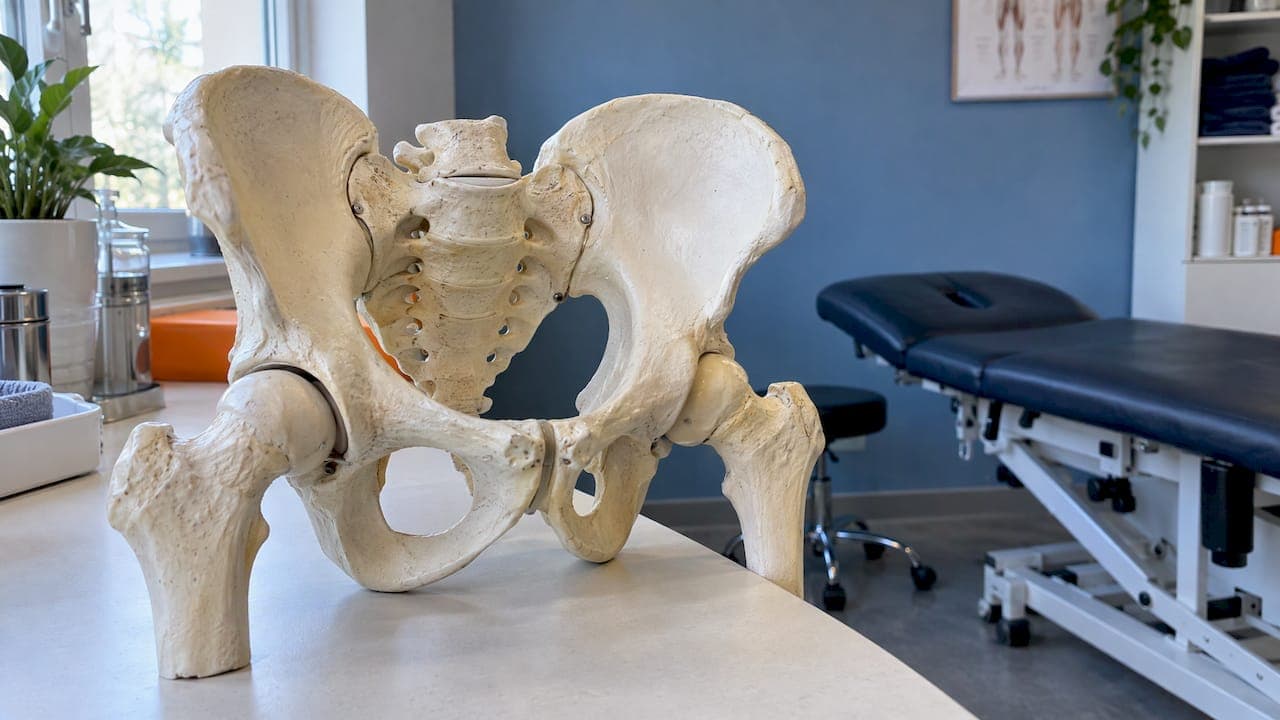
Sacroiliac joint pain comes from the joints that link the base of your spine to your pelvis. It is usually felt low in the back and buttock, and it can spread into the groin, hip or back of the leg. It is often mistaken for a hip, lower back or sciatic problem, which is why a careful hands-on assessment matters. Many people manage it with activity changes, targeted exercise and physiotherapy, and this guide explains how to tell what is going on and what to do next.
TL;DR
- The sacroiliac (SI) joints sit between the sacrum and the pelvis. Pain is usually low in the back or buttock and can travel into the groin and leg.
- SI joint pain looks very like hip, lumbar spine and sciatic problems, so diagnosis relies on a clinical assessment rather than a single test.
- Changing position often, avoiding long spells of sitting or standing, and keeping gently active are sensible first steps.
- See your GP or call NHS 111 if pain has not improved after a few weeks. Go to A&E for numbness around the genitals or anus, or changes in bladder or bowel control.
- Physiotherapy at our Bedfordshire and Buckinghamshire clinics starts with an assessment, priced at £76.
Table of Contents
- What the sacroiliac joints are and what they do
- Where sacroiliac joint pain is felt
- What can cause it
- How sacroiliac joint pain is diagnosed
- Everyday changes that may ease the pain
- Physiotherapy and other treatment options
- Our perspective
- Pregnancy and the months after birth
- When to get medical advice
- Book an assessment
- FAQ
- Sources
What the sacroiliac joints are and what they do
You have two sacroiliac joints, one on each side of the lower back. Each sits between the triangular sacrum at the base of the spine and an iliac bone of the pelvis. According to a British Association of Spinal Surgeons patient leaflet hosted by an NHS foundation trust, the joints act as shock absorbers and pass the load of the upper body down to the legs.
That job explains why they can become sore. They carry your weight when you stand, walk, climb stairs and turn over in bed. They are built for small amounts of movement, and trouble tends to start when they move too much, too little, or become irritated or injured.
The same leaflet describes SI joint pain as pain that may be felt directly over the joint and lower back, and may also travel behind the hips, into the groins and down the backs of the legs.
Where sacroiliac joint pain is felt
The typical picture is a one-sided ache low in the back, just beside the base of the spine, with a deeper ache in the buttock. A 2024 review in Pain Practice reports that SI joint pain is generally felt below the L5 level of the spine in the gluteal region, and that referred pain can also appear in the lower back, groin, upper back, abdomen or lower limb.
People often describe it in these ways:
- A deep ache on one side of the lower back or buttock.
- Pain that eases when walking but flares when standing still, or the other way round.
- Discomfort getting up from a chair, turning in bed or climbing stairs.
- Pain into the groin, hip or back of the thigh.
Tingling, numbness and leg symptoms
A common question is whether the SI joint can cause tingling. Neurosurgery guidance from Weill Cornell lists pain in the back, buttocks, groin, hips, legs or feet, along with tingling, numbness or a feeling that the knee is buckling. It notes that these symptoms can mimic sciatica, which is pain caused by compression or irritation of the sciatic nerve.
This overlap is the main reason people are unsure what they have. If your leg pain is sharp, follows a line down the leg and comes with pins and needles, our guide on how physiotherapy helps with sciatica explains how that problem is assessed and treated. Persistent weakness or numbness in the leg always needs medical review.
What can cause it
The British Association of Spinal Surgeons leaflet describes three broad routes to SI joint pain: the joint becomes inflamed through cartilage wear and arthritis, it moves abnormally (too much or too little), or it is injured. In practice, people tend to link their pain to something like:
- A fall onto the buttocks or a sudden twisting movement.
- Repetitive loading on one leg, such as running, or lifting and twisting at work.
- Pregnancy and the months after birth, when ligaments around the pelvis change.
- Differences in how the hips, spine or legs share load, for example after hip or spinal problems.
- Inflammatory conditions of the spine. Pain that is worse after rest and eases with movement is worth mentioning to your GP.
Often there is no single clear cause, and that is normal. Treatment does not depend on finding one dramatic event.
How sacroiliac joint pain is diagnosed
Diagnosis is not straightforward. A 2025 NHS commissioning policy on spinal pain says SI joint pain is difficult to diagnose and often misdiagnosed as back or hip pain. It recommends starting with four clinical tests: the Gillet test, standing forward flexion, sitting forward flexion and supine-to-sit. The British Association of Spinal Surgeons guidance makes the same point, that the pain can be mistaken for a hip joint or lumbar spine problem because it can be so similar.
What this means for you:
- A history matters. Where the pain sits, what provokes it and what eases it all help separate SI joint pain from a hip or lumbar spine source.
- Hands-on testing matters. A physiotherapist can combine movement and position tests to see whether your pattern points to the SI joint.
- Scans are not always the answer. If your clinician thinks imaging would help, we can provide an image assessment and a referral letter, and review the results with you afterwards.
If your symptoms are mainly around the outer hip, the cause may be a tendon rather than the joint. Our gluteal tendinopathy programme and guide to physiotherapy for hip pain cover that overlap.
Everyday changes that may ease the pain
You do not need to stop moving. The usual advice for pelvic joint pain is to avoid staying in one position too long. NHS pelvic health guidance from DynamicHealth suggests avoiding prolonged sitting or standing, changing position often, using cushions or pillows for comfort, managing posture during daily tasks, and using heat or ice on painful areas. That page is written for pregnancy, but the practical principles apply to many people with pelvic joint pain.

What is the best way to sit?
There is no single perfect posture, and the best one is the one you change. Some practical ideas:
- Sit with both feet flat and your weight shared evenly across both buttocks, rather than perched on one side.
- Avoid crossing your legs or tucking one foot under you for long periods.
- Place a small cushion or rolled towel behind your lower back if it feels supported.
- Stand up and walk for a minute or two regularly, rather than waiting for the pain to build.
In bed and on your feet
A pillow between the knees when lying on your side can make nights more comfortable. When getting out of bed or a car, keep your knees together and turn as one unit instead of swinging one leg out. Try to share weight evenly between both legs when standing, and avoid carrying heavy bags on one side.
Body weight and the menstrual cycle
People often ask whether losing weight helps and whether periods affect SI joint pain. We could not find an NHS or other authoritative UK source that answers either question directly for this joint, so we would rather not guess. If you notice your pain changes across your cycle, make a note of it and tell your physiotherapist or GP, as it helps them build the picture.
Physiotherapy and other treatment options
Most people start with conservative care. Mayo Clinic notes that treatment often includes exercises and over-the-counter anti-inflammatory pain relievers. Check with a pharmacist or your GP that such medicines are suitable for you.
What physiotherapy involves
At our clinics, a physiotherapy assessment looks at how your pelvis, lower back, hips and legs work together. Treatment is built around your findings and may include:
- Hands-on techniques to ease stiff or sore areas.
- Exercises for the hips, glutes and deep trunk muscles, so the pelvis is better supported.
- Advice on sitting, lifting, sleeping and returning to sport or work.
- A graded plan to build activity back up.
Pilates can be a useful bridge between treatment and long-term strength. We run group and one-to-one Pilates sessions, and our lower back pain exercises give a starting routine you can try between appointments.
If your pain comes from an inflammatory spinal condition such as axial spondyloarthritis, an NHS trust leaflet describes exercise as the single most important thing you can do for yourself, and says it should be regular, consistent and kept up long term. That consistency is a good principle for most SI joint rehabilitation.
When injections or other procedures are considered
If pain stays significant despite good rehabilitation, a specialist may consider further options. The NHS policy above says steroid and local anaesthetic injections into the SI joint may assist diagnosis and allow physiotherapy, and that radiofrequency denervation is supported after diagnostic injections. The British Association of Spinal Surgeons leaflet says the benefit of injections varies and can last weeks, months or years, and that specialist pain-clinic assessment may be considered if symptoms have not improved after six weeks.
After an injection, a Dudley Group NHS leaflet advises increasing activity gradually and waiting before starting new exercises until your muscles have had time to adapt. Follow the advice from the team who treated you.

For chronic SI joint pain with a confirmed diagnosis, where non-surgical management has not controlled it, NICE guidance on iFuse sets out when that fusion procedure is an option. This is a specialist decision made after clinical assessment and a positive response to a diagnostic injection.
Our perspective
Sacroiliac joint pain is a good example of why a thorough first appointment matters. The symptoms overlap with hip, lower back and sciatic problems, and treating the wrong area wastes weeks.
Our multidisciplinary team has treated musculoskeletal problems since 1986, and that breadth is useful here. A physiotherapist can assess the pelvis, spine and hip together, and where it helps, we can arrange imaging referrals, Pilates for strength and control, or acupuncture or sports massage alongside treatment.
Our approach is to explain what we find in plain words, give you exercises you can do at home, and review progress with you. We aim for you to understand your pain and feel in control of it, not simply to settle a flare-up.
Ivan
Pregnancy and the months after birth
The pelvic joints are under extra strain during and after pregnancy, and many women meet SI joint or wider pelvic girdle pain at that time. Our pelvic girdle pain exercises for every trimester were written with physiotherapist input. After birth, steady rebuilding of the deep trunk muscles is part of recovery, and this guide to postpartum core strengthening shows how to progress gradually week by week.
If pregnancy-related pain is stopping you walking, sleeping or caring for your family, tell your midwife or GP, and book an assessment with a physiotherapist.
When to get medical advice
The NHS back pain page gives clear thresholds. Speak to your GP or call NHS 111 if:
- Pain has not improved after a few weeks of home treatment.
- It limits your daily activities or is causing you concern.
- It is severe, or getting worse quickly.
- It followed unexplained weight loss, or you notice a lump or a change in the shape of your back.
- It is worse at night, or when coughing, sneezing or opening your bowels.
- It is in the upper back rather than the lower back.
Call 999 or go to A&E for numbness or weakness in both legs, numbness around the genitals or anus, changes in bladder or bowel control, changes in sexual function, chest pain, or pain after a serious accident.
Book an assessment
If your pain has lasted more than a couple of weeks, or keeps coming back, a physiotherapy assessment is the clearest next step. At our Bedfordshire and Buckinghamshire clinics, a physiotherapy assessment costs £76 and follow-up physiotherapy treatment is £67 per session. A double-length assessment is £102 and a double treatment is £77. We accept private payment and health insurance. See the full price list and booking options.

If your clinician advises imaging, an image assessment is £76, an image referral letter is £10 and an image results review is £67. Pilates group classes are £9 each and one-to-one Pilates is £50 a class.
FAQ
Can sacroiliac joint pain heal on its own?
Some episodes settle without treatment, especially if the trigger was a minor strain. A Cleveland Clinic page suggests having pain near the SI joint assessed if it does not get better within a week. If your pain lingers, keeps returning or limits work, sleep or exercise, an assessment gives you a plan rather than leaving you waiting.
Can the sacroiliac joint cause tingling in the leg?
It can. Tingling, numbness and a buckling feeling in the knee have all been described with SI joint dysfunction, and they can mimic sciatica. Because nerve symptoms have several possible sources, have them assessed. Numbness around the genitals or anus, or bladder or bowel changes, are emergencies.
How do I tell sacroiliac joint pain from hip pain?
The two are easily confused, and NHS guidance notes that SI joint pain is often misdiagnosed as back or hip pain. Pain low beside the spine and in the buttock points towards the SI joint, while pain deep in the groin may point to the hip. Only a clinical assessment can separate them reliably.
When should I see a physiotherapist rather than my GP?
You can book a private physiotherapy assessment directly, without a referral. Go to your GP or NHS 111 first if your pain is severe, rapidly worsening, follows unexplained weight loss or comes with other symptoms listed on the NHS back pain page.
Sources
- British Association of Spinal Surgeons sacro-iliac joint pain leaflet (Fylde Coast NHS Foundation Trust)
- Symptoms of Sacroiliac Joint Dysfunction (Weill Cornell Neurological Surgery)
- Sacroiliac joint pain, Pain Practice, 2024
- NHS spinal pain commissioning policy, SIJ and cervical
- Pelvic girdle pain in pregnancy (DynamicHealth NHS)
- Sacroiliitis diagnosis and treatment (Mayo Clinic)
- Axial spondyloarthritis advice and exercises (East Suffolk and North Essex NHS Foundation Trust)
- Sacroiliac joint injections (The Dudley Group NHS Foundation Trust)
- iFuse for treating chronic sacroiliac joint pain (NICE)
- Back pain (NHS)
- Postpartum core strengthening guide