

TL;DR:
- Multidisciplinary teams improve back rehabilitation outcomes by addressing physical, psychological, and social factors simultaneously. Early, coordinated care significantly enhances long-term recovery and functional gains. Patient active participation and clear communication with the team boost rehabilitation success and help prevent relapse.
A multidisciplinary team (MDT) in back rehabilitation is defined as a coordinated group of healthcare professionals who address the physical, psychological, and social factors that drive recovery. The role of multidisciplinary teams in back rehabilitation is now considered the clinical standard for complex and chronic back conditions, replacing the older biomedical model that treated pain as a purely physical problem. Teams typically include physiotherapists, psychologists, occupational therapists, social workers, and vocational specialists. Structured MDT care improves 12-month functional recovery scores by 44% compared to non-structured care. That figure alone explains why coordinated, timely rehabilitation has become the benchmark for spinal recovery.

What are the core roles within a multidisciplinary back rehabilitation team?
Multidisciplinary teams address the complex interaction of physical, emotional, and social factors that single-discipline care cannot resolve alone. Each professional brings a distinct contribution, and the overlap between roles is where real recovery happens.
- Physiotherapist. The physiotherapist leads physical recovery through graded exercise programmes, manual therapy, and movement retraining. Their work rebuilds strength, restores mobility, and teaches you how to manage flare-ups independently.
- Psychologist or pain counsellor. Mental health screening and psychological interventions are now core components of pain management. Psychologists address fear-avoidance beliefs, catastrophising, and the anxiety that often makes pain feel worse than it is.
- Occupational therapist. The occupational therapist focuses on your ability to perform daily tasks and return to work. They assess your environment, recommend adaptations, and design activity programmes that fit your real life.
- Social worker. Social workers bridge the gap between medical treatment and functional living. They identify housing, financial, or family pressures that slow recovery and connect you with practical support.
- Vocational specialist. Vocational experts address occupational and environmental factors that affect long-term quality of life, particularly for patients whose back condition has interrupted their employment.
Communication between these roles is not optional. Without it, you receive five separate opinions rather than one coherent plan.
Pro Tip: Ask your team at the first appointment who your key contact is. Knowing which professional coordinates your plan prevents confusion and keeps your care moving forward.
How does the team approach improve back rehabilitation outcomes?
The evidence for collaborative care in back rehab is direct and consistent. Integrating physiotherapy and psychological support produces clinically significant improvements in pain intensity, anxiety, and health-related quality of life for patients with chronic low back pain. That combination works because pain is never purely physical. Stress, sleep, and mood all amplify the signals your nervous system sends.
Timing matters as much as team composition. Each week of delay in starting multidisciplinary rehabilitation negatively impacts long-term recovery outcomes. The sooner coordinated care begins, the greater the functional improvement you can expect. This is why early intervention in back recovery is now a clinical priority rather than a preference.
The table below summarises the key outcome differences between structured MDT care and non-structured single-discipline care.
| Outcome area | Structured MDT care | Non-structured care |
|---|---|---|
| Functional recovery score | 44% improvement at 12 months | Significantly lower gains |
| Pain intensity | Clinically significant reduction | Modest or inconsistent reduction |
| Mental health | Anxiety and mood addressed directly | Rarely assessed or treated |
| Work participation | Vocational integration supported | Often not addressed |
| Relapse prevention | Skills transferred to daily life | Limited self-management support |
The biopsychosocial model underpins all of this. It treats your back condition as the product of physical damage, psychological response, and social context working together. A team approach is the only practical way to address all three at once.
"Successful rehabilitation extends beyond physical treatment to psychosocial adaptation. The transition from clinical care to self-management is the most critical phase for preventing relapse and sustaining improvements."
Role of Structured Multidisciplinary Rehabilitation in Optimizing Functional Recovery
What is the difference between multidisciplinary and interdisciplinary care?
The terms are often used interchangeably, but the distinction matters for your recovery experience. Understanding it helps you ask better questions and engage more effectively with your team.
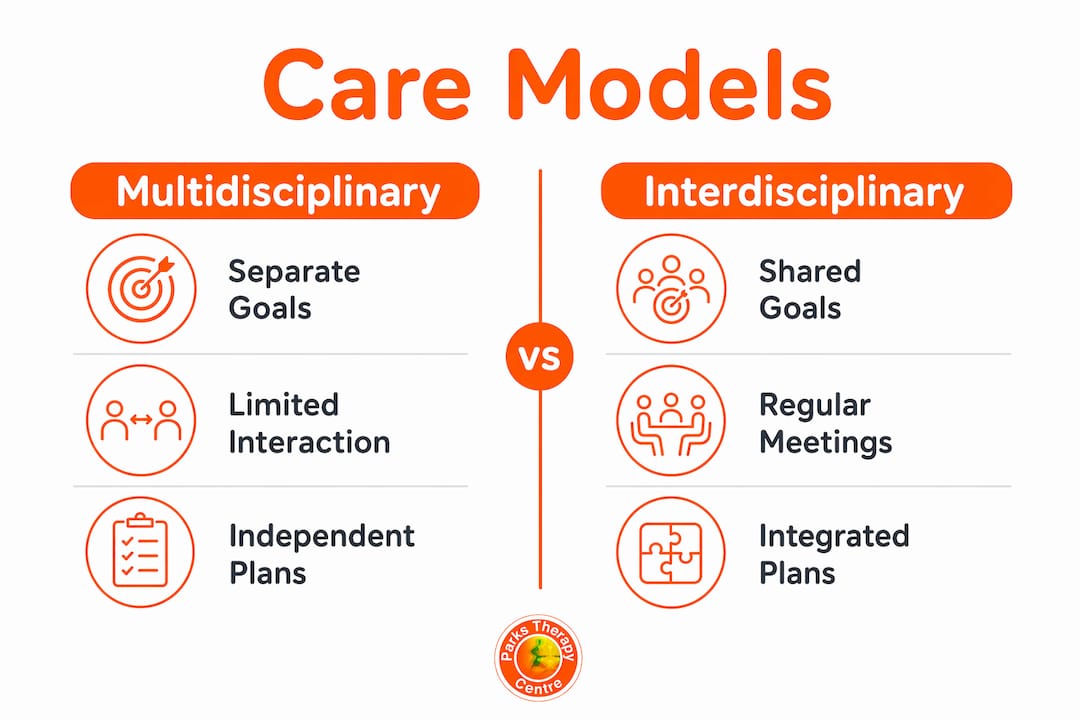
A multidisciplinary approach means each professional assesses and treats you independently. They may share notes, but they set their own goals and work largely in parallel. You might see a physiotherapist on Monday and a psychologist on Wednesday, with little formal coordination between the two sessions.
An interdisciplinary approach means the team meets regularly, sets shared goals, and adjusts the overall plan together. Your physiotherapy targets and your psychological coping strategies are designed to reinforce each other. Interdisciplinary models reduce fragmentation and duplication of effort, which is particularly important for complex or long-standing back conditions.
| Feature | Multidisciplinary | Interdisciplinary |
|---|---|---|
| Goal setting | Each discipline sets own goals | Shared goals agreed by the whole team |
| Communication | Periodic, often written | Regular joint meetings |
| Care coordination | Parallel, limited overlap | Integrated, actively coordinated |
| Best suited for | Straightforward presentations | Complex or chronic conditions |
| Patient experience | Multiple separate appointments | Cohesive, joined-up plan |
For patients with chronic back pain, a history of failed treatments, or significant psychological involvement, interdisciplinary care consistently delivers better results. Interdisciplinary case management produces significant improvements in body functions, daily activities, and life roles. That breadth of improvement is difficult to achieve when professionals work in silos.
Pro Tip: When you start a new rehabilitation programme, ask whether the team holds joint case reviews. If they do, you are in an interdisciplinary model. If not, request a single written summary that all your clinicians have agreed on.
How can you actively participate in your back rehabilitation?
Your engagement is not a passive courtesy to the team. It is a clinical variable that directly affects your outcome. Patient and family involvement in rehabilitation is essential for maintaining progress and preventing relapse once formal treatment ends. The skills you practise during sessions only transfer to daily life if you apply them consistently outside the clinic.
Here are the most effective ways to take an active role in your recovery.
- Attend every scheduled appointment. Gaps in attendance break the momentum of graded exercise and psychological work. If you must cancel, rebook within 48 hours.
- Write down your goals before each session. Arriving with a specific question or target keeps your appointments focused and helps the team adjust your plan accurately.
- Communicate changes in your symptoms honestly. Telling your physiotherapist that an exercise causes sharp pain is not a complaint. It is clinical information that prevents setbacks.
- Apply self-management strategies daily. Breathing techniques, pacing strategies, and movement habits practised between sessions reinforce the neurological and psychological changes your team is working to create.
- Involve a trusted family member or carer. Engaging family members consistently throughout rehabilitation strengthens the support network that sustains your progress at home.
- Use digital tools for tracking. Symptom diaries, step counters, and pain journals give your team objective data between appointments. They also help you notice gradual improvements that are easy to overlook day to day.
- Plan for the transition out of formal care. The period when structured sessions end is the highest-risk phase for relapse. Work with your team to build a written self-management plan before your final appointment.
The biopsychosocial model in physiotherapy frames your recovery as a collaboration between you and your clinicians, not something done to you. That shift in perspective is often the single most powerful change a patient can make.
Key takeaways
Multidisciplinary teams in back rehabilitation produce measurably better outcomes than single-discipline care because they address physical, psychological, and social recovery simultaneously.
| Point | Details |
|---|---|
| MDT care improves recovery | Structured MDT programmes improve 12-month functional recovery scores by 44% compared to non-structured care. |
| Start early | Each week of delay in beginning coordinated rehabilitation reduces long-term functional improvement. |
| Know your team's model | Interdisciplinary care, with shared goals and joint reviews, outperforms parallel multidisciplinary working for complex cases. |
| Active participation matters | Patient engagement and daily self-management are clinical variables, not optional extras. |
| Transition planning prevents relapse | The move from formal care to self-management is the highest-risk phase and requires a written plan. |
Why I think most patients underestimate what a good MDT can do
The shift from biomedical to biopsychosocial care is the most significant change in back rehabilitation in a generation. Yet most patients I speak with still arrive expecting a physiotherapist to "fix" their back, as if it were a mechanical fault. That expectation sets them up for frustration.
What I have observed consistently is that the patients who recover best are not the ones with the least severe injuries. They are the ones who understand that their pain has multiple drivers and who engage with every member of their team accordingly. A psychologist is not a sign that your pain is "in your head." A social worker is not a sign that your case is hopeless. Both are signs that your team is taking your recovery seriously.
The biggest practical challenge I see is communication breakdown within teams. When professionals do not share a common language or a shared record, patients fall through the gaps. If you ever feel that your left hand does not know what your right hand is doing, say so directly. Ask for a joint summary. That single request can reset the entire dynamic.
Early, coordinated care is not a luxury. The evidence is clear that delay costs you functional capacity you may not recover. If you are waiting to see whether your back "sorts itself out," the data suggests that waiting is itself a clinical decision with consequences.
— Ivan
Back rehabilitation support at Parkstherapycentre
Parkstherapycentre has provided patient-centred, multidisciplinary therapy approaches across Bedfordshire and Buckinghamshire since 1986. The centre brings together physiotherapists, sports injury specialists, acupuncturists, and podiatrists under one roof, with a shared commitment to coordinated care for musculoskeletal conditions including chronic and acute back pain.
Whether you are recovering from a back injury, managing a long-term spinal condition, or looking for a structured rehabilitation plan, Parkstherapycentre offers personalised assessments and evidence-based treatment programmes. The team accepts most major insurance providers and offers online booking for your convenience. Visit Parkstherapycentre to book your initial assessment and find out which specialists are right for your recovery.
FAQ
What professionals are typically in a back rehabilitation MDT?
A back rehabilitation MDT typically includes physiotherapists, psychologists, occupational therapists, social workers, and vocational specialists. The exact composition depends on the complexity of your condition and the setting.
How much better are MDT outcomes compared to single-discipline care?
Structured multidisciplinary rehabilitation improves functional recovery scores by 44% at 12 months compared to non-structured care. That improvement spans physical function, pain levels, and mental health.
Does it matter how quickly I start multidisciplinary rehabilitation?
Yes. Each week of delay in starting coordinated care measurably reduces your long-term recovery potential. Early referral to a structured programme produces significantly better outcomes than waiting.
What is the difference between multidisciplinary and interdisciplinary rehabilitation?
Multidisciplinary teams work in parallel with limited coordination, while interdisciplinary teams set shared goals and hold regular joint reviews. Interdisciplinary care is more effective for complex or chronic back conditions.
How can I get the most from my rehabilitation team?
Attend every appointment, communicate symptom changes honestly, practise self-management strategies daily, and plan your transition out of formal care before your final session. Patient engagement is a direct predictor of long-term recovery success.