

TL;DR:
- Physiotherapy assessments involve a structured conversation, physical testing, movement analysis, and goal setting to accurately identify underlying issues. They include screening for serious conditions, functional tests like the single-leg sit-to-stand, and active patient input to tailor effective treatment plans. Proper assessment is essential for tracking progress, preventing re-injury, and achieving faster recovery aligned with personal goals.
Most people walking into their first physiotherapy session assume the therapist will press on a sore spot, identify the problem, and hand over a set of exercises. The reality is far richer than that. A physiotherapy assessment explained properly looks more like a structured conversation combined with careful physical testing, functional movement analysis, and shared goal setting. Understanding how physiotherapy assessments work before you arrive means you can give more useful information, ask better questions, and make genuinely informed decisions about your treatment.
Table of Contents
- Key takeaways
- What happens in a physiotherapy assessment
- Functional tests and what they actually reveal
- How your input shapes the treatment plan
- Why assessment matters for your recovery
- My honest perspective on physiotherapy assessments
- Start with a proper assessment at Parkstherapycentre
- FAQ
Key takeaways
| Point | Details |
|---|---|
| It's more than finding pain | Assessments cover your history, movement quality, strength, and personal goals, not just the site of pain. |
| Red flags are screened first | Your physiotherapist checks for serious conditions requiring urgent referral before any hands-on treatment begins. |
| Functional tests reveal hidden faults | Tests like the single-leg sit-to-stand expose movement problems invisible in static or isolated strength tests. |
| Your goals shape treatment | Sharing specific aims, such as returning to running, allows your physiotherapist to personalise your plan. |
| Active participation speeds recovery | Patients who engage openly with the assessment process tend to see better and faster outcomes. |
What happens in a physiotherapy assessment
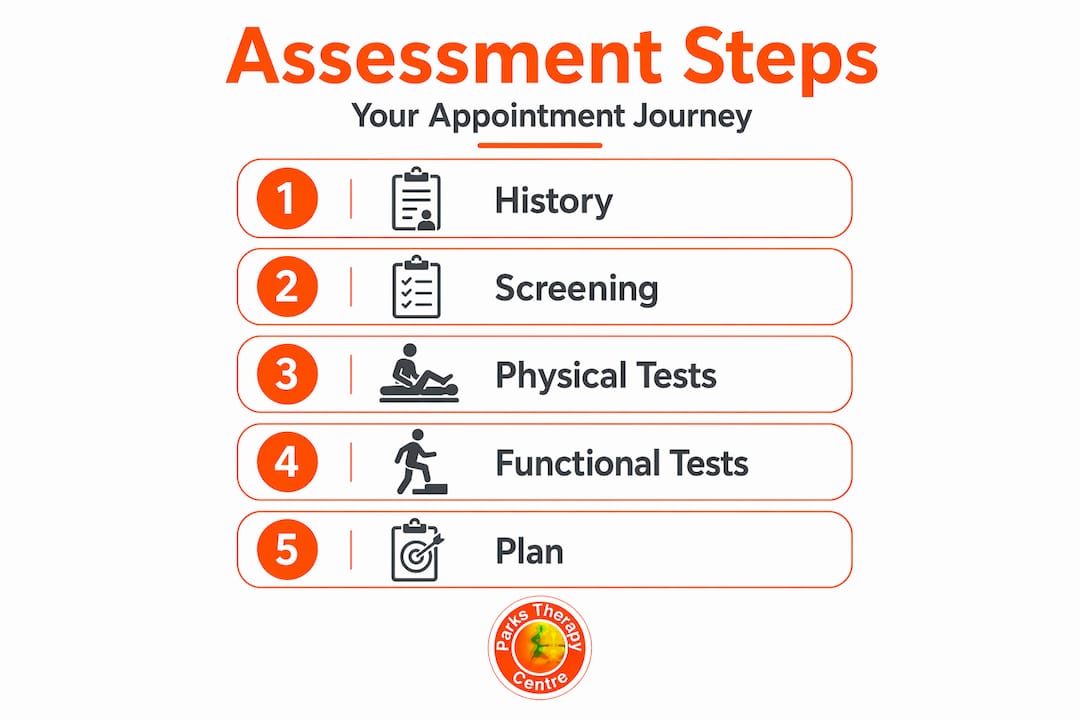
The physiotherapy evaluation process follows a clear sequence, though it rarely feels mechanical. Your physiotherapist moves between listening and testing, building a picture of not just where you hurt but why you hurt.
The session typically opens with a subjective assessment. This is where your therapist gathers your history: when the problem started, what makes it worse or better, how it affects your daily life. Alongside this, they explore what physiotherapists call ICE, which stands for your Ideas, Concerns, and Expectations. Do you have a theory about what has gone wrong? Is there something specific you are worried about? What are you hoping treatment will achieve? These questions are not small talk. Assessment incorporates patient ICE to make treatment genuinely tailored rather than generic.
Next comes the objective assessment, which is the hands-on, movement-based portion of the session. This includes:
- Observation: how you sit, stand, and move before any formal testing begins
- Palpation: feeling the tissue around the affected area for tenderness, muscle tone, or swelling
- Range of motion: measuring how far a joint moves compared to expected norms
- Strength testing: checking isolated muscle groups for weakness or inhibition
- Special tests: specific clinical tests that help confirm or rule out particular diagnoses, such as the Hawkins Kennedy test for shoulder impingement or the Slump test for neural tension
Assessment includes pain history and physical tests as standard, but what separates a thorough assessment from a brief one is the layer of functional and movement analysis that comes next.
A critical but often overlooked component is red flag screening. Before treatment starts, your physiotherapist asks about symptoms that might indicate something more serious than a musculoskeletal injury. Red flag symptoms such as night pain or sudden neurological changes require urgent attention and may prompt an immediate referral rather than continued physiotherapy. This screening protects you, not delays you.
Functional tests and what they actually reveal
Isolated strength tests have their place, but they tell an incomplete story. A muscle can test strong when you are lying on a couch and still fail completely when your body is upright, loaded, and moving. That is exactly why functional tests reveal neuromuscular coordination under real conditions, rather than in artificially simplified positions.
Two tests come up repeatedly in musculoskeletal and injury assessments.
| Test | What it measures | What it reveals |
|---|---|---|
| Single-leg sit-to-stand | Lower-limb strength, pelvic control, knee stability | Dynamic valgus, pelvic drop, trunk compensation |
| Timed Up and Go (TUG) | Mobility, balance, and functional independence | Phase durations, gait quality, fall risk indicators |
The single-leg sit-to-stand test is particularly illuminating. The test takes less than one minute to perform and requires no special equipment, yet it gives your physiotherapist a live view of glute control, knee alignment, and how well your pelvis stays level during load. The most frequently observed fault is dynamic valgus, where the knee drifts inward under bodyweight. This single movement fault is linked to knee pain, hip pain, and lower back problems, often all at once.

The Timed Up and Go test works differently. You stand up from a chair, walk three metres, turn, walk back, and sit down. Simple as that sounds, the TUG test measures functional performance across healthy, older, and neurological populations with real clinical precision. Therapists measure not just the total time but individual phase durations, which can pinpoint whether the issue is in rising, walking, or turning.
Pro Tip: Before your assessment, practise standing on one leg for 10 seconds. If you cannot do it without significant sway or your knee collapsing inward, make a note of this to mention. It gives your physiotherapist a useful starting reference and often confirms what functional testing reveals.
What these tests share is their ability to expose compensation patterns. You can read more about how physiotherapy tools are used across recovery phases once the assessment has established your baseline.
How your input shapes the treatment plan
Here is something patients consistently underestimate: your words matter as much as your test results. The physiotherapy assessment is designed to be a two-way process, and the quality of your treatment plan depends significantly on what you share.
The ICE framework gives you a specific way to contribute. When your therapist asks what you think might be causing your problem, answering honestly is far more useful than saying "I don't know." Even if you are wrong, your ideas shape the conversation and help the therapist correct misunderstandings early. When they ask about your concerns, sharing something like "I am worried this is something structural" or "I am scared to move it in case I make it worse" gives the therapist crucial information about your mental model of the injury.
Expectations are where treatment plans live or fail. Specific goals enable better personalised planning than vague aims like "I just want less pain." Compare these two examples:
- "I want to be able to run a 5k by September without knee pain" gives your physiotherapist a timeline, a load target, and a specific movement to build towards.
- "I just want my knee to feel better" gives very little to build a structured programme around.
The difference is not about effort or motivation. It is about specificity. Stating specific aims helps physiotherapists tailor exercise programmes and set realistic expectations from day one.
Pro Tip: Write down your top three goals before your appointment, along with any activities you have stopped doing because of your injury. This takes five minutes and often produces the most useful ten minutes of the session.
If you want to walk in already prepared, the Parkstherapycentre guide on preparing for physiotherapy sessions covers exactly what to bring and expect beforehand.
Why assessment matters for your recovery
Understanding the role of clinical assessment in physiotherapy goes well beyond satisfying curiosity. It directly affects how well your treatment works and how quickly you recover. Here is why the physiotherapy evaluation process is foundational rather than optional:
-
It identifies the actual cause, not just the symptoms. Pain is often referred or compensatory. A sore knee may originate from a hip that is not loading properly. Without thorough assessment, treatment chases the symptom rather than the source.
-
It provides an evidence-based starting point. Every exercise, manual technique, or programme recommended by your physiotherapist should be traceable back to something found in the assessment. Without that baseline, treatment is guesswork.
-
It allows your progress to be tracked objectively. When the single-leg sit-to-stand or range of motion is measured at assessment, it becomes a benchmark. Your therapist can repeat the same test at four weeks and show you, in concrete terms, what has changed.
-
It protects you from treatments that are not suitable. The importance of physiotherapy assessment lies partly in what it rules out. Not every shoulder pain is safe to mobilise aggressively. Not every lower back pain is appropriate for heavy loading. Assessment makes these distinctions.
-
It empowers you as a patient. When you understand the assessment findings, you can engage more actively with your rehabilitation. You are not just following instructions. You are working towards a goal that makes sense to you because it was set based on your own body and your own priorities.
The step-by-step physiotherapy recovery guide from Parkstherapycentre expands on how assessment findings translate into structured, phased recovery programmes.
My honest perspective on physiotherapy assessments
I have seen a significant number of patients come in frustrated because previous treatment "did not work." In most cases, when you dig into what happened, the assessment was either rushed or one-directional. The therapist tested things, wrote notes, and handed over a programme. No real dialogue about goals, no exploration of the patient's beliefs about their injury, and no meaningful baseline to measure progress against.
Assessment is not a formality before the real treatment starts. It is the treatment starting. Everything that follows depends on the quality of what is gathered here. When patients understand this, they show up differently. They bring notes, ask questions, and push back when something does not make sense. That engagement, in my experience, is one of the strongest predictors of recovery.
I also think there is a common misconception that raising concerns during assessment is somehow being difficult. The opposite is true. A physiotherapist who hears that you are anxious about movement, or that you have had a previous bad experience, can adjust their approach from the first session. Withholding that information just delays getting the care you actually need.
The other thing worth saying plainly: early functional assessment prevents a lot of suffering down the line. People who get assessed properly at the beginning of an injury tend to avoid the cycle of partial recovery, re-injury, and frustration. The assessment is your map. Going without it is not brave. It is just slower.
— Ivan
Start with a proper assessment at Parkstherapycentre

If this has helped clarify what to expect, the natural next step is booking an assessment with people who take it seriously. Parkstherapycentre has been delivering professional physiotherapy across Bedfordshire and Buckinghamshire since 1986, with a team qualified to assess everything from sports injuries and musculoskeletal pain to post-surgical recovery. Every initial consultation includes the full assessment process described here, carried out by chartered physiotherapists who treat you as an individual, not a diagnosis. Insurance cover is accepted, online booking is available, and you can have your first appointment confirmed within minutes. Visit Parkstherapycentre to book your initial physiotherapy assessment today.
FAQ
What happens in a first physiotherapy assessment?
Your physiotherapist takes a full history of your problem, assesses your movement and strength through physical tests, screens for serious conditions using a red flags checklist, and discusses your goals for treatment. The session typically lasts between 45 minutes and one hour.
Why is the physiotherapy assessment so important?
Assessment identifies the underlying cause of pain or movement dysfunction rather than just the symptoms. It creates a measurable baseline so that progress can be tracked and treatment adjusted based on real data rather than guesswork.
What are red flags in a physiotherapy assessment?
Red flags are symptoms requiring urgent attention such as sudden loss of bladder or bowel control, severe night pain, unexplained weight loss, or progressive neurological symptoms. When these are present, your physiotherapist will refer you appropriately rather than continuing with standard treatment.
What is the single-leg sit-to-stand test used for?
It assesses lower-limb strength, glute control, and knee stability under load. The test is widely used for injury screening and movement analysis because it reveals faults that do not appear in static or lying-down tests.
How should I prepare for my physiotherapy assessment?
Write down when your problem started, what makes it better or worse, and what specific activities you want to return to. The more clearly you can describe your goals, the more targeted and effective your treatment plan will be from the very first session.