
TL;DR:
- Small technique errors can hinder progress in Pilates, but targeted adjustments based on core principles can improve strength and posture. Mastering breathing, core engagement, and avoiding common mistakes like shoulder shrugging or arching the lower back enhances effectiveness. Consistent, mindful practice with professional guidance fosters sustainable improvements and injury prevention.
Recurring aches, frustrating plateaus, and the nagging feeling that your Pilates practice should be delivering more. These experiences are far more common than most people admit, and they rarely stem from a lack of effort. More often, they come from small but significant technique errors that accumulate over time. The good news is that targeted adjustments, grounded in the foundational principles of Pilates, can produce measurable improvements in strength, posture, and pain reduction. This guide walks you through everything from core principles to common mistakes, so you can practise smarter and feel the difference.
Table of Contents
- Understand the core Pilates principles
- Master breath, core engagement, and movement control
- Common Pilates mistakes and how to fix them
- Adapt, progress, and personalise your practice for better results
- See tangible results: evidence for consistent, mindful practice
- What most Pilates guides miss: mindset, patience, and progress over perfection
- Discover support for your Pilates journey
- Frequently asked questions
Key Takeaways
| Point | Details |
|---|---|
| Master core principles | The six Pilates principles—breath, concentration, control, centring, precision, and flow—drive real improvement. |
| Prioritise mindful movement | Focus on breath coordination and slow, controlled motion to prevent injuries and maximise benefits. |
| Adjust and progress safely | Use modifications, props, and gradual progression to support your body’s needs and long-term results. |
| Measure progress, not perfection | Track personal gains and enjoy the process instead of chasing flawless movements. |
Understand the core Pilates principles
Every Pilates session, whether on a mat or a reformer, is built on six foundational principles. Master the six core Pilates principles: breath, concentration, control, centring, precision, and flow. These are not abstract ideals. They are practical guides that shape every movement you make in class.
For a deeper breakdown, the Pilates principles explained resource from Complete Pilates offers clear definitions for each. Understanding these principles is also central to the role of Pilates in rehabilitation, where precise, mindful movement supports recovery and long-term wellbeing.
Here is what each principle means in practice:
- Breath: Drives movement and prevents tension from building
- Concentration: Keeps your mind fully engaged with each action
- Control: Ensures muscles, not momentum, do the work
- Centring: Anchors movement in the core or powerhouse
- Precision: Prioritises quality of form over quantity of repetitions
- Flow: Creates smooth, connected transitions between movements
The difference between following these principles and ignoring them is substantial:
| Approach | Outcome |
|---|---|
| Principles followed | Efficient activation, reduced injury risk, steady progress |
| Principles ignored | Compensatory patterns, strain, slower results |
| Partial application | Inconsistent gains, occasional discomfort |
"It is better to do five repetitions perfectly than ten sloppily. Quality of movement is the only currency that counts in Pilates."
When you treat these principles as a checklist at the start of every exercise rather than vague background theory, your body learns to move with intention. That shift alone can transform an average session into a genuinely effective one.
Master breath, core engagement, and movement control
Once you have clarified the six principles, focus on implementing them correctly with every repetition. This is where most practitioners either unlock significant gains or continue repeating the same patterns without progress.
Follow these steps to synchronise breath and movement effectively:
- Inhale through the nose to prepare for the movement
- Exhale through the mouth on the effort or exertion phase
- Maintain a steady rhythm rather than holding your breath
- Let the exhale drive abdominal activation naturally
- Check that your ribcage softens rather than flares with each breath
Coordinate breath with movement by inhaling to prepare and exhaling on exertion. This pattern is not a suggestion; it is what separates controlled movement from mere physical effort.
For core work, engage the core by drawing the belly button gently towards the spine while maintaining a neutral spine and using lateral breathing. Neutral spine means preserving the natural curves of your back without flattening or over-arching. Lateral breathing, where the ribcage expands sideways rather than the belly puffing forward, allows the deep core muscles to stay active throughout.

Learn more about how to engage your core from a Pilates-specific perspective to refine your technique further. This is especially relevant if you are exploring Pilates for lower back problems, where core engagement directly supports spinal stability.
Pro Tip: Use lateral breathing rather than belly breathing during exercises. Place your hands on the sides of your ribcage and feel it expand outward as you inhale. This keeps your core active and avoids the habit of bracing or holding your breath.
| Element | When applied correctly | When neglected |
|---|---|---|
| Breath timing | Fluid movement, better endurance | Tension, fatigue, poor activation |
| Core engagement | Spinal protection, strength gains | Lower back strain, poor posture |
| Neutral spine | Even muscle load, less pain | Compensation patterns, injury |
Common Pilates mistakes and how to fix them
Breath and control are crucial, but avoiding classic mistakes is just as essential for sustained improvement. Many practitioners repeat the same errors session after session without realising it, and those patterns quietly limit progress.
Here are the most frequent form errors and how to correct them:
- Shrugging the shoulders: A classic tension response. Draw shoulders away from your ears before and during every movement. Think of them as anchored down your back.
- Arching the lower back: Often caused by weak core engagement. Re-establish neutral spine before beginning any exercise.
- Straining the neck: Especially common in curl-up exercises. Support your head with your hands or a rolled towel if needed, and avoid pulling on the neck.
- Skipping the warm-up: Cold muscles respond poorly and increase injury risk. Common mistakes to avoid consistently include skipping preparation and cool-down phases.
- Comparing yourself to others: Pilates is not a competitive sport. Your range of motion, fitness level, and history are unique.
- Using momentum instead of control: If you are swinging limbs or rushing through reps, slow down and check that your muscles, not gravity, are doing the work.
- Over-gripping: Excessive tension in the hands, feet, or jaw is a sign you are working harder than necessary in the wrong places.
- Inconsistent practice: Sporadic sessions undo progress. Regularity matters far more than intensity.
For more on staying safe while training, the guides on sports injuries and safe training and physiotherapy tips for beginners offer practical context. You can also explore mistakes and fixes in Pilates from Saran Pilates for additional corrections.
"There is no perfect form, only progress. Each session is an opportunity to move with a little more intention than the last."
Pro Tip: Before each exercise, run a quick mental body scan. Check your shoulder position, jaw tension, lower back curve, and breath. Ten seconds of self-assessment prevents ten minutes of reinforcing a bad habit.
Adapt, progress, and personalise your practice for better results
Correcting mistakes is half the battle; the other is making Pilates sustainable and tailored to you. A practice that does not account for your body's current state will eventually produce frustration rather than results.
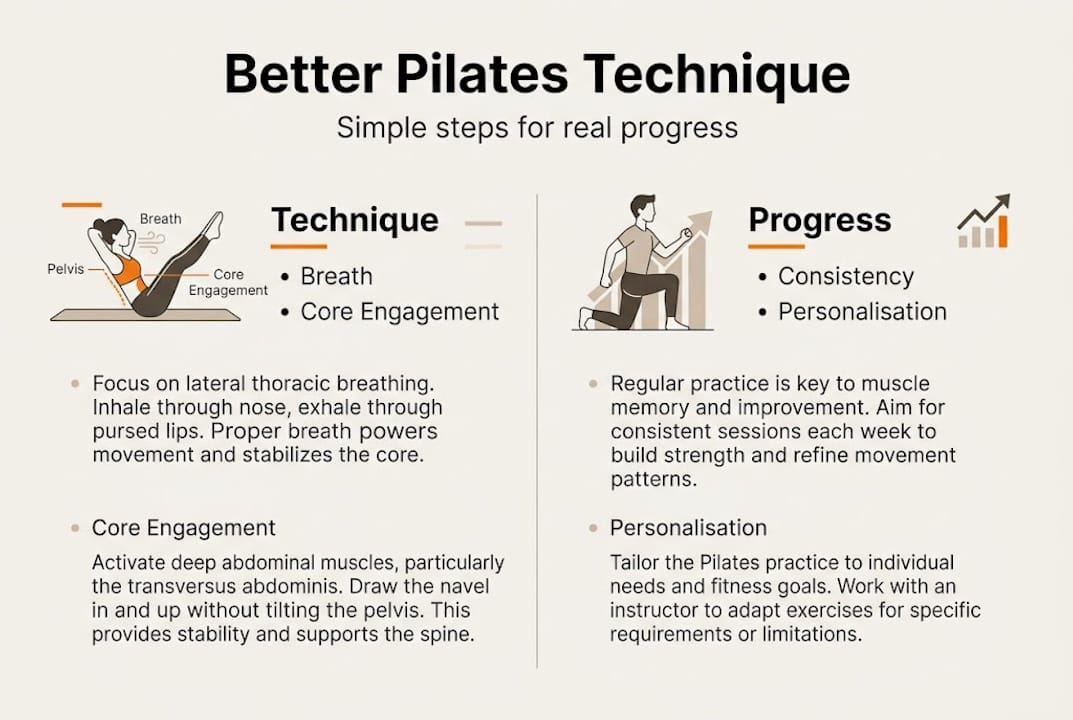
Use modifications and props for injuries or accessibility, and progress through guided steps for safety. Props such as resistance bands, foam rollers, Pilates rings, and cushions are not signs of weakness. They are intelligent tools that allow you to maintain correct form when your body is not yet ready for the full expression of a movement.
Here are steps to progress safely from beginner to more advanced work:
- Begin every new exercise with the simplified or supported version
- Practise that version until it feels easy and completely controlled
- Remove one support element at a time rather than jumping to the full move
- Add repetitions before adding difficulty or load
- Rest and reassess on days when fatigue, soreness, or discomfort is present
For a broader perspective on personal pacing and a limitless Pilates mindset, the Pilates Journal offers a thoughtful take on moving beyond comparison and self-imposed ceilings.
Useful props and adaptations to consider:
- Rolled towels under the head or pelvis for spinal support
- Resistance bands to assist or challenge arm and leg work
- Pilates rings (magic circles) for targeted inner thigh or arm engagement
- Soft balls for core and balance challenges
- Wall support for standing balance exercises
If you are recovering from an injury, the resources on Pilates for musculoskeletal recovery and injury prevention for active adults provide excellent grounding for a considered approach.
Pro Tip: Keep a brief practice journal. Note which exercises felt strong and which felt uncomfortable. Over time, patterns emerge that tell you far more about your progress than any single session can.
See tangible results: evidence for consistent, mindful practice
With your practice tailored and consistent, what measurable benefits can you actually expect? The research is encouraging. Pilates improves pain, disability, postural control, and function; practising two to three sessions per week for four to eight weeks reduces low back pain scores significantly.
For added context on what clinical practice reveals, the evidence-based physiotherapy results page from Parks Therapy Centre offers useful perspective.
You may also wonder whether classical vs contemporary Pilates is the right approach for your goals. Here is a simple comparison:
| Style | Key features | Best suited for |
|---|---|---|
| Classical Pilates | Fixed sequences, traditional apparatus, emphasis on flow | Those seeking foundational mastery |
| Contemporary Pilates | Adapted for rehab, modern biomechanics, greater flexibility | Rehabilitation, injury recovery, beginners |
Day-to-day, improvements tend to show up in ways that feel personal and cumulative:
- Less morning stiffness and lower back ache
- Improved posture during long periods of sitting or standing
- Greater confidence in movement and balance
- Reduced frequency of minor muscle strains
- A clearer sense of where your body is in space (proprioception)
These changes are not dramatic overnight shifts. They are the quiet, compounding result of consistent, mindful practice.
What most Pilates guides miss: mindset, patience, and progress over perfection
Here is something most technique guides will not tell you directly: there is no universally correct alignment. Every body is shaped differently, with structural variations in the hips, spine, and shoulders that mean one person's ideal neutral position looks quite different from another's. Chasing someone else's aesthetic form is one of the most common reasons practitioners plateau or develop new discomfort.
Real improvement in Pilates is iterative. It looks like small refinements built on feedback, not sudden perfect execution. That feedback matters enormously, which is why working with a qualified instructor, even occasionally, is worth far more than a hundred solo sessions spent guessing. This connects directly to the role of Pilates in rehabilitation, where professional guidance shapes recovery and prevents setbacks.
Self-compassion is not softness. It is the practical decision to stay consistent rather than burn out chasing an ideal that does not apply to your body. Long-term change, built through patience and intelligent practice, will always outperform short-term perfectionism.
Discover support for your Pilates journey
If you are ready to take your practice further or need guidance after an injury, expert support can make a significant difference. At Parks Therapy Centre, our multidisciplinary team has been helping people move better and recover safely since 1986.
Whether you are looking to deepen your technique, manage a musculoskeletal condition, or understand how rehabilitation with Pilates can support your recovery, we provide personalised assessments and programmes across our Bedfordshire and Buckinghamshire locations. Our physiotherapists and specialist practitioners work alongside your Pilates goals, not separately from them. Book online today and take the next step towards a stronger, more resilient practice.
Frequently asked questions
How do I know if I am doing Pilates correctly?
Correct Pilates technique feels controlled and pain-free, with engaged core muscles and comfortable, steady breathing. For genuine feedback, work with a certified instructor who can observe and correct your form in real time.
How often should I practise Pilates to see improvement?
Practising two to three times per week for four to eight weeks delivers measurable gains in pain reduction, function, and postural control for most people.
What are the main differences between classical and contemporary Pilates?
Classical Pilates uses fixed sequences with a focus on flow and mastery, while contemporary Pilates adapts movements for rehabilitation, modern biomechanics, and greater accessibility.
What should I do if a Pilates exercise feels uncomfortable or painful?
Stop immediately, reassess your alignment, and try a modification or prop to reduce demand. If discomfort continues, seek guidance from a qualified instructor or physiotherapist before continuing.
How can Pilates help with injury prevention and recovery?
By building strength, stability, and movement awareness, Pilates improves postural control and supports rehabilitation, reducing the risk of future injuries over time.
Recommended
- Understanding the role of Pilates in rehabilitation
- Discover how Pilates therapy aids musculoskeletal recovery
- Is Pilates good for lower back problems? Evidence & tips
- Pilates Classes | Parks Therapy Centre | Biggleswade, St Neots, Bedford, Milton Keynes
- Advanced swimming technique tips for peak performance – Peak Performance Swim Camp