

TL;DR:
- Choosing a physiotherapist involves verifying HCPC registration and MCSP chartered status.
- An effective initial appointment includes detailed history, physical assessment, clear diagnosis, and personalized goals.
- Active, goal-oriented rehabilitation with patient engagement leads to better long-term recovery outcomes.
Picture this: you've been living with a nagging knee pain for three months. A friend suggests physiotherapy, your GP nods in agreement, and suddenly you're staring at a screen full of local options with no idea where to begin. Should you go through the NHS? Book privately? Does it matter if they specialise? What does "chartered" even mean? If this sounds familiar, you're not alone. Choosing the right physiotherapist is one of those decisions that feels unnecessarily complicated, yet getting it right makes an enormous difference to how quickly and fully you recover. This guide breaks it down into clear, practical steps.
Table of Contents
- Understand your needs and treatment options
- Check credentials and professional registration
- What to expect at your first appointment
- Watch for red flags and common mistakes
- A better way to choose your physiotherapist: what most guides don't tell you
- Find qualified, local physiotherapists in Bedfordshire and Buckinghamshire
- Frequently asked questions
Key Takeaways
| Point | Details |
|---|---|
| Check official credentials | Always ensure your physiotherapist is chartered and HCPC-registered for safety and quality. |
| Understand your treatment | Choose a physiotherapist who offers individualised assessment and sets clear goals for recovery. |
| Demand active management | Active programmes with exercise and education are more effective than advice alone, especially for complex pain. |
| Know your access routes | NHS and private pathways both offer options in Bedfordshire and Buckinghamshire—ask about self-referral opportunities. |
Understand your needs and treatment options
Building from this introduction, let's clarify exactly what you need from a physiotherapist and which access routes make the most sense.
The first and most important step is knowing what you're dealing with. Physiotherapy is not a single service. It covers a wide range of conditions, and the physio who is brilliant at treating a rotator cuff tear may have limited experience managing pelvic girdle pain (PGP) in pregnancy. Getting specific about your condition from the start saves you time and makes your early conversations with clinics much more productive.
Common conditions that bring people to physiotherapy include:
- Musculoskeletal pain such as back pain, neck pain, hip and knee problems, and shoulder injuries
- Sports injuries ranging from ligament sprains and muscle strains to stress fractures and tendon problems
- Pregnancy-related discomfort, particularly pelvic pain, lower back pain, and postural changes
- Post-surgical rehabilitation after joint replacements, repairs, or orthopaedic procedures
- Neurological conditions such as stroke recovery or multiple sclerosis-related mobility issues
For conditions like back pain, joint problems, and sports injuries, NHS pathways to physiotherapy support appropriate assessment and personalised treatment planning from the outset. Knowing this helps you plan whether to approach your GP first or self-refer directly.
For pregnancy-related pelvic pain such as PGP or SPD (symphysis pubis dysfunction), the situation is slightly different. The NHS notes that physiotherapy aims to relieve pain, improve muscle function, and restore pelvic stability, and that referral to specialist obstetric physiotherapy may be recommended. General physiotherapists can help, but a specialist with obstetric experience can make a significant difference here. For a deeper look at your options, explore pregnancy physiotherapy types and how they relate to different stages and symptoms.
Access pathways: NHS vs. private
| Pathway | How to access | Typical wait time | Cost |
|---|---|---|---|
| NHS (GP referral) | See GP first, then referred | Weeks to months | Free |
| NHS (self-referral) | Contact your local service directly | Weeks to months | Free |
| Private (self-booking) | Book directly with clinic | Same week or sooner | Fee per session |
| Private (insurance) | Confirm cover, book with approved provider | Fast with authorisation | Covered by insurer |
If you're dealing with a sports injury and need to return to training quickly, the NHS waiting list may not suit your timeline. Conversely, if you have a chronic condition and cost is a concern, the NHS route is worth pursuing. For anyone managing a sports injury and wanting to understand more about the process, reading about managing sports injuries gives a practical overview of what effective care looks like.
Pro Tip: If you are pregnant or planning exercise-based rehabilitation, prioritise finding a physiotherapist with documented specialist experience in that area, not just a general practitioner who sees the occasional pregnancy case.
Check credentials and professional registration
Once you know which service and condition apply, it's vital to check that your physiotherapist has the right qualifications.
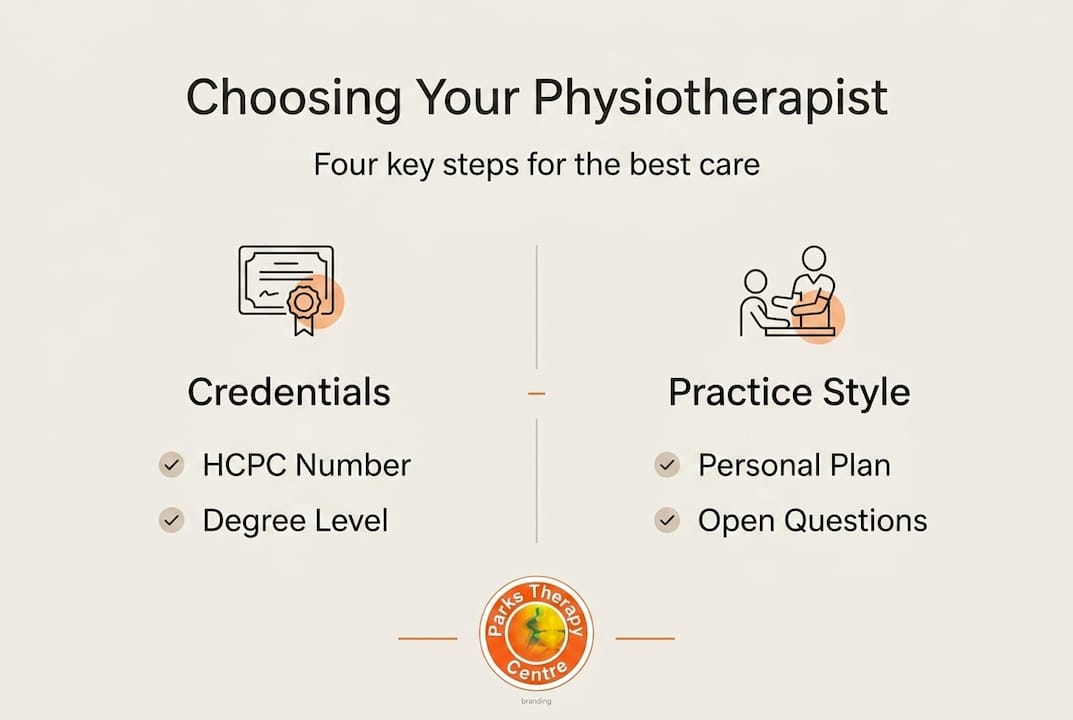
In the UK, this is genuinely straightforward to verify, and yet a surprising number of people skip this step entirely. Two credentials matter above everything else.
First: HCPC registration. The Health and Care Professions Council regulates physiotherapists in the UK. Any practising physiotherapist must be on the HCPC register. If they are not, they are not legally permitted to use the title "physiotherapist." You can search the public register online at any time. This is your non-negotiable baseline.
Second: Chartered status (MCSP). The Chartered Society of Physiotherapy (CSP) awards chartered status to members who meet its professional standards. Look for the letters "MCSP" after the physiotherapist's name. When choosing private physiotherapy, the NHS advises confirming the practitioner is both MCSP and HCPC-registered before proceeding.
How to verify credentials: step by step
- Visit the HCPC register at hcpc-uk.org and search the practitioner's name
- Confirm their registration status is "current" and not lapsed or restricted
- Look for "MCSP" on the clinic's website or the physiotherapist's profile
- Cross-check by visiting the CSP's Find a Physio directory to confirm chartered membership
- If booking through a multi-therapist clinic, verify each individual practitioner separately
Pro Tip: Always look for "MCSP" after the physiotherapist's name, not just the clinic's general claim of being "qualified." Individual registration matters more than brand-level assurances.
Chartered vs. unregistered: what's the difference?
| Factor | Chartered and HCPC-registered | Unregistered or non-chartered |
|---|---|---|
| Legal right to use the title "physiotherapist" | Yes | No |
| Subject to professional conduct rules | Yes | No |
| Can be investigated for malpractice | Yes | Limited recourse |
| Evidence-based training standards | Verified | Unknown |
| Insurance and liability | Covered | Uncertain |
This comparison matters because the term "therapist" is not protected in the UK. Anyone can call themselves a "sports therapist" or "movement therapist" without formal registration. HCPC and MCSP credentials are your guarantee that the person treating you has met a defined and independently verified standard of competence. When selecting the right clinic, checking the qualifications of individual practitioners should be your very first filter. Clinics that practise evidence-based physiotherapy will always highlight this information prominently.
What to expect at your first appointment
After confirming credentials, it's important to know what a quality first appointment looks like so you can recognise genuinely good care when you receive it.

A first physiotherapy session is not just a brief chat. Done properly, it is a thorough clinical encounter that gives the physiotherapist the information they need to build a plan that is specific to you. Understanding the structure of a good initial assessment means you are far less likely to accept poor practice without realising it.
What should happen in a quality initial assessment
- Subjective history: The physiotherapist asks detailed questions about your symptoms, when they started, what makes them better or worse, your occupation and lifestyle, and any relevant medical history
- Objective physical assessment: This includes tests of strength, range of motion, balance, and functional movement. For pregnancy-related conditions, assessment of pelvic stability and posture is also important
- Clinical reasoning and diagnosis: The physiotherapist should explain what they believe is happening and why, in plain language you can understand
- Discussion of treatment options: You should be offered choices, not just told what will happen to you
- Agreed plan with clear milestones: This includes an expected number of sessions and agreed goals for what success looks like
"At your first physiotherapy appointment, you can typically expect your symptoms and history to be discussed, a physical assessment carried out such as strength and balance tests, a discussion of treatment options, and advice on how many sessions you are likely to need."
If your first appointment feels rushed, skips the history, or jumps straight into hands-on treatment without any explanation, that is a sign that the process is being shortcut.
Questions worth asking at your first appointment:
- What do you think is causing my symptoms?
- What does my treatment plan involve, and how long should it take?
- Will my programme include exercises I can do at home?
- How will we know if the treatment is working?
- At what point would you refer me to someone else if this isn't improving?
Taking an active role from the very first session sets the tone for a more productive relationship with your physiotherapist. You can prepare even further by reading about booking your first assessment and what to bring, or by reviewing guidance on preparing for your session so that you make the most of every minute.
Watch for red flags and common mistakes
Even with preparation, there are pitfalls to avoid and warning signs that suggest you might need to reconsider your provider or approach.
Some of the most common mistakes people make when seeking physiotherapy are subtle enough that they only become obvious months down the line, when progress stalls or symptoms return. Knowing what to watch for early can save you significant time, money, and frustration.
Common pitfalls to avoid:
- Accepting vague credentials or assumptions without verifying on the HCPC register
- Continuing with a therapist who provides no clear treatment goals or progress reviews
- Relying entirely on passive manual therapy (massage, manipulation) without any active rehabilitation component
- Ignoring a lack of communication between your physiotherapist and your GP or midwife, particularly in pregnancy
- Accepting a one-size-fits-all plan that does not account for your specific condition, fitness level, or lifestyle
- Delaying treatment hoping symptoms will resolve on their own, particularly for pregnancy-related pelvic pain
For anyone managing pelvic pain in pregnancy, the research here is particularly clear. Educational approaches alone are demonstrably less effective than multimodal programmes that combine education with exercise and active physical interventions. A physiotherapist who provides a leaflet and a brief explanation is not providing the same standard of care as one who delivers a structured, progressive exercise programme alongside manual work.
"If pelvic pain in pregnancy is significant or causes considerable distress, the NHS advises letting your GP or midwife know, as additional treatment beyond physiotherapy support alone may be needed."
This is an important reminder that physiotherapy, while highly effective, does not operate in isolation. Your GP, midwife, and physiotherapist should be aware of each other's involvement, especially during pregnancy.
Pro Tip: For persistent pain or functional limitations that are not improving after three to four sessions, ask your physiotherapist directly whether your plan includes progressive exercise and when your first formal review point will be. If they cannot answer clearly, consider seeking a second opinion.
Red flags that suggest you may need to reconsider your provider include: no personalised plan after the first session, repeated cancellations or rescheduling without explanation, no home exercise component, and any dismissal of symptoms you consider significant. Reviewing what a full recovery guide recommends can help you benchmark your own experience, and understanding the range of physiotherapy techniques available means you can have a more informed conversation about whether your current plan is truly appropriate.
A better way to choose your physiotherapist: what most guides don't tell you
Most guides will tell you to check credentials and ask a few questions. That is the minimum. What they rarely say is that credentials are the foundation, not the ceiling.
The single most reliable indicator of a good physiotherapist is not their degree or their membership letters. It is whether they treat you as a partner in your own recovery. A physiotherapist who explains the reasoning behind each element of your plan, adjusts it based on your feedback, and helps you understand what function is being targeted with each exercise is worth ten times as much as one who simply works their way through a protocol.
We have seen this pattern repeatedly. Patients arrive after months of passive treatment that provided short-term relief but no lasting change. They were never given a clear end-goal, their sessions were never reviewed against agreed milestones, and no one ever asked whether they felt functional progress. That is not physiotherapy done well. That is physiotherapy done to you, rather than with you.
The evidence-based recovery lessons consistently show that active, function-focused rehabilitation produces better long-term outcomes than passive treatment alone. Seek out a physiotherapist who genuinely engages with your goals and is honest about what the realistic timeline looks like. That honesty, even when the news is not what you hoped for, is a sign of quality.
Find qualified, local physiotherapists in Bedfordshire and Buckinghamshire
Ready to put this into action? Here is a trusted route to connect with local professionals who meet these standards.

At Parks Therapy Centre, all physiotherapists are chartered (MCSP) and registered with the HCPC, and have been providing patient-centred care across Bedfordshire and Buckinghamshire since 1986. Whether you are managing a sports injury, living with musculoskeletal pain, or seeking specialist support during pregnancy, the team is qualified to help across multiple local clinic locations. Insurance cover is accepted from many leading providers. You can book your appointment online in minutes and get your first assessment arranged quickly, without waiting for a GP referral. The right care, with the right credentials, is closer than you think.
Frequently asked questions
Do I need a GP referral to see a physiotherapist?
In many cases you can self-refer to physiotherapy through the NHS or book privately without seeing your GP first, though availability of self-referral varies by local area. Ask your GP surgery about what is available locally if you are unsure.
How do I check if a physiotherapist is registered?
Search their full name on the HCPC public register and confirm their status is current. You should also look for "MCSP" chartered status on their profile or clinic listing to verify they meet professional standards.
What if I have pregnancy-related pelvic pain?
Ask for referral to a physiotherapist with specialist obstetric experience, and inform your GP or midwife if pain is severe, persistent, or causing significant distress, as you may need additional support beyond physiotherapy.
What questions should I ask at my first physiotherapy appointment?
Ask about your diagnosis, expected session numbers, and whether your plan includes active exercises rather than advice alone. Clarifying these points from the start will help you track progress and avoid a passive-only treatment approach.