
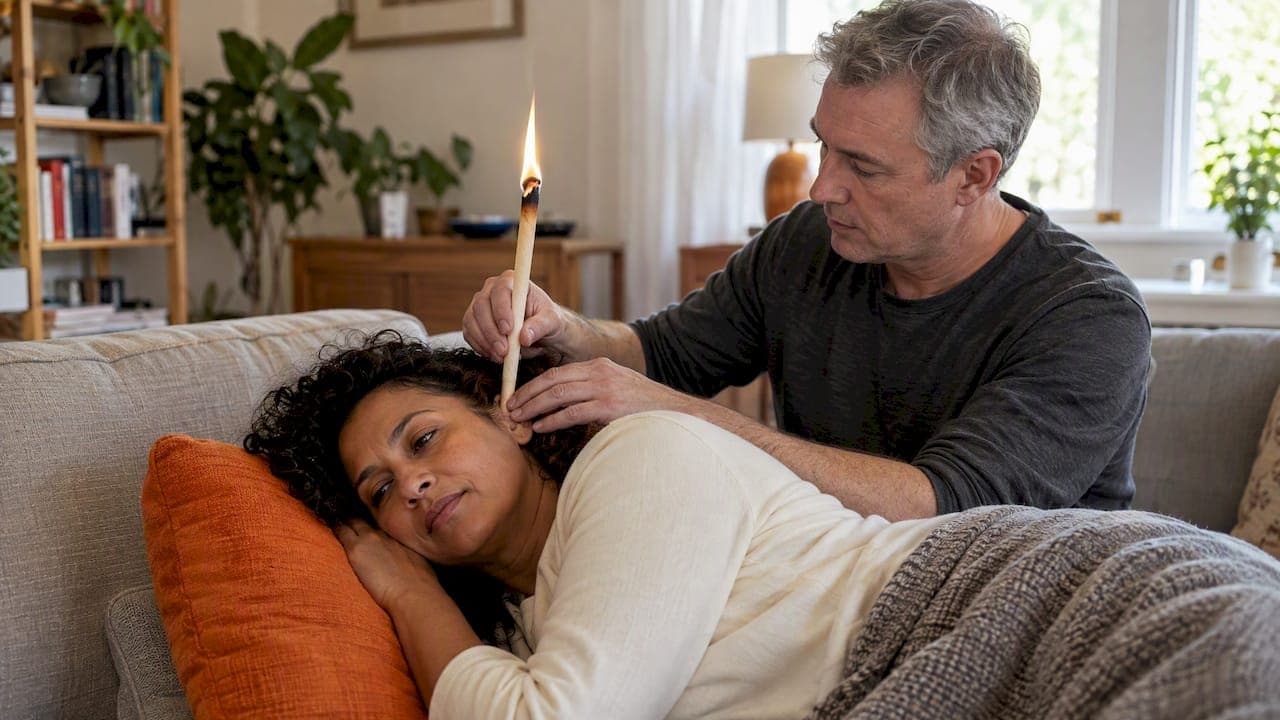
Ear candling is not safe, and it does not remove earwax. The documented harms include facial and ear burns, candle wax blocking the ear canal, infection, temporary hearing loss and a perforated eardrum. Health bodies in the UK, Canada and the US advise against it, and no good evidence shows any benefit. If your ears feel blocked, there are safer routes, and this guide sets them out.
TL;DR
- Ear candling has no proven benefit. Health Canada says it can cause burns, hot-wax injury, a blocked ear canal, a perforated eardrum and temporary hearing loss.
- The brown residue in a used candle is not earwax pulled from your ear. Testing found no suction, and candle wax was left in some ears.
- Earwax is normal and usually clears itself. If it is not causing symptoms, leave it alone.
- If your ears feel blocked, softening drops for a short period are the usual first step. Pain, discharge, bleeding, sudden hearing loss or a known perforation need professional assessment.
- Our clinic offers ear wax removal at £70 per treatment, so you do not need a candle.
Table of Contents
- What ear candling is and why people try it
- Does ear candling work?
- The main risks of ear candling
- How common are the injuries?
- What UK health guidance says
- Who is at highest risk
- Our perspective
- What to do instead if your ears feel blocked
- When to seek professional help straight away
- Ear wax removal at The Parks Therapy Centre
- Why people still believe in ear candles
- A short checklist before you consider candling
- FAQ
- Sources
What ear candling is and why people try it
An ear candle is a hollow tube of fabric, usually coated in wax. One end goes into or against the ear while the other end is lit. Sellers claim the flame creates gentle suction that draws wax and impurities out of the ear. Some also claim it helps with sinus problems, vertigo, glue ear or stress, as described in the British Tinnitus Association factsheet on ear candles.
The appeal is easy to understand. Blocked ears are uncomfortable, the treatment looks gentle, and the packaging often sounds reassuring. Some products are sold as "Hopi" candles, which suggests a traditional origin. Neither the name nor the soothing setting changes what happens in the ear canal.
Does ear candling work?
No. The most cited test is a 1996 study, Ear candles: efficacy and safety. It tested burning candles on an ear-canal model, in a small trial on eight ears, and through a survey of 122 otolaryngologists (ear, nose and throat specialists). It found no negative pressure from the burning candle and no removal of earwax. In some ears, candle wax was actually deposited.
This matters because the whole claim rests on suction. If the candle creates no suction, nothing can be drawn out.
Why the residue in the candle looks convincing
After candling, some people are shown a brown, waxy residue in the stub of the candle and told it came from their ear. The research does not support that. Since no suction was measured and no wax was removed in the trial, the material is far more likely to be burnt candle wax and fabric debris. Cutting open an unused candle and burning it away from the ear leaves similar material.
The main risks of ear candling
The ear canal is narrow, lined with delicate skin and ends at the eardrum. Putting a burning object next to it creates several hazards. Health Canada lists burns, hot-wax injury, ear-canal blockage, perforated eardrum and temporary hearing loss. The UK-facing risks are the same.
Burns to the face, scalp and ear
The flame, hot ash and dripping wax can all burn skin. Burns to the face, scalp and ear are among the best documented injuries. Hair and nearby fabric can also catch fire, and the person lying on their side cannot easily move away.
Hot wax in the ear canal
Molten wax can run into the canal and set there. A case reported in the British Journal of General Practice describes a woman who presented to her GP after candling. The person performing it burned herself while removing the candle and spilled wax into the woman's ear canal. Wax that hardens deep in the canal can need removal by an ENT team, and in the reported case this was potentially under general anaesthetic. A perforated eardrum and mild conductive hearing loss were still present at one-month follow-up.
Blocked ears and hearing loss
Wax from the candle can add a blockage where there was none, or make an existing one worse. Hearing loss from this is often temporary, but it can last until the blockage is professionally removed.
Infection and eardrum damage
The same article lists outer-ear infection (otitis externa) and perforation of the eardrum among the recorded harms. A perforated eardrum can cause pain, hearing loss and a higher risk of infection, and needs medical assessment.
How common are the injuries?
Nobody knows the true rate, because there is no register of ear candling harms. What exists are reports. In the otolaryngologist survey, 21 of the 122 specialists reported treating injuries from ear candles. As summarised in the BJGP review, the reported injuries included:
| Reported injury | Number of cases |
|---|---|
| Burns | 13 |
| Ear canal blockage | 7 |
| Temporary hearing loss | 6 |
| Outer-ear infection | 3 |
| Eardrum perforation | 1 |
These are counts of injuries that specialists reported, not rates across everyone who has tried candling. Some people have a single session and feel fine. That does not make the practice safe. It means the harm is unpredictable, and the gain is nil.
What UK health guidance says
Local NHS commissioning guidance for Buckinghamshire, Oxfordshire, Berkshire West and Frimley states that there is no evidence that ear candles or ear vacuums remove wax. It also describes earwax as a normal substance that cleans, lubricates and protects the ear canal, and advises that it normally leaves the ear naturally.
The American Academy of Otolaryngology-Head and Neck Surgery goes further. In its earwax guideline update, it explains that attempts to remove wax with objects, including ear candles, can push material deeper and injure the canal or eardrum.
So, is ear candling recommended by doctors? No. Neither NHS guidance nor the professional bodies describe it as a treatment. The BJGP authors concluded that GPs should discourage ear candling, as its claimed mechanism is unverified, no reliable benefit has been recorded and it could do more harm than good.

Regulators abroad say the same
In 2010 the US Food and Drug Administration warned consumers to stay away from ear candles. Health Canada's advice is also clear: avoid them. Different regulators reviewing the same evidence have reached the same view.
Who is at highest risk
Candling is a poor idea for anyone, but some people face extra danger. The BJGP review describes it as contraindicated for people with a perforated eardrum, grommets or recent ear surgery. A candle should also never be used near children, who may move suddenly.
People who wear hearing aids deserve a particular mention. If your aids feel muffled or keep whistling, wax is a common suspect, but a blockage can have other causes. Our guide to earwax and hearing aids explains when drops help and when clinic care is the better step.
Our perspective
We are a physiotherapy and multidisciplinary clinic, established in 1986, and we see how people look for relief from discomfort that is hard to ignore. Wanting to fix a blocked ear at home is natural. Our concern is that candling offers comfort without evidence and adds risks that a quiet sitting room does not make obvious.

What we would say to a patient is simple. Blocked or muffled hearing is a symptom, and wax is only one possible cause. The American Academy of Otolaryngology notes that fullness, tinnitus or hearing loss should not automatically be assumed to be wax, because infection or other ear disease can look similar. A candle cannot tell the difference. A trained clinician looking into the ear can.
That is why we treat ear wax removal as a clinical service rather than a home remedy, and why our advice is to start gently and seek assessment early when something does not settle. We would rather see someone for a straightforward check than for a burn or a blocked canal after a candle.
— Ivan
What to do instead if your ears feel blocked
Leave symptom-free earwax alone
Wax is not dirt. If it is not causing symptoms, you do not need to remove it. Do not push cotton buds or other objects into the canal. The AAO-HNS guidance warns that this can push wax deeper and injure the ear.
Try softening drops for a short time
NHS-linked guidance commonly advises 2 to 3 drops of olive or almond oil, twice daily, for up to 2 weeks in suitable patients, as set out in the local ICB earwax policy. Two cautions apply:
- Do not use drops if you have a perforated eardrum.
- Almond oil is unsuitable if you have a nut allergy.
A pharmacist can advise on suitable over-the-counter drops. A self-care briefing for clinicians notes that wax-related blocked ears can be treated first without a GP appointment or prescription, using simple drops.
Our article on ear wax removal methods covers the softening step and the clinic options that follow it.
Get assessed if symptoms continue
If self-care has not helped, see a clinician rather than repeating home procedures. The same guidance says persistent symptoms after self-care should prompt clinical advice.
When to seek professional help straight away
Do not wait to try drops if you have any of the following. Contact your GP, a pharmacist or an ear clinician:
- Ear pain
- Discharge or bleeding from the ear
- Marked or sudden hearing loss
- A known perforated eardrum
- Previous ear surgery or grommets
- Wax that may have been spilled in the ear during candling
If you have already candled and now have pain, reduced hearing or a feeling of something in the ear, do not try to dig it out. Get it examined. Burns to the skin of the face or ear also need medical advice.
Ear wax removal at The Parks Therapy Centre
If drops have not worked and you want the blockage dealt with properly, we offer ear wax removal at £70 per treatment. You can see it alongside our other published prices on our prices page. If you want to know what private clinics generally charge across the UK, our guide to private ear wax removal costs breaks it down.
Our team is multidisciplinary and has served Bedfordshire and Buckinghamshire patients since 1986. If you are unsure whether your symptoms are wax at all, tell us when you book so that we can advise on the right appointment. You can start from our home page and book online.
Why people still believe in ear candles
Several reasons keep the practice alive despite the evidence.
- The warm, quiet setting feels therapeutic. Relaxation is real, but it comes from lying still for twenty minutes, not from the candle.
- The residue looks like proof. As above, it is most likely candle material.
- Natural or traditional branding. Labels such as "Hopi" or "beeswax" imply safety. A natural material can still burn skin and block a canal.
- Symptoms often settle on their own. Wax can shift naturally, so the candle gets the credit.
- Medical-sounding claims. One sceptical writer who contacted the UK regulator found that the MHRA view on ear candles is that products making medical claims would need to be classified as medical devices. A seller's claim of classification is therefore not proof of safety or benefit.
A short checklist before you consider candling
- Do you have symptoms? If not, leave the wax alone.
- Have you tried softening drops for the recommended period?
- Do you have pain, discharge, bleeding or hearing loss? See a clinician now.
- Do you have a perforation, grommets or past ear surgery? Do not use drops or candles without medical advice.
- Is someone offering candling as a cure for sinus trouble, vertigo or tinnitus? There is no evidence for those claims either.
FAQ
Is ear candling safe?
No. Health Canada advises avoiding it because it has no proven medical benefit and can cause burns, hot-wax injury, a blocked canal, a perforated eardrum and temporary hearing loss. UK NHS guidance says there is no evidence it removes wax.
Does ear candling pull out wax?
No. Testing found no negative pressure from the burning candle and no wax removal in a trial on eight ears. The brown residue in the stub is most likely candle material, not wax from your ear.
Do doctors recommend ear candling?
No. The BJGP authors concluded that GPs should discourage it, and the American Academy of Otolaryngology-Head and Neck Surgery cautions against pushing objects, including candles, into the ear. UK NHS pathways treat softening drops and clinician-led removal as the options, not candles.
Are Hopi ear candles safe?
The name does not change the risk. A Hopi candle is still a burning hollow tube next to the ear, with the same hazards of burns, dripped wax and blockage. UK health guidance does not list them as a recommended option.
What should I do if wax or a candle injury is already in my ear?
Do not try to remove it yourself. See a GP or ear clinician promptly, especially if there is pain, discharge, bleeding or reduced hearing. Hardened wax deep in the canal can need specialist removal.
Sources
- Ear candling, Health Canada
- Ear candles: efficacy and safety, PubMed
- Ear candling: should general practitioners recommend it?, PMC
- Management of earwax, BOB ICB and Frimley ICB policy statement
- Self-care briefing for clinicians: earwax
- AAO-HNSF earwax guideline update
- Ear candles, British Tinnitus Association
- FDA consumer information on ear candles
- Finger Auricular Therapy, Lee Turnpenny