
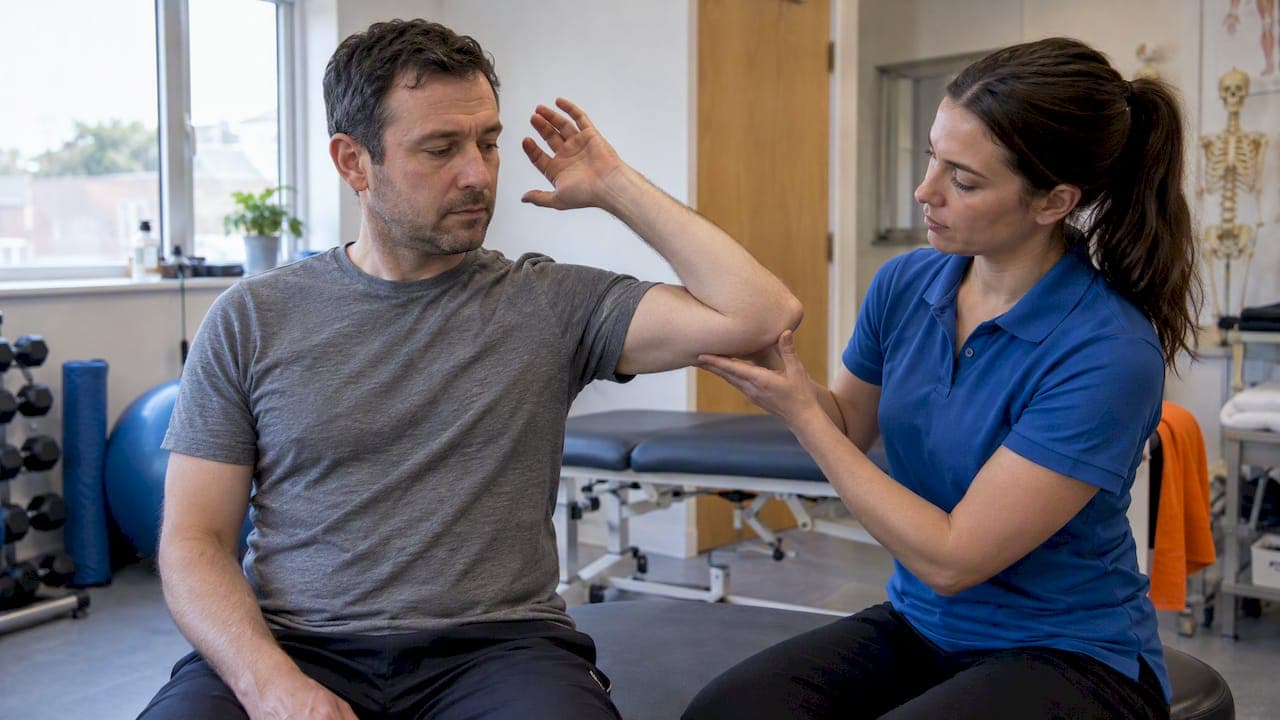
Most people with ulnar nerve entrapment start with conservative care: activity changes, night splints and physiotherapy including nerve-gliding exercises. About half of patients improve without an operation. Persistent symptoms, progressive weakness or visible muscle wasting are the signs that usually call for a surgical opinion.
TL;DR:
- Track symptoms over several weeks, including frequency, sleep disruption, grip strength, and daily tasks; seek specialist review if progress stalls or strength declines.
- Pooled review results showed improvement in around 89% with splints versus 54% with injections; try splinting first, reserving injections for intolerance or temporary relief.
- A therapist may prescribe 10 repetitions, building toward three daily sets only while comfortable; stop if tingling lingers, numbness spreads, grip weakens, or pain increases.
- Visible hand muscle wasting, worsening weakness, severe nerve test results, or persistent symptoms despite conservative care warrant surgical review; existing muscle loss may not fully recover.
- Desk work often resumes within two to three weeks after surgery, while heavier manual work usually takes four to six weeks or longer.
Table of Contents
- What are the symptoms of ulnar nerve entrapment and how is it diagnosed?
- What does conservative treatment for ulnar nerve entrapment involve?
- How do night splints and injections fit into treatment?
- How do physiotherapy and nerve-gliding exercises help?
- When should you consider ulnar nerve surgery?
- What is recovery like after ulnar nerve release surgery?
- How do we stage assessment and treatment for ulnar nerve entrapment?
- Book a physiotherapy assessment for your elbow and hand symptoms
- FAQ
- Sources
What are the symptoms of ulnar nerve entrapment and how is it diagnosed?
Ulnar nerve entrapment at the elbow, also called cubital tunnel syndrome, usually announces itself through the hand. You may notice:
- Intermittent pins and needles in the ring and little fingers
- Numbness that comes on when the elbow stays bent, such as holding a phone or sleeping
- Symptoms that are worse at night
- A weaker grip and clumsier fine finger movements
- In advanced cases, clawing of the fingers and wasting of the small muscles of the hand
Diagnosis starts with your history and a hands-on examination. Clinicians often use an elbow flexion test, holding the elbow bent to see whether symptoms are reproduced, and check grip strength and the sensation in each finger. If the picture is unclear, or if weakness is present, nerve conduction studies measure how well the nerve is transmitting signals, and imaging may be used to look for a structural cause.
Symptoms in the little finger are not always from the elbow. Neck and wrist problems can mimic them, which is why a proper assessment matters. For broader context on how clinicians separate nerve symptoms from different sources, this guide to lumbar radiculopathy symptoms from a neighbouring chiropractic practice explains how neurological red flags are recognised.
What does conservative treatment for ulnar nerve entrapment involve?
Conservative care means treating the nerve without surgery. NHS patient guidance describes most mild to moderate cases as managed with pain relief, splinting and activity modification, and keeps surgery for when these fail or muscle function is lost. The core measures are:
- Education about what irritates the nerve
- Avoiding prolonged elbow flexion and leaning on the inner elbow
- Night-time splinting to keep the arm straighter
- Physiotherapy, including nerve-gliding exercises
- Simple pain relief or anti-inflammatory medicines where suitable
Evidence snapshot: A systematic review and meta-analysis found conservative management can be effective, with education and activity modification improving symptoms in many cases.
A pragmatic approach is to give conservative care a structured trial of several weeks, and to track four things: how often symptoms occur, how much they disturb your sleep, your grip strength and how easily you manage daily tasks. A diary on your phone is enough. Steady improvement means carry on. No change, or any slide in strength, means it is time to ask for a specialist review rather than waiting.
How do night splints and injections fit into treatment?
A night splint holds the elbow in a gentler position so the nerve is not stretched and compressed for hours. It is usually the first thing to try. Comfort is the main obstacle: NHS information notes that many patients find it hard to wear a splint all night.
Practical tips for tolerating one:
- Ask for a splint fitted to your arm rather than relying on one that is too bulky
- Keep the elbow only slightly bent, not forced straight
- Pad the edges and check the skin each morning
- Build up wear gradually over the first few nights
The review evidence is encouraging for splinting. In the pooled meta-analysis, splint devices showed an improvement rate of around 89%, while steroid or lidocaine injections showed pooled improvement of around 54%. These are figures from the review's pooled studies, and individual results vary.
That points to a sensible order: splinting first, and injections considered when a splint cannot be tolerated or as a temporary bridge towards surgery.
Pro Tip: If a rigid splint wakes you, try a soft towel wrapped loosely around the elbow so you cannot bend it fully. It keeps the arm out of deep flexion without the bulk.

How do physiotherapy and nerve-gliding exercises help?
A physiotherapist aims to restore smooth movement of the nerve through the elbow, reduce outside compression, correct the arm postures that provoke symptoms and strengthen the muscles that support the arm. We also look at how you work, sleep and exercise, because small posture changes often matter as much as the exercises themselves.
Nerve gliding is the technique most specific to this condition. A clinical study of therapist-applied ulnar nerve gliding used repetitive passive wrist movement with the elbow at its maximal comfortable flexion. It reported lower pins and needles and better grip strength and nerve conduction in most patients, with symptoms abolished in 16 of 17 patients after an average of 5.8 months of treatment. It was a small study, so treat it as encouraging rather than conclusive.
A home programme your therapist may set looks like this:
- Start with the elbow comfortably straight and the arm by your side.
- Bend the elbow slowly while moving the wrist in a gentle, controlled way, stopping at the point where you feel a mild stretch, never pain.
- Repeat 10 times, resting between sets, and build to three sets a day as it stays comfortable.
- Progress only when the exercise causes no lingering tingling afterwards.
- Stop and contact a clinician if numbness spreads, your grip weakens or pain increases.
Pro Tip: Gliding should feel like movement, not stretching. If you feel strong tension or tingling during the exercise, you are pushing too far.
Our guides to physiotherapy for elbow injuries and step-by-step hand pain rehabilitation show how this kind of progression works in practice.
When should you consider ulnar nerve surgery?
Many mild cases settle without an operation, but some should not wait. Objective signs that point towards surgery include:
- Visible wasting of the hand muscles
- Persistent or worsening weakness
- Severe changes on nerve conduction testing
- Symptoms that have not improved after a fair trial of conservative care
Hand therapy guidance describes the decision as a shared one between you and the surgeon, with surgery most strongly indicated when there is objective muscle loss or severe nerve test results.
Key point: The British Society for Surgery of the Hand reserves surgery for persistent or severe symptoms such as muscle atrophy or weakness.
If your symptoms are getting worse, ask for referral promptly. Nerve damage that has already caused wasting may not fully recover, so delay carries a cost.
What is recovery like after ulnar nerve release surgery?
The two common operations are simple decompression, which releases the nerve where it is squeezed, and anterior transposition, which also moves the nerve to the front of the elbow. A systematic review suggests little to no difference in clinical outcomes between them, with simple decompression often preferred for its lower complication rate. Surgeons may adapt the plan during the operation if the nerve proves unstable or under tension.
- It is usually day-case surgery
- Gentle, frequent hand movements, such as touching thumb to each fingertip, reduce stiffness and swelling
- Desk work often resumes within 2–3 weeks, heavier manual work after 4–6 weeks or more
- Report redness, discharge or increasing pain to your surgical team
How do we stage assessment and treatment for ulnar nerve entrapment?
At our clinic, we begin with a full assessment to judge whether conservative care is appropriate, then build a plan around supervised nerve-gliding, splinting advice and targeted strengthening. Imaging or a surgical referral comes only if the response is poor or objective signs appear. Our multidisciplinary team has practised locally for many years, and we work with insurers, so your cover may be accepted.
— Ivan
Book a physiotherapy assessment for your elbow and hand symptoms

If your symptoms persist, are getting worse or are limiting what you can do, a hands-on assessment is the sensible next step. We offer:
- Physiotherapy assessment at £76 and treatment at £67, with current prices listed here
- Image assessment and referral letters where scans are needed
- Supervised exercise and rehabilitation sessions
You can book online, and we accept major insurers where applicable. Book your assessment with us and we will start with a clear plan.
This article is general information, not a substitute for advice from a qualified doctor. Consult a qualified healthcare professional about your own circumstances before acting on anything here.
FAQ
How long does it take to recover from ulnar nerve surgery?
Recovery is gradual. Many people return to desk work, with heavier manual work taking longer. Published cohorts report high rates of return to activity after surgery.
What is ulnar neuropathy?
Ulnar neuropathy is damage or irritation of the ulnar nerve, most often where it passes behind the inner elbow. It causes numbness and tingling in the ring and little fingers and, if severe, hand weakness.
Can carpal tunnel syndrome affect the little finger?
Classic carpal tunnel syndrome affects the thumb, index and middle fingers rather than the little finger. Numbness in the little finger points more towards the ulnar nerve, though a clinician should confirm the source. Our carpal tunnel physiotherapy guide explains the wrist-level picture.
What are the symptoms of nerve damage in the hand?
Common signs are numbness, pins and needles, burning, weak grip and clumsiness with small movements. Muscle wasting or clawing of the fingers suggests more advanced damage and needs prompt assessment.
Sources
- Roh
- Conservative Treatment of Ulnar Nerve Compression at the Elbow: A Systematic Review and Meta-Analysis - PMC
- Bssh
- Cubital tunnel syndrome