
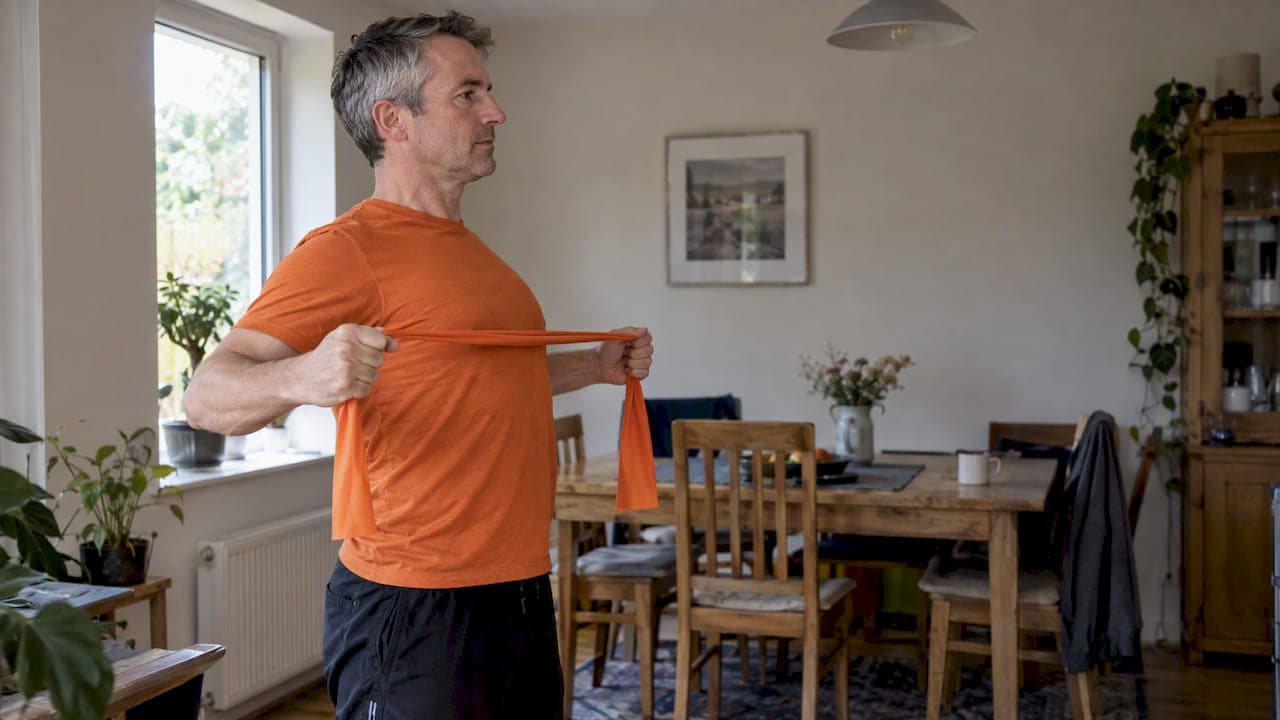
Gentle stretching of the scalene and pectoral muscles, scapular stabiliser endurance work, nerve glides and diaphragmatic breathing are the main thoracic outlet syndrome exercises we use to ease compression and restore function. Start gently, keep pins and needles at a minimum and stop if they build. Seek a physiotherapy assessment if symptoms are severe or getting worse. After surgery, programmes begin on day one with breathing and light neck and shoulder movement.
TL;DR:
- A narrative review found combined stretching, strengthening, and posture programs improved symptoms in roughly 50–90% of thoracic outlet syndrome cases.
- Hold each neck or chest stretch for 10 seconds, keep the doorway elbow at or below shoulder height, and reduce the range if tingling rises.
- For shoulder blade work, use no resistance or a light band, complete 10–15 controlled repetitions, then increase repetitions before adding resistance or weights.
- After surgery, hospital guidance commonly schedules exercises three to four times daily and advises avoiding driving and heavy lifting for about four weeks.
- Seek emergency care for a suddenly cold, pale, blue, or swollen arm; arrange physiotherapy if symptoms persist after several weeks of home exercise.
Table of Contents
- Which thoracic outlet syndrome exercises should you start with at home?
- How do you stretch the scalene and pectoral muscles safely?
- How do you strengthen the scapular stabilisers without aggravating symptoms?
- What are nerve glides, and how do you do them at home?
- How can breathing and mobility work support recovery?
- What should you do after thoracic outlet decompression surgery?
- How should you progress your exercises and dose them safely?
- When should you see a physiotherapist or your surgeon?
- How we apply these exercises in practice
- How can our physiotherapy help if home exercises are not enough?
- FAQ
- Sources
Which thoracic outlet syndrome exercises should you start with at home?
A short, well-chosen routine beats a long one you cannot sustain. A narrative review of exercise for TOS reports that exercise improves symptoms in roughly 50–90% of cases, and recommends combining stretching, strengthening and postural correction. These are the exercises we suggest as a first set:
- Scalene stretch: sitting tall, rest one hand under the seat, tilt your ear towards the opposite shoulder and hold for about 10 seconds.
- Doorway pectoral stretch: forearm on the door frame, elbow at or below shoulder height, lean through gently and hold for about 10 seconds.
- Scapular retraction: draw your shoulder blades back and down, as if tucking them into your back pockets, for 5–10 repetitions.
- Serratus activation: press your forearms into a wall and gently push your shoulder blades apart, keeping your neck relaxed.
- Pendulum: lean forward, let the arm hang and swing it in small, easy circles.
- Median nerve glide: a slow, small-range movement of the arm and neck, described in full below.
- Diaphragmatic breathing: slow breaths into the lower ribs with the shoulders soft, several times a day.
Stop any exercise that increases numbness, pins and needles or overall pain. If you have had surgery, begin lying down or well supported and follow your surgeon's instructions first. Aim for a gentle session two to three times a day rather than one long effort.
How do you stretch the scalene and pectoral muscles safely?
Tight scalenes and pectoralis minor are common contributors to a narrowed outlet, which is why primary care guidance describes frequent daily stretching of these muscles as the usual starting point. Technique matters more than force. Hospital exercise leaflets, such as the Leicester NHS TOS exercise leaflet, suggest holding each stretch for around 10 seconds and repeating it, and stopping if pins and needles increase.
Scalene stretch, step by step
- Sit upright on a firm chair with your feet flat and your shoulders relaxed.
- Hold the seat edge with the hand on the side being stretched. This keeps the shoulder from lifting.
- Tilt your head away, bringing your ear towards the opposite shoulder, until you feel a mild pull along the side of your neck.
- Turn your nose a small way towards the armpit of the side you are stretching, if that feels comfortable.
- Hold for about 10 seconds while breathing slowly, then return to the start.
- Repeat gently on each side, as comfortable.
Doorway and corner pectoral stretches
- Stand in a doorway and place your forearm against the frame, with your elbow bent and level with, or just below, your shoulder.
- Step one foot forward and let your chest move gently through the doorway until you feel a stretch across the front of the chest.
- Keep your ribs down and your neck long. Do not push into a stretch that sends tingling into the hand.
- Hold for about 10 seconds and repeat gently.
- For a corner stretch, place both forearms on two walls meeting at a corner and lean in slowly. The same stop rule applies.
Pro Tip: Aim for a stretch you can describe as "mild and easing". If you feel burning, tingling or a heavy arm, back off to a smaller range and angle the arm lower.
After surgery, stretch only within the range your surgical team has approved. Early on, this usually means very small, supported movements. Our guide to desk neck pain covers the posture habits that can undo these stretches during the working day.
How do you strengthen the scapular stabilisers without aggravating symptoms?
Weak or fatigued stabilisers let the shoulder blade droop, which can narrow the space the nerves and vessels travel through. The middle and lower trapezius, rhomboids and serratus anterior are the muscles we focus on. A clinical review of TOS exercise recommends low-load, high-repetition endurance work with bands or light weights, with attention to scapular control, breathing and alignment. The aim is stamina, not heavy lifting.
Good starting options:
- Scapular retractions: squeeze the shoulder blades back and down, hold for a few seconds and release. Aim for 10 repetitions.
- Prone I, Y and T raises: lying face down, lift the arms in an I, Y or T shape just off the floor with thumbs up, keeping the neck long. Begin with a small range and no weight.
- Banded rows: anchor a light band at chest height and pull the elbows back, leading with the shoulder blades rather than the neck.
- Serratus wall push: with forearms on a wall, push away so the shoulder blades spread around the ribcage. Stop before the shoulders hike up.
- Wall slides: slide the forearms up a wall within a comfortable range, keeping the shoulder blades moving smoothly.
Avoid pulling the arm too far across the chest in a rowing or pressing movement, as excessive horizontal adduction can provoke symptoms in some people.
For load, begin with a light band or no resistance at all. Choose a level where you can complete 10–15 slow repetitions with good form and no increase in tingling. Progress in this order: more repetitions first, then a stronger band, then light dumbbells. Keep the neck soft throughout, because gripping with the upper trapezius defeats the purpose.

Pro Tip: Finish each set while you still have two or three clean repetitions left. Fatigue that makes your shoulders creep towards your ears is your cue to stop.
For wider shoulder progressions, our article on shoulder impingement exercises sets out a graded approach to scapular control.
What are nerve glides, and how do you do them at home?
Nerve glides, also called neurodynamic exercises, encourage the nerves of the brachial plexus to slide more freely through the neck, shoulder and arm. Research on neuromobilisation describes them as helping to decrease extrinsic and intraneural pressure and improve sliding capacity. They should feel like a gentle tension, never a sharp pull or a flare of pins and needles.
Median nerve glide
- Stand or sit tall with your arm out to the side at about shoulder height, palm facing forward.
- Bend the elbow and bring the hand towards your ear, then straighten it again in a slow, flowing movement.
- As the arm straightens, tilt your head slightly away. As it bends, tilt back towards the hand.
- Repeat 5–10 times, then rest.
Ulnar and radial variations
- For the ulnar glide, make an "OK" sign with the hand and bring it towards your face, like a mask, then return slowly.
- For the radial glide, turn the arm inwards with the wrist flexed, gently shrug the shoulder down and tilt the head away within a comfortable range.
- Keep each repetition small and smooth, stop if your symptoms ramp up, and work at most a few times a day.
Nerve glides can improve symptoms when they are small, slow and comfortable, and most people should avoid anything that reproduces their worst pins and needles.
In clinic, some athletes and post-operative patients progress to mechanically loaded neurodynamics, a staged approach using bands and graded loads. A recent case report describes this approach in an endurance athlete after surgery. It needs supervision and is not a home exercise.
How can breathing and mobility work support recovery?
Shallow chest breathing keeps the upper ribs and shoulders lifted, which adds to the squeeze on the outlet. Slowing the breath and using the diaphragm lets the shoulders settle, supports rib movement and helps posture. The post-operative Worcestershire leaflet uses the active cycle of breathing technique (ACBT) from day one, and the same ideas help anyone to manage TOS conservatively.
- Diaphragmatic breathing: one hand on the lower ribs, breathe in through the nose for about four seconds so the ribs widen, then out slowly. Try 5–10 breaths, several times a day.
- ACBT: relaxed breathing, then a few deep breaths with a brief hold, then relaxed breathing again, finishing with gentle huffs if you need to clear your chest.
- Thoracic rotation: sitting with your arms crossed, turn the upper back slowly from side to side, keeping the hips still.
- Walking: short, regular, relaxed walks with the arms swinging freely help circulation and keep the shoulders moving without load.
What should you do after thoracic outlet decompression surgery?
Post-operative guidance varies between hospitals, so your surgeon's own leaflet always comes first. The Worcestershire NHS leaflet is typical: breathing exercises and gentle neck and shoulder girdle mobility start on day one, practised three to four times daily, with heavy lifting and driving avoided for around four weeks.
- Day 1: diaphragmatic breathing and ACBT, neck retraction and shoulder girdle movements, lying or well supported, three to four times a day.
- Weeks 1–4: add active shoulder joint exercises gradually, rest the arm on pillows and avoid carrying, pushing or pulling anything heavier than a full kettle, as Worcestershire's guidance advises.
- Weeks 4–6: with outpatient physiotherapy, widen the range and begin light strengthening if your team agrees.
Post-operative leaflets advise practising exercises three to four times daily and avoiding heavy lifting and driving for around four weeks.
Some pulling and discomfort when you start is normal because of swelling and muscle spasm. It should ease quickly with movement, and exercises must not raise your overall pain. Our guide to surgery rehabilitation exercises explains how recovery usually builds.
How should you progress your exercises and dose them safely?
Consistency matters more than intensity. Begin with 5–10 repetitions of each exercise and build towards several short sets spread across the day. Favour endurance over heavy loading, in line with the clinical review on scapular rehabilitation.
Progress one variable at a time:
- Increase repetitions first, then move to a stronger band, then light dumbbells.
- Widen the shoulder range gradually, from around 0–30° towards 45–90° as tolerated.
- If symptoms flare, drop back a step for a few days before trying again.
Stop and seek prompt review if you notice:
- Increasing numbness or tingling that does not settle.
- Progressive weakness in the arm or hand.
- A cool, pale, blue or swollen arm or hand.
- Pain that keeps worsening despite easing off.
Our home physiotherapy exercise guide is a useful companion for planning a weekly routine.
When should you see a physiotherapist or your surgeon?
Contact your surgeon or seek urgent medical care if your arm turns cold, pale or blue, swells suddenly, or weakens quickly, or if you lose feeling markedly. These can signal a vascular or neurological problem. Seek immediate emergency care.
Arrange a physiotherapy assessment if symptoms persist after a consistent few weeks of home exercise, if you cannot progress, or if you are unsure which exercises suit your type of TOS. A systematic review notes that exercise selection should be individualised by a specialist. Bring:
- A short symptom diary showing when symptoms occur.
- The exercises you have tried and how they felt.
- Any scan reports or surgical letters.
For arm symptoms that start in the neck, our cervical radiculopathy programme can help you tell the two apart.
How we apply these exercises in practice
Exercise advice is only as good as the assessment behind it. When we see someone with TOS, we examine posture, neck and shoulder movement, scapular control and nerve sensitivity, then choose a handful of exercises and set a sensible progression. We monitor symptoms at each visit and combine breathing work, hands-on treatment and graded neurodynamics where appropriate. Many people also find that an adjacent manual approach, such as the neck and shoulder care at Elaris Chiropractic, fits alongside a rehabilitation plan.
— Ivan
How can our physiotherapy help if home exercises are not enough?
If your symptoms are not easing, a physiotherapy assessment gives you a clear picture of what is driving them and which exercises to change. We assess your posture, mobility, strength and nerve sensitivity, then adjust your programme and progress it in person. A physiotherapy assessment costs £76 and follow-up treatment £67, as listed on our prices page. We accept major insurance plans and offer online booking, so you can arrange a session whenever supervised progression would help.
This article is general information, not a substitute for advice from a qualified doctor. Consult a qualified healthcare professional about your own circumstances before acting on anything here.
FAQ
What stretches are good for thoracic outlet syndrome?
Scalene, doorway pectoral and corner pectoral stretches are commonly used. NHS exercise leaflets suggest holding each for around 10 seconds and stopping if pins and needles increase.
Can you fix a pinched nerve with exercise?
Exercise can often ease nerve irritation by improving posture, reducing muscle tension and helping the nerve glide more freely. A narrative review found that combined stretching, strengthening and postural programmes help in roughly 50–90% of TOS cases. Persistent or worsening symptoms need professional assessment.
Can you provide me with a PDF of exercises for thoracic outlet syndrome?
Several NHS trusts publish free leaflets, including the Leicester TOS exercise leaflet and a post-operative instruction sheet. If you have had surgery, follow your own surgical team's version.
Can thoracic outlet syndrome affect the shoulder?
Yes. TOS often produces aching around the shoulder and neck, and weak or poorly controlled shoulder blade muscles can contribute to it. Strengthening the scapular stabilisers and improving shoulder range are standard parts of rehabilitation.
Sources
- Physiotherapy Advice and Exercises following Thoracic Outlet Decompression - Worcestershire Acute Hospitals NHS Trust
- Thoracic Outlet Syndrome: Biomechanical and Exercise Considerations
- Thoracic Outlet Syndrome: Biomechanical and Exercise Considerations