

TL;DR:
- Soft tissue therapy addresses injury, pain, and mobility by targeting muscles, tendons, ligaments, and fascia. It employs various techniques like Swedish massage, deep tissue, and trigger point therapy, supported by strong clinical evidence for improving chronic pain and dysfunction. Consistent treatment and active self-care maximize benefits and promote long-term recovery.
Soft tissue therapy is far more than a relaxing massage. The role of soft tissue therapy extends across injury treatment, chronic pain management, and restoring function to muscles, tendons, ligaments, and fascia that have been stressed, damaged, or restricted. Many people arrive at a clinic expecting a general rubdown and leave surprised by how targeted and clinically grounded the work actually is. This article breaks down how soft tissue therapy works, which techniques are used and why, what the research says about outcomes, and how you can get the most from it whether you are recovering from injury or managing persistent discomfort.
Table of Contents
- Key takeaways
- The role of soft tissue therapy: how it works
- Core soft tissue manipulation techniques
- Evidence on benefits for injury treatment and pain relief
- What to expect and how to get the most from it
- My perspective: what most people get wrong about soft tissue therapy
- Ready to experience professional soft tissue therapy?
- FAQ
Key takeaways
| Point | Details |
|---|---|
| More than massage | Soft tissue therapy addresses injury, pain, and mobility, not just relaxation or muscle soreness. |
| Multiple techniques, tailored approach | Therapists blend methods like myofascial release, trigger point therapy, and Swedish techniques based on your specific needs. |
| Strong clinical evidence | Research supports significant improvements in pain scores and function for conditions including TMJ dysfunction and chronic low back pain. |
| Session frequency matters | A single session rarely produces lasting change; consistent treatment paired with home care delivers the best outcomes. |
| Supplement between sessions | Tools like KT Tape and targeted stretching maintain tissue alignment and circulation between appointments. |
The role of soft tissue therapy: how it works
Soft tissue therapy is a hands-on clinical treatment applied to the body's soft tissues, specifically muscles, tendons, ligaments, and fascia. These structures are the most commonly injured and the most frequently overlooked when people seek help for pain. Unlike bone or joint issues, soft tissue problems are often invisible on scans yet profoundly limiting in daily life.
When a therapist applies manual pressure and movement to these tissues, several things happen simultaneously. Locally, increased circulation brings oxygen and nutrients to damaged areas and removes metabolic waste. Restricted fascia and muscle fibres begin to release, restoring length and reducing the pulling forces that cause referred pain and postural problems.
Beyond the local tissue effects, massage therapy triggers the release of dopamine and serotonin while activating the parasympathetic nervous system, which reduces anxiety and promotes the body's natural recovery state. This is why people often feel both physically looser and genuinely calmer after a session. It is not coincidence. It is neurochemistry.
Pro Tip: Staying well hydrated before and after a session supports the flush of metabolic waste from treated tissues and reduces post-treatment soreness.
The effectiveness of a session also depends significantly on the practitioner's skill in applying pressure. Effective deep tissue work requires the therapist to use core body weight and hand bracing rather than simply pressing harder with the hands alone. This distinction matters because it allows consistent, controlled pressure without injury to either the therapist or the client.
Key physiological effects of soft tissue therapy include:
- Increased local blood and lymphatic circulation
- Reduction in muscle tension and trigger point activity
- Improved range of motion through fascial release
- Stimulation of tissue repair processes
- Modulation of pain signals via the nervous system
Core soft tissue manipulation techniques
Understanding the specific tools a therapist uses helps you know what to expect and why each approach is chosen. Soft tissue manipulation techniques are not interchangeable. Each has a distinct mechanism and a set of conditions where it performs best.
The five Swedish massage techniques
Swedish massage uses five core techniques in deliberate ratios to prepare tissue, treat tension, and reduce post-session soreness. Effleurage (long gliding strokes) warms the tissue and improves circulation. Petrissage (kneading and lifting) addresses deeper muscle layers. Friction targets specific areas of adhesion or scar tissue. Tapotement uses rhythmic percussion to stimulate blood flow. Vibration promotes relaxation through oscillation. Applied well, these five techniques address most surface-level soft tissue presentations.
Deep tissue, myofascial release, and trigger point therapy
Where Swedish techniques work primarily through circulation and relaxation, deep tissue work targets the deeper muscle layers and chronic holding patterns that Swedish cannot reach. Myofascial release focuses specifically on the fascial network, using sustained, low-load stretching to release restrictions that contribute to widespread pain. Trigger point therapy identifies hypersensitive spots within a muscle that refer pain elsewhere and applies direct compression to deactivate them.
Blending Swedish and deep tissue techniques based on client tolerance reduces soreness and improves overall outcomes compared to deep tissue work alone. A competent therapist will rarely use just one method throughout an entire session.
| Technique | Primary target | Best used for | Key effect |
|---|---|---|---|
| Swedish massage | Superficial muscle, circulation | Relaxation, mild tension, prep work | Improved circulation, reduced anxiety |
| Deep tissue massage | Deep muscle layers, chronic tension | Postural issues, sports injuries | Breaks down adhesions, restores length |
| Myofascial release | Fascial restrictions | Widespread pain, post-surgical tightness | Restores fascial glide and mobility |
| Trigger point therapy | Hyperirritable muscle knots | Referred pain, headaches, neck issues | Deactivates pain referral patterns |
| Shockwave therapy | Tendons, calcifications | Plantar fasciitis, tendinopathy | Stimulates cellular repair |
Shockwave therapy deserves a specific mention as a newer adjunct. Shockwave therapy reactivates healing by creating microtrauma that stimulates the body's repair mechanisms and encourages new blood vessel formation. For stubborn tendon conditions that have plateaued with manual therapy alone, it can be the difference between partial and full recovery.
Pro Tip: If your therapist is only ever using one technique in every session, that is worth questioning. The most effective practitioners continually assess and adjust based on how your tissues respond.
Evidence on benefits for injury treatment and pain relief
The clinical case for soft tissue therapy is strong and growing. It is no longer a matter of anecdote or tradition. Recent research gives us concrete data on outcomes for specific conditions.
For temporomandibular joint (TMJ) dysfunction, a randomised controlled trial found that soft tissue manipulation over five sessions produced significantly better improvements in mouth opening and pain reduction than medication alone. The 34-participant study highlighted how manual therapy outperforms pharmacotherapy when function is the primary goal, not just temporary symptom suppression.
For chronic low back pain, a study with 41 psychosomatic inpatients found that both fascia-focused therapy and conventional physiotherapy delivered NRS pain score reductions of approximately 3.21 points over six weeks. That is a clinically meaningful change on a ten-point scale.
"Soft tissue therapy addresses the mechanical and neurological drivers of pain rather than masking them, which is why its effects tend to be more durable than medication for musculoskeletal conditions."
The impact of soft tissue therapy on chronic musculoskeletal pain goes beyond pain scores. Patients typically see improvements in:
- Range of motion and joint mobility
- Functional performance in daily and sporting activities
- Sleep quality, which is heavily disrupted by persistent pain
- Psychological wellbeing linked to reduced pain load
The comparison with pharmacotherapy is particularly relevant. Medications for musculoskeletal pain often carry side effects and dependency risks. Soft tissue therapy addresses the mechanical and neurological drivers of pain rather than suppressing the signal. This is why its effects are typically more sustained when treatment is paired with good home care.
From a prevention standpoint, evidence-based physiotherapy approaches that include soft tissue therapy reduce relapse rates in patients with chronic musculoskeletal conditions. Treating the tissue changes rather than just the symptoms shifts the trajectory from managing flare-ups to actually reducing their frequency.
What to expect and how to get the most from it
Most soft tissue therapy sessions follow a clear structure, and knowing what to expect helps you engage with the process rather than just endure it. Here is a typical sequence:
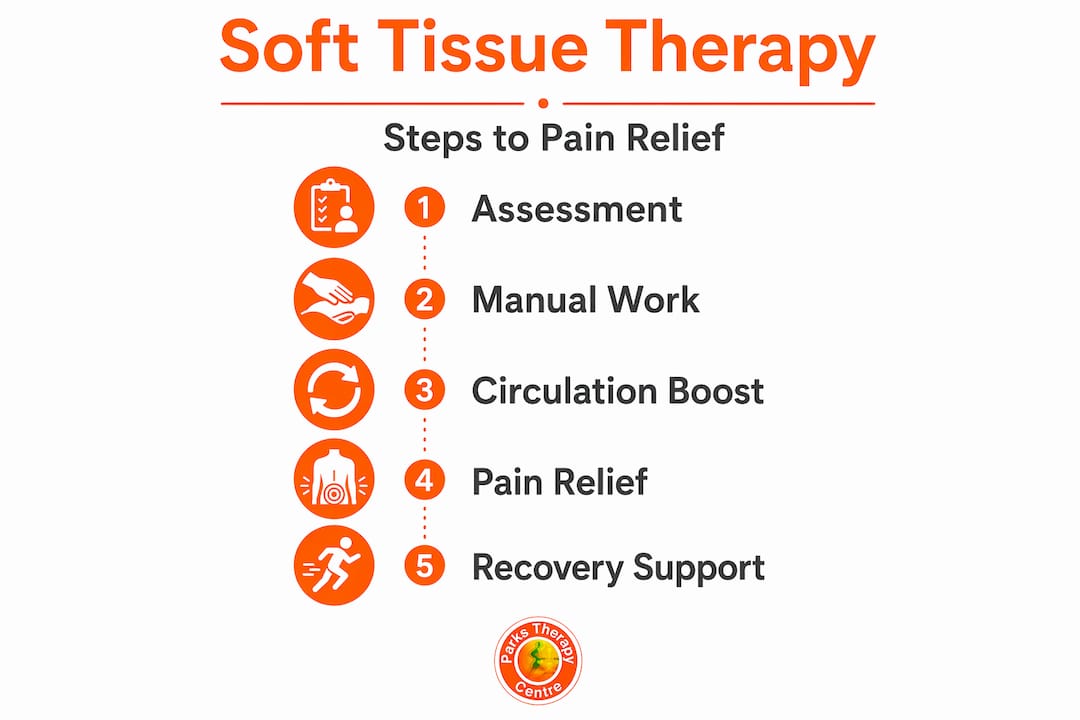
- Assessment. Your therapist will ask about your symptoms, history, and goals. They will often assess your posture and movement to identify tissue restrictions beyond the area of reported pain.
- Preparation. Light techniques warm the tissue and begin increasing circulation before deeper work is applied.
- Treatment. The core of the session targets the specific tissues identified during assessment using the most appropriate combination of techniques.
- Integration. Slower, lighter work at the end allows the nervous system to settle and the body to begin integrating the changes made.
- Aftercare guidance. A good therapist will give you specific recommendations before you leave, covering stretching, posture cues, or movement habits to reinforce the session's work.
Lasting change rarely comes from a single appointment. Tissues that have been restricted, scarred, or overloaded over months or years need repeated stimulus to reorganise. Think of it as training the tissue, not fixing it in one go.
Between sessions, KT Tape supports tissue alignment and maintains circulation in treated areas, effectively extending the benefit of each appointment. It is a simple, affordable tool that many therapists now recommend as standard aftercare.
Pro Tip: After your session, avoid intense exercise for 24 hours. Light movement and gentle stretching support recovery, but heavy loading on recently treated tissue can blunt the benefits.
Soft tissue therapy also works best within a broader picture. If you are dealing with musculoskeletal pain and recovery, combining soft tissue treatment with corrective exercise, posture work, and lifestyle adjustments produces outcomes that neither approach achieves alone.
My perspective: what most people get wrong about soft tissue therapy
I have worked alongside many clients who come in convinced that a harder, more painful session means a better result. It is one of the most persistent myths in manual therapy, and it leads to unnecessary discomfort and, sometimes, setbacks.
The most skilled therapists I have seen work are not the ones who press the hardest. They are the ones who read tissue response, adapt in real time, and know precisely when to deepen pressure and when to ease off. Depth without timing is just discomfort. Depth with timing and technique is change.
What I find genuinely underappreciated is how much the patient's engagement between sessions determines the outcome. A session that takes forty-five minutes of skilled work can be largely undermined by twelve hours of the same posture or movement habit that loaded the tissue in the first place. Therapy and self-care are not alternatives. They are partners.
One more thing worth saying: one-off treatments can provide temporary relief, but they rarely resolve the underlying issue. If you have seen a therapist twice and decided it does not work, you likely have not given the process enough time or consistency to show what it can actually do.
— Ivan
Ready to experience professional soft tissue therapy?
At Parkstherapycentre, our qualified therapists have been delivering evidence-based soft tissue therapy across Bedfordshire and Buckinghamshire since 1986. Each treatment plan is built around your individual presentation, blending the most appropriate techniques for your condition and goals.
Whether you are managing a sports injury, chronic pain, or general muscle tension, our team can design a programme that goes beyond temporary relief. We also integrate supportive tools like KT Tape into aftercare to extend the benefits of every session. To find out how our soft tissue therapy services can support your recovery, explore our full range of treatments and book a consultation online today.
FAQ
What does soft tissue therapy actually treat?
Soft tissue therapy treats conditions affecting muscles, tendons, ligaments, and fascia, including sports injuries, chronic back pain, TMJ dysfunction, headaches, postural tension, and post-surgical stiffness. It is used for both acute injuries and long-standing musculoskeletal conditions.
How many sessions of soft tissue therapy do you need?
Most people notice improvement within two to four sessions, but lasting change typically requires a course of six or more, depending on the severity and duration of the condition. Your therapist should reassess and adjust the plan as your tissue responds.
Is soft tissue therapy the same as a regular massage?
No. While massage is one component, soft tissue therapy is a clinical treatment that may include myofascial release, trigger point therapy, and deep tissue work, all guided by assessment of your specific condition and functional goals.
Can soft tissue therapy help with chronic pain?
Yes. Research shows that both fascia-focused therapy and conventional soft tissue approaches reduce chronic pain scores significantly over a course of treatment. It also addresses the mechanical causes of pain, which tends to produce more durable results than pain medication alone.
When should you avoid soft tissue therapy?
You should avoid soft tissue therapy over areas with acute inflammation, open wounds, blood clots, or active infection. Always inform your therapist of any underlying health conditions or medications before your first session.