

Most partial tears of the thumb's ulnar collateral ligament heal well in a thumb spica splint over three to six weeks. A complete tear, a displaced bony fragment or a Stener lesion, where the torn ligament flips out of place, usually needs surgical repair. Start with rest, ice and immobilisation immediately, and arrange a hand or orthopaedic assessment quickly if the thumb feels unstable or pain is severe.
TL;DR:
- Partial UCL tears generally heal well within three to four weeks using immobilization, but complete tears with displaced fragments or Stener lesions require surgical repair.
- A Stener lesion occurs when the torn ligament flips out of place, blocking natural reattachment and necessitating surgery for proper healing.
- Imaging such as X-ray, ultrasound, or MRI helps confirm the severity and displacement, guiding whether conservative treatment or surgery is needed.
- Early, correct management of injuries prevents long-term issues like grip weakness, joint instability, and osteoarthritis.
- Rehabilitation involves gradual range-of-motion exercises, gradual strength rebuilding, and sport-specific testing, often taking several weeks after conservative or surgical treatment.
Table of Contents
- What skier's thumb is and how it occurs
- Symptoms, clinical tests and when to see a clinician
- Immediate first aid and conservative treatment
- When surgery is recommended and what it involves
- Rehabilitation: exercises and return-to-sport timelines
- Prognosis, complications and when to seek reassessment
- How Parkstherapycentre approaches skier's thumb assessment
- Book a thumb assessment with Parkstherapycentre
- Sources
What skier's thumb is and how it occurs
Skier's thumb damages the ulnar collateral ligament (UCL) at the base of the thumb, the joint known as the metacarpophalangeal (MCP) joint. This ligament stabilises the thumb during pinch and grip, so even a minor tear can make everyday tasks, from turning a key to holding a cup, feel unexpectedly weak.
The injury gets its name from the mechanism: a skier falls with a pole strap looped around the thumb, forcing it sideways and backwards. The same forces show up in football, rugby, cycling and simple falls onto an outstretched hand, which is why clinicians sometimes call the chronic version "gamekeeper's thumb".
Severity is usually graded:
- Grade 1: ligament stretched, joint stable
- Grade 2: partial tear with mild to moderate laxity
- Grade 3: complete tear, often with marked instability
Grade matters because it dictates the entire treatment pathway that follows.
Symptoms, clinical tests and when to see a clinician
Swelling and bruising over the inside of the thumb's base, combined with tenderness right at the UCL and a pinch grip that suddenly feels unreliable, point strongly towards a ligament injury rather than a simple sprain.
A clinician confirms the diagnosis with a few straightforward steps:
- Inspection and palpation to locate tenderness precisely over the UCL rather than the joint capsule generally.
- The valgus stress test, where the thumb is gently angled away from the hand to check for excessive sideways give at the MCP joint.
- Comparison with the uninjured thumb, since baseline laxity varies between people.
- Local anaesthetic testing in some cases, because pain and swelling can mask true instability during a standard exam, a limitation the Merck Manual notes explicitly.
Imaging supports the clinical picture rather than replacing it. An X-ray checks for an avulsion fracture at the ligament's attachment point. Ultrasound or MRI can show whether a torn ligament has displaced beyond the adductor aponeurosis, the layer of tissue that sits over it. Seek urgent hand or orthopaedic review if the joint feels grossly unstable, if a fragment of bone has clearly shifted on X-ray, or if pain remains severe despite splinting.
Immediate first aid and conservative treatment
Immediate care follows the standard R-I-C-E protocol: rest the thumb, apply ice, compress gently and elevate the hand. MedlinePlus recommends icing for 20 minutes every hour while awake for the first 48 hours, then two to three times daily after that, always with a cloth between ice and skin to prevent burns.
Over-the-counter analgesia such as paracetamol or ibuprofen manages pain in the early days, and the thumb should not be forced through movement to "test" it. That test belongs to a clinician, not the patient.
Splinting choices depend on severity:
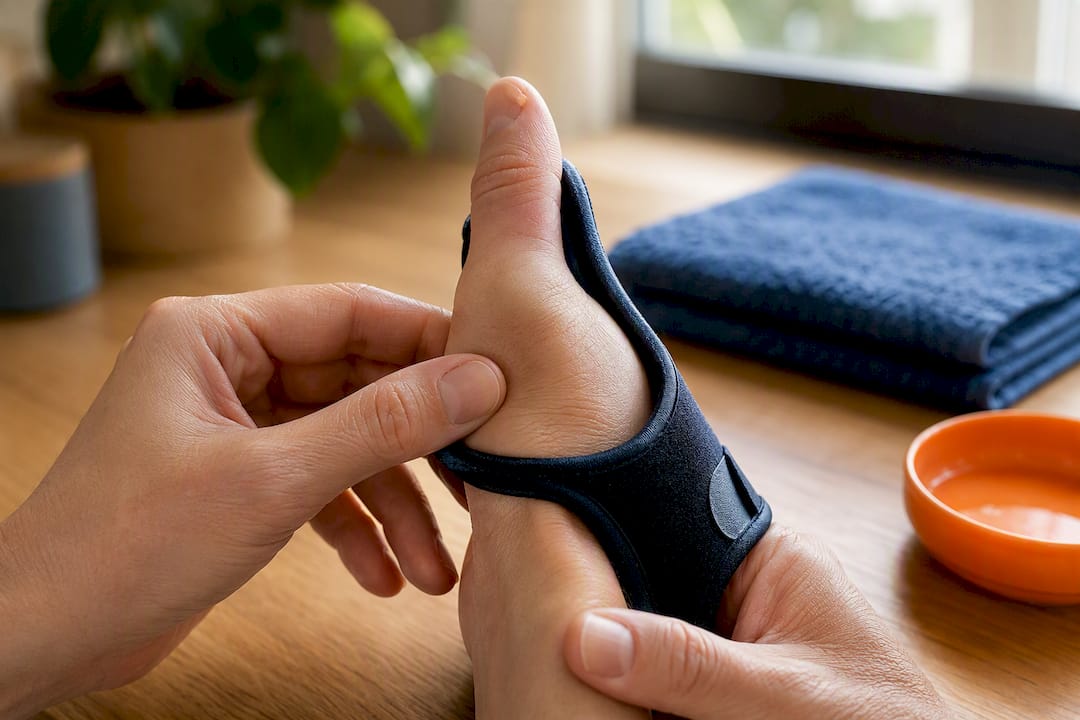
- Thumb spica cast or splint: rigid, extends from the forearm to the thumb tip, used for confirmed partial tears needing strict immobilisation.
- Removable thumb spica brace: allows periodic hygiene checks and, later, controlled movement, often used once initial swelling has settled.
For a straightforward partial tear, the Merck Manual describes a thumb spica worn for three to four weeks, with many patients easing into light activity within several weeks. Reassessment at that point checks stability and pinch strength before progressing.
Pro Tip: Keep the splint dry and check the skin around the thumb daily for pressure marks. A splint that has softened, cracked or slipped no longer immobilises the joint properly, and a therapist can remake it in minutes at review.
Our own guidance on ice after injury covers safe application in more detail if you are managing symptoms at home before your appointment.
When surgery is recommended and what it involves
Surgery becomes necessary when the ligament cannot heal on its own, and the clearest reason for that is a Stener lesion. This occurs when the torn UCL retracts and flips to sit superficial to the adductor aponeurosis, physically blocking it from reattaching to bone, as explained in detail by NCBI Bookshelf. No amount of splinting fixes that anatomy.
Surgeons generally operate when they find:
- Marked instability on stress testing, particularly with a soft or absent endpoint
- A displaced bony avulsion fragment visible on imaging
- Persistent instability after a proper trial of immobilisation
- Tears displaced beyond roughly 3mm or with soft tissue interposed, which a PMC study on displacement thresholds links to immobilisation failure
The typical procedure repairs the ligament directly, sometimes reattaching an avulsed bone fragment with a small anchor or wire, followed by several weeks in a cast before therapy begins.
Surgical series report return-to-sport rates near 98% following repair, though complications including stiffness, nerve irritation and reduced range of motion occur in a meaningful minority of cases.
Early repair tends to produce better functional outcomes than delayed surgery on a chronically unstable thumb.
Rehabilitation: exercises and return-to-sport timelines
Rehabilitation follows the injury's grade and treatment path, not a fixed calendar, but the structure is consistent across cases.
- Protected active range of motion, started once the splint permits, focusing on gentle flexion and extension without stressing the ligament sideways.
- Progressive strengthening, introducing pinch and grip exercises with putty or resistance bands as pain allows.
- Functional and sport-specific drills, reintroducing catching, gripping equipment or pole use gradually, under load that mimics the original injury mechanism.
- Objective return-to-play testing, comparing grip and pinch strength against the uninjured hand before clearance.
Mild partial tears managed conservatively often return to light activity within several weeks. More severe injuries, and almost all post-surgical cases, need several more weeks before full sport-specific loading resumes. Hand therapists and occupational therapists play a central role here, adjusting splints, guiding graded loading and catching setbacks early. Our hand pain therapy guide walks through home exercises that complement supervised sessions.
Pro Tip: Track pinch strength with a simple pinch gauge if your therapist provides one. Pain easing is not the same as strength returning, and returning to sport on pain relief alone is one of the most common causes of reinjury.
Prognosis, complications and when to seek reassessment
Outcomes for correctly managed injuries are generally good.
Left untreated, a complete tear or missed Stener lesion carries real long-term risk:
- Chronic pinch and grip weakness that limits daily tasks and sport
- Persistent joint instability with repeated "giving way"
- Accelerated degenerative change at the MCP joint over years
If pain persists well beyond the expected timeline, if the thumb keeps giving way during pinch, or if grip strength plateaus below the uninjured side, that warrants a further specialist review rather than continued waiting.
How Parkstherapycentre approaches skier's thumb assessment
Our multidisciplinary team assesses suspected UCL injuries with full stability testing, applies appropriate splinting on the same visit, and builds a structured hand therapy plan around your grade of injury. Where surgery looks likely, we streamline referral to orthopaedic specialists rather than leaving you to navigate that pathway alone. Booking is straightforward, and most major insurers are accepted alongside private appointments.
— Ivan
Book a thumb assessment with Parkstherapycentre
Parkstherapycentre gives you same-pathway access to assessment, splinting and rehabilitation in one clinic, rather than separate trips to a GP, an imaging centre and a physiotherapist before treatment even starts. Our team applies a thumb spica or brace where appropriate, then builds your therapy plan around real strength benchmarks, not guesswork about when it feels "better".

If your thumb feels unstable, swelling hasn't settled, or pinch strength still lags days after a fall, book an appointment through our online booking system rather than waiting to see if it improves on its own. Appointments accept most private health insurance, and our hand pain prevention guide is worth reading once you're back to full activity, to reduce the chance of a repeat injury on your next fall or ski trip.
Sources
For deeper clinical detail, see StatPearls on ulnar collateral ligament injury, MedlinePlus on cold therapy, and the British Society for Surgery of the Hand's patient guide.
This article is general information, not a substitute for advice from a qualified doctor. Consult a qualified healthcare professional about your own circumstances before acting on anything here.
- MedlinePlus — Cold and heat therapy
- Merck Manual — Ulnar collateral ligament sprains
- NCBI Bookshelf — Ulnar collateral ligament: Stener lesion explanation