
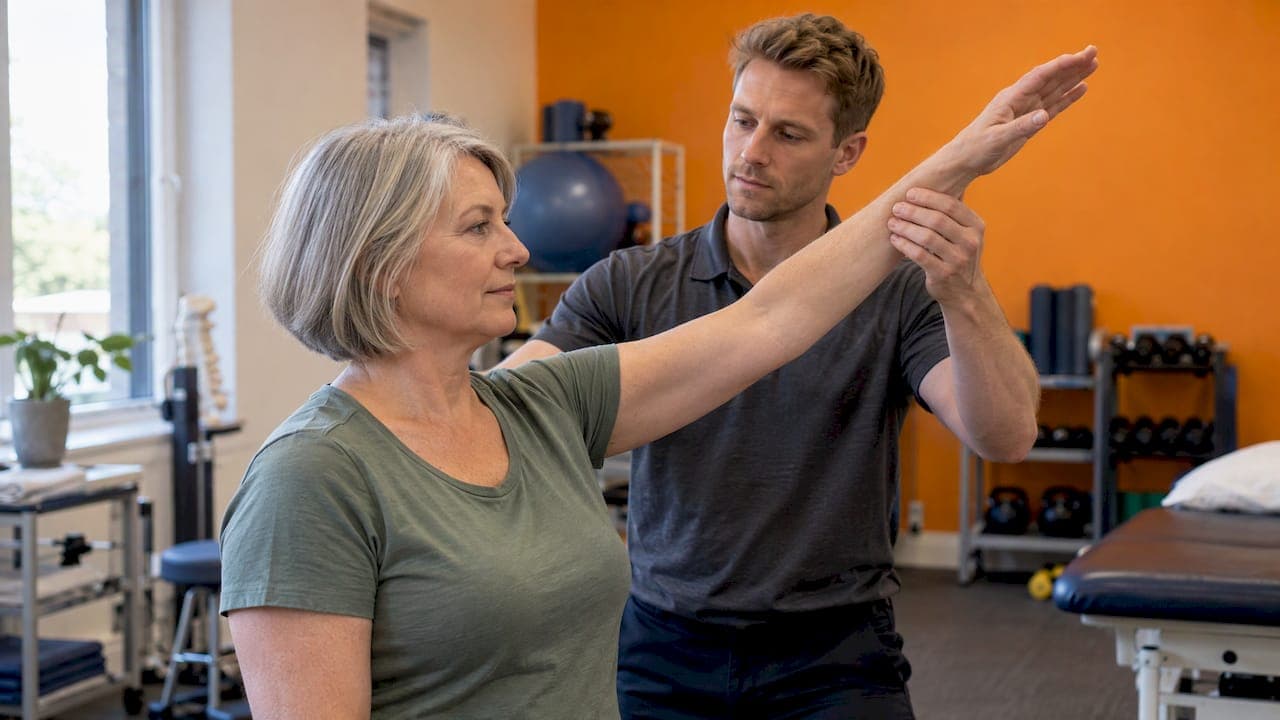
Shoulder instability rehab is a staged programme of physiotherapy that retrains the muscles around the joint so the ball stays centred in the socket. After a first dislocation, physiotherapy usually lasts 4 to 12 weeks. For instability without a major injury, it can take up to six months. This guide covers the stages, the exercises used for a subluxating shoulder, the changes after surgery, and the signs that you need a specialist.
TL;DR
- Most shoulder instability can be managed without surgery. Strengthening and retraining the muscles around the joint is the core of treatment.
- Rehab is staged: early gentle movement, then strength, then fast and unpredictable loading, then a check of readiness for sport.
- Expect 4 to 12 weeks after a traumatic dislocation, and up to 6 months when instability has no clear injury behind it.
- An unreduced or suspected dislocation needs emergency care. A first dislocation, repeated episodes or no progress need specialist review.
- Exercises should be set by a physiotherapist, because the right programme depends on the direction of instability.
Table of Contents
- What shoulder instability and subluxation mean
- When to seek urgent or specialist help
- The stages of rehab after a dislocation or subluxation
- Shoulder subluxation exercises: how a structured programme looks
- How long recovery takes
- Rehab after shoulder stabilisation surgery
- Our perspective
- Supporting your rehab with Pilates and strength work
- Book a physiotherapy assessment
- FAQ
- Sources
What shoulder instability and subluxation mean
The shoulder is a ball and socket joint with very little bony restraint. Shoulder instability happens when the structures around it do not keep the ball held firmly in the socket. It ranges from partial slipping (subluxation) to complete dislocation.
There are two broad patterns:
- Traumatic instability: a fall, tackle or accident forces the joint out. The ligaments or labrum may be damaged.
- Atraumatic instability: the shoulder slips with everyday or minor movements, with no single injury. It mainly affects people under 25, and guidance suggests considering screening for hypermobility in these patients.
A labrum injury often goes with a dislocation. Our guide to shoulder labrum tear rehab covers that recovery phase by phase.
When to seek urgent or specialist help
If you think the shoulder is currently dislocated, go to emergency care. NICE CKS advises immediate emergency assessment for a suspected acute dislocation. Do not try to put it back yourself.
Referral to a shoulder surgeon is advised in these situations:
- after a first-time dislocation
- with recurrent painful dislocations
- when symptoms affect your job or leisure activities
- when symptoms are not improving with physiotherapy
Age matters too. People over 40 should have early imaging after a dislocation to check the rotator cuff, and a tear should be reviewed by a shoulder surgeon. Those under 25 should see a shoulder surgeon within 6 weeks. People aged 25 to 40 should be assessed for instability at 3 to 6 months.
For atraumatic instability, the national pathway recommends starting with physiotherapy in primary care, with early escalation if you do not improve. The same pathway advises against steroid injections for pain relief in this condition, because they are unlikely to help and can undermine rehabilitation.
The stages of rehab after a dislocation or subluxation
Good programmes are criterion-based: you move on when you meet strength and control targets, not simply when a number of weeks has passed. A 2024 review of non-operative management prefers this approach to fixed time-based protocols. It also says the shoulder should not stay immobilised beyond 3 weeks after a first-time anterior dislocation or subluxation.
Stage 1: settle and move (about weeks 0 to 2)
The aim is to let pain settle and begin moving. NICE CKS says early mobilisation should be encouraged as soon as pain allows. A hospital programme describes starting to move the arm as much as feels able in the first one to two weeks. A sling is for comfort only and is weaned off.
Typical early work includes elbow, wrist and hand movement, gentle pendulum swings and assisted lifting of the arm within a comfortable range. A physiotherapist will help you find a safe zone where you feel confident moving. Jaggi and Alexander describe this safe zone as central to rehabilitation.
Stage 2: rebuild strength and control (from about week 2)
From two weeks, the focus shifts to strength and reactivity as pain allows. Physiotherapy exercises strengthen the surrounding muscles and improve how quickly and accurately the muscles and ligaments respond, so the joint stays stable.
The national pathway says exercise should target proprioception, the rotator cuff and the muscles around the shoulder blade. Examples include:
- isometric holds into external and internal rotation
- resistance band rotations with the elbow by your side
- rows and scapular setting exercises
- supported weight-bearing through the hand, for example on a wall or table
Stage 3: dynamic and fast loading
The four-stage model adds dynamic exercises that vary position, range, load and speed. Here the programme starts to look like your real life: reaching overhead, pushing, pulling and carrying.
Stage 4: unpredictable movement and return to sport
The final stage adds perturbations and unexpected movements, then checks readiness for sport. Patients are usually advised to avoid contact sport for 3 months after a dislocation. Return to work and driving can happen as soon as you feel safe, comfortable and confident.

Shoulder subluxation exercises: how a structured programme looks
A shoulder that slips partway needs the same principles: control first, then strength, then speed. Rehabilitation is also direction-specific, because the injury and the weaknesses differ depending on which way the shoulder moves. A programme for a forward slip is not the same as one for a backward or multidirectional slip. Weakness elsewhere in the chain, such as the trunk and shoulder blade, can contribute too.
One widely used example is the Derby Shoulder Instability Programme. Physiopedia describes it as target-led, prescribed twice daily, with two sections:
- Section 1: speed of muscle activation, plyometrics and slowing down fast movement.
- Section 2: proprioception, muscle balance and trunk stability.
You move to the next exercise in a section when you hit the target for the current one. Late-stage targets include dropping and catching a 1 kg weight at 90° scaption for 100 repetitions, 50 falling press-ups in standing, 20 plyometric clap push-ups and 60 seconds of single-handed ball rolling on a wall. These are late-stage goals, not a starting point. Starting them too early can provoke the shoulder, so a physiotherapist should decide when you are ready.
A simple home routine in the early stage, once your clinician agrees, might look like this:
| Exercise | How | Aim |
|---|---|---|
| Isometric external rotation | Back of the hand pressed into a wall, elbow by your side, hold 10 seconds | Wake up the rotator cuff without moving the joint |
| Band row | Elbows close to the body, squeeze the shoulder blades | Shoulder blade control |
| Wall slide | Forearms on the wall, slide up within a pain-free range | Confident overhead movement |
| Supported weight-bearing | Hands on a table, gentle weight through the arms | Joint position sense |
Stop and seek advice if the shoulder feels as if it is slipping out, or you have numbness, pins and needles or colour change in the arm.
How long recovery takes
- After a traumatic dislocation: physiotherapy usually lasts 4 to 12 weeks.
- Atraumatic instability: non-operative treatment achieves successful outcomes in 50 to 80% of cases, and this can take up to 6 months.
- Review point: if you improve within 12 weeks, a further 3 to 6 months of treatment is justified.
- When to escalate: continued instability despite a prolonged course of physiotherapy should prompt specialist referral.
The national pathway also stresses that most people respond to treatment for atraumatic instability, even though it can be slow. Steady, consistent work matters more than intensity.
Rehab after shoulder stabilisation surgery
Some people need surgery, for example after repeated dislocations. Rehab is then more cautious, and your surgeon's protocol always comes first.
- Weeks 0 to 3: a Delphi consensus of surgeons, physiotherapists and patients agreed on a sling for up to 3 weeks, with movement only within a defined safe zone.
- Weeks 3 to 6: one hospital guideline allows no passive external rotation beyond 20° in this period.
- From 6 weeks: resisted movement was agreed in the Delphi consensus. Driving may be possible from 6 weeks.
- 3 months: heavy lifting is avoided until then, and return to manual work needs at least 12 weeks.
- 4 months onward: contact sport may restart, and full rehabilitation usually takes 6 to 12 months.
After an open repair, forceful forward lifting, outward rotation and resisted inward rotation are avoided for six weeks. By 3 to 6 months the aim is full range of movement without apprehension.
Our perspective
In our clinics, the people who recover best are the ones who understand the plan. Instability rehab is slow, and it is easy to stop when the shoulder feels better at week four.
We build programmes around the direction your shoulder moves, your job and your sport. We keep the staging criterion-based, so you progress when your strength and control are ready.
Our multidisciplinary team can also arrange imaging referrals when they are needed, and we can add Pilates for controlled shoulder blade and trunk work once the early stages are complete.
Ivan
Supporting your rehab with Pilates and strength work
Trunk and shoulder blade control matter because kinetic chain deficits can contribute to instability. Once your physiotherapist agrees, supervised Pilates is a controlled way to build that. See our six week Pilates plan for shoulder pain. If rotator cuff weakness is part of the picture, our rotator cuff rehab guide sets out the longer strengthening timeline.
Book a physiotherapy assessment
At Parks Therapy Centre, an assessment is £76 and follow-up treatment sessions are £67. Pilates group classes are £9 per class and one-to-one Pilates is £50. We have been treating patients across Bedfordshire and Buckinghamshire since 1986, and we accept all major health insurance plans. You can see every fee on our prices page.
If you want classes alongside treatment, look at our Pilates classes in Biggleswade, St Neots, Bedford and Milton Keynes.
FAQ
Can a subluxated shoulder heal without surgery?
Often, yes. A hospital trust notes that instability can often be managed without surgery, using exercises that strengthen and coordinate the muscles around the joint. If it keeps slipping despite good rehab, a specialist opinion is the next step.
How often should I do shoulder instability exercises?
The Derby programme is prescribed twice daily. Your physiotherapist will set the frequency for your stage, and it is usually lower early on while the shoulder settles.
When can I return to sport?
Patients are usually advised to avoid contact sport for 3 months after a dislocation. Return depends on meeting strength and control criteria, not just time.
Do I need a scan?
For atraumatic instability, imaging is not usually needed in primary care. After a dislocation in people over 40, early imaging is advised to check the rotator cuff.
Sources
- NICE CKS: Shoulder pain, instability disorders
- Musculoskeletal Matters: Shoulder instability
- East Sussex MSK shoulder and elbow triage guidance 2025
- BESS/BOA atraumatic shoulder instability pathway 2019
- Olds and Uhl 2024, non-operative management
- University Hospitals of Derby and Burton: shoulder instability
- Jaggi and Alexander 2017, rehabilitation for shoulder instability
- Derby Shoulder Instability Programme, Physiopedia
- Delphi consensus on rehabilitation after arthroscopic stabilisation
- Royal Berkshire NHS: anterior stabilisation advice
- Oxford University Hospitals: anterior stabilisation guidelines
- NHS Tayside: instability and recurrent dislocation