
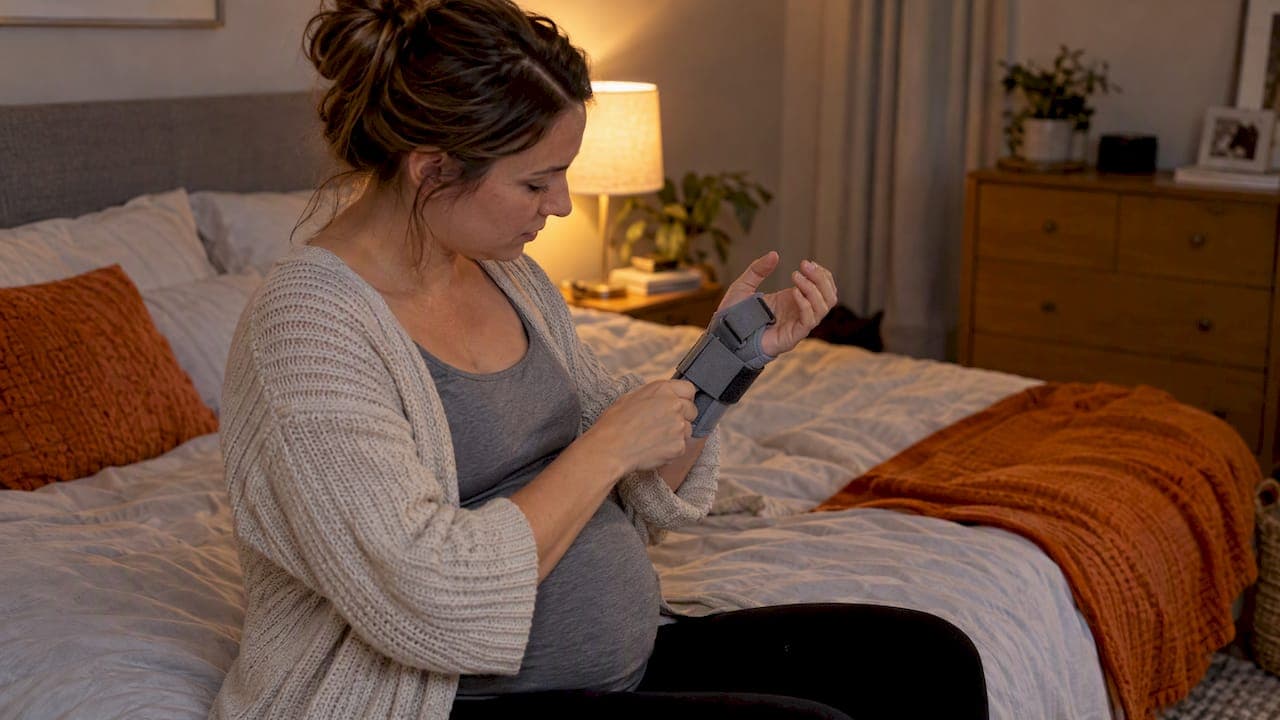
The most reliable relief for carpal tunnel syndrome in pregnancy is a combination of three things: a wrist splint worn at night, keeping your wrists straight during daily tasks, and resting your hands raised so fluid can drain. Gentle nerve and tendon gliding exercises add to this. Most women improve with these measures, and symptoms usually settle after the birth. This guide explains how to use each one, which treatments to avoid while pregnant, and when a physiotherapy assessment is worth booking. It also covers sciatica, which often turns up alongside hand symptoms.
TL;DR
- Pregnancy carpal tunnel is caused by fluid pressing on the median nerve in the wrist, and it is most common in the third trimester.
- Start with a night splint, a neutral wrist position in daily tasks, elevation and gentle gliding exercises.
- Paracetamol is the first-choice pain reliever in pregnancy. Ibuprofen and similar anti-inflammatories are generally not recommended, particularly after 20 weeks.
- Shockwave therapy and high-intensity laser are not used during pregnancy. Ask your midwife, GP or a physiotherapist before trying any new treatment.
- Tell your midwife or GP if you have constant numbness, weakness or dropping things. Symptoms can continue after birth, so ergonomics matter for newborn care too.
Table of Contents
- Why pregnancy causes carpal tunnel symptoms
- Carpal tunnel relief that works in pregnancy
- Treatments to avoid or approach with caution
- Will it go away after the baby arrives?
- When to seek help
- Our perspective: treat the habits, not just the wrist
- A note on sciatica in pregnancy
- How we can help at Parks Therapy Centre
- FAQ
- Sources
Why pregnancy causes carpal tunnel symptoms
The carpal tunnel is a narrow passage in the wrist. It carries tendons, blood vessels and the median nerve, which gives feeling and movement to the thumb and fingers. Hospital patient information from University Hospital Southampton explains that when the nerve is compressed, it causes symptoms in the hand.
In pregnancy, the usual cause is fluid retention. An NHS trust leaflet notes that this fluid sits inside the tunnel and squeezes the nerve, and that symptoms are more common in the third trimester.
How common is it? Estimates vary widely. The same Southampton information cites an incidence range of 11% to 55.4%, with higher figures reported in some clinical settings. The practical point is that you are far from alone.
What it feels like
Typical symptoms are tingling, numbness and aching in the thumb, index, middle and part of the ring finger. They are often worse at night or first thing in the morning. You may wake shaking your hand, or find that gripping a mug or a phone is harder than usual. The NHS carpal tunnel page describes pressure on a nerve in the wrist causing tingling, numbness and pain in the hand and fingers.
Carpal tunnel relief that works in pregnancy
Conservative care is the main approach. NHS England's decision aid on carpal tunnel syndrome lists pregnancy among the situations where symptoms often improve after the birth. A 2025 review in Cureus stresses individualised plans that prioritise conservative measures, with surgery reserved for severe cases that do not respond.
1. Wear a splint at night
A splint holds the wrist straight while you sleep. Without one, many people curl their wrists without realising, which increases pressure on the nerve. A Hull University Teaching Hospitals leaflet says splints work best at night, that many people find elastic ones more comfortable than rigid ones, and that they should be worn consistently for at least two to three weeks to give swelling time to settle.
Practical tips:
- Choose a splint that holds the wrist in a neutral position, not bent up or down.
- If it feels tight or your fingers swell or change colour, loosen or remove it.
- Wear it every night for a few weeks before judging whether it helps.
2. Keep the wrist neutral in daily life
NHS England's guidance treats activity modification as part of conservative management: avoid repeated wrist bending and forceful gripping. In our experience, this is the step people underestimate. Small changes include:
- Hold your phone with the wrist straight, or use voice notes and speech-to-text.
- Keyboard and mouse: keep forearms supported and wrists level, and take short breaks.
- Push a trolley with an open palm and a straight wrist rather than a tight grip.
- Carry shopping on your forearms or in a rucksack, not in clenched fingers.
- Share heavy tasks such as wringing cloths, opening jars and lifting laundry baskets.
These habits become even more useful after birth. Holding, lifting and feeding a newborn all load the wrist. If you are looking for more ideas on supporting your body through daily pregnancy tasks, this clinician-vetted guide to round ligament pain stretches covers another common ache.
3. Elevate your hands
When resting, prop your arms on a pillow or rolled towel so the hands sit higher than the elbows. A leaflet from NHS Borders recommends propping the affected arm to reduce swelling and avoiding sleeping on the affected side at night. Elevation helps fluid drain away from the wrist.
4. Use cold or warmth carefully
The NHS Borders leaflet suggests a small ice pack wrapped in a tea towel over the wrist for 5 to 10 minutes, or alternating warm and cool. Never put ice or heat straight on skin. The Cheshire and Wirral guidance says heat or cold should be avoided where there is poor circulation, skin infection, diabetes or reduced sensation, because you may not feel damage happening. If any of those apply to you, ask your midwife or GP first.
5. Move the nerve and tendons gently
Rest matters, but so does movement. The NHS Borders leaflet suggests simple exercises three times a day, such as:
- Gently bend and straighten the wrist, 10 times.
- Spread your fingers wide, then make a fist, 10 times.
- Touch each fingertip to your thumb in turn.
Stop if the exercises increase tingling or pain, and ask a physiotherapist to check your technique. Nerve gliding exercises are best taught individually, because the right range depends on how irritated the nerve is.
6. Choose pain relief with care
The MHRA's Drug Safety Update on paracetamol in pregnancy says paracetamol is the recommended first-choice pain reliever in pregnancy, taken at the lowest effective dose for the shortest time. Non-steroidal anti-inflammatory drugs such as ibuprofen are generally not recommended, particularly after 20 weeks, because of risks to the baby's heart and kidneys. Check any medicine with your pharmacist, midwife or GP.
Treatments to avoid or approach with caution
Physiotherapy for carpal tunnel outside pregnancy can include several machine-based treatments. A Cureus review reports that high-intensity laser and extracorporeal shockwave therapy are contraindicated in pregnancy, and that therapeutic ultrasound and phonophoresis are generally avoided or used with great caution.
We offer shockwave therapy for other conditions, but it is not part of a pregnancy carpal tunnel plan. In pregnancy, the emphasis is on splinting, positioning, education, gentle exercise and, where suitable, hands-on techniques.
Steroid injections are sometimes discussed. A 2024 narrative review notes that there is a lack of studies on the safety of corticosteroid options in pregnancy. Any such decision belongs with your GP, obstetric team or a hand specialist, not with a self-directed trial.
Will it go away after the baby arrives?
Usually, yes. A review of pregnancy-related hand and wrist problems describes a generally benign outlook, with symptoms resolving within a few weeks of delivery and linked to loss of pregnancy weight gain.
It is not always that quick. A systematic review summarised in a 2024 paper found that over 50% of patients reported symptoms a year after birth, and about 30% up to three years. The physical demands of looking after a newborn, such as repeated lifting, feeding and holding, may keep the nerve irritated. So keep using your night splint and neutral-wrist habits after the birth if symptoms linger, and book an assessment rather than waiting.

When to seek help
Self-care is a good first step, but do not leave symptoms to chance. The Cureus review finds pregnancy carpal tunnel is often underdiagnosed and undertreated, with only a minority of women receiving specific therapy.
See your midwife or GP if:
- Numbness is constant rather than coming and going.
- Your grip is weakening, or you are dropping objects.
- Symptoms wake you every night despite a splint.
- Hand swelling is sudden or severe, or you also have headaches, visual changes or pain under the ribs. These can be signs of pre-eclampsia, which needs urgent medical advice.
Book a physiotherapy assessment if you want a clear diagnosis, a splint fitted properly, and a plan tailored to your job, your trimester and your daily routine.
Our perspective: treat the habits, not just the wrist
We have treated musculoskeletal problems since 1986, and pregnancy hand symptoms follow a familiar pattern. Women arrive in the third trimester with night tingling, having tried a splint for a few days and given up. Often the splint is not the issue. The daytime habits are: phone grip, laptop posture, lifting toddlers, wringing cloths.

Our approach is to assess the whole picture. We look at the neck, shoulder and wrist as well as the hand, because nerve irritation can be affected along the arm. We show you how to position the wrist during the tasks you actually do, and teach gliding exercises at the right level. We are also clear about what we will not do. Treatments such as shockwave are left out during pregnancy, and we refer on to your GP or obstetric team when a problem needs medical input.
We would rather you feel in control of your symptoms for the last weeks of pregnancy and the first months with a baby than rely on one device or one session.
— Ivan
A note on sciatica in pregnancy
Many readers searching for carpal tunnel relief are also dealing with sciatica, pain that travels from the buttock down the leg. The principles are similar: reduce pressure, stay gently active and support the body at night.
- Sleeping: lie on your side with a pillow between your knees, and consider a pillow under the bump. A maternity pillow guide suggests lying on the side that does not hurt and supporting the hips with a pillow between the legs.
- Exercise: gentle walking, pelvic tilts and supervised Pilates can help many women stay comfortable. Our pregnancy Pilates guide for each trimester explains how classes are adapted.
- Treatment: hands-on care may be suitable in pregnancy. See our guide to the role of manual therapy in pregnancy and our overview of types of physiotherapy for pregnancy.
If you have numbness around the groin or inner thighs, loss of bladder or bowel control, or sudden leg weakness, seek urgent medical help the same day through 111, your midwife or A&E.
How we can help at Parks Therapy Centre
We are a multidisciplinary clinic with locations across Bedfordshire and Buckinghamshire. We accept private payment and major health insurance. A physiotherapy assessment for pregnancy hand or back symptoms covers diagnosis, splint and positioning advice, and an exercise plan.
Current published prices include:
| Service | Price |
|---|---|
| Physiotherapy Assessment | £76 |
| Physiotherapy Treatment | £67 |
| Physiotherapy Assessment (Double) | £102 |
| Physiotherapy Treatment (Double) | £77 |
| Pilates Group Sessions | £9 per class |
| Pilates One-to-One | £50 per class |
See the full list on our prices page, or visit our home page to book online. If you would like to read more on the clinical side, our physiotherapy for carpal tunnel syndrome guide covers it in depth.
FAQ
Is there a wrist brace that can help with carpal tunnel during pregnancy?
Yes. A splint that keeps the wrist neutral, worn at night, is a standard first step. NHS guidance says many people prefer elastic splints and that two to three weeks of consistent wear is needed to judge the effect. A physiotherapist can check the fit.
Will pregnancy carpal tunnel go away?
For most women it improves within weeks of the birth. However, research reviewed in 2024 found that a substantial number still had symptoms a year later. If yours persist beyond a few weeks postpartum, ask your GP or a physiotherapist for an assessment.
Why does pregnancy carpal tunnel hurt so much, especially at night?
Fluid builds up in the narrow carpal tunnel and presses on the median nerve. At night, wrists often curl and fluid settles, so pressure rises. A night splint and raising your hands on a pillow target both factors.
Can I take ibuprofen for the pain?
The MHRA says paracetamol is the first-choice pain reliever in pregnancy at the lowest effective dose. NSAIDs such as ibuprofen are generally not recommended, particularly after 20 weeks. Speak to your pharmacist, midwife or GP before taking anything.
Sources
- University Hospital Southampton: Carpal tunnel syndrome during pregnancy
- Cheshire and Wirral: Carpal tunnel syndrome during and after pregnancy
- NHS: Carpal tunnel syndrome
- NHS England: Making a decision about carpal tunnel syndrome
- Cureus: Pregnancy-related carpal tunnel syndrome
- Hull University Teaching Hospitals: Carpal tunnel syndrome, your diagnosis and treatment options
- NHS Borders: Carpal tunnel syndrome during pregnancy
- MHRA Drug Safety Update: paracetamol and pregnancy
- PMC: Management of de novo carpal tunnel syndrome in pregnancy
- PMC: Pregnancy-related hand and wrist problems
- Boppy: How to sleep with sciatica pain during pregnancy