
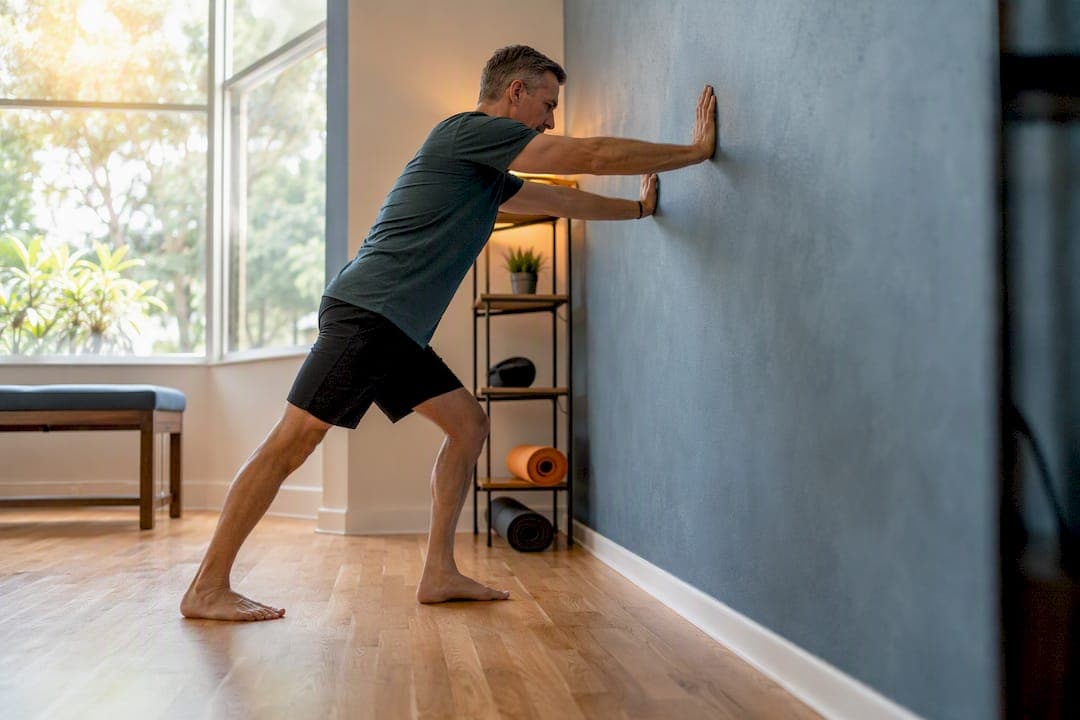
The core programme for plantar fasciitis is simple: daily calf and plantar fascia stretches, targeted foot strengthening, and short bouts of rolling, done consistently for four to eight weeks. Most people notice real improvement within that window, provided the exercises are done properly and often enough.
Start today with:
- Calf stretch against a wall, 20 to 30 second hold, three times, both legs
- Soleus stretch with a bent knee, same timing
- Plantar fascia towel stretch, pulling the toes back until you feel the arch tighten
- Towel scrunches to wake up the small muscles under the arch
- Calf raises, two to three sets of 10 to 15
- Rolling the arch on a ball or frozen bottle for one to two minutes
Do the main stretches first thing in the morning and again after any long spell of sitting, since the fascia tightens overnight and after inactivity. Add the strengthening moves once a day. Stop any exercise that produces sharp or worsening pain and read on for the full technique breakdown.
Key Takeaways
Plantar fasciitis improves fastest when daily calf and fascia stretching is combined with intrinsic foot strengthening and consistent supportive footwear, typically within four to eight weeks.
| Point | Details |
|---|---|
| Stretch dosage matters | Hold each stretch 20 to 30 seconds, repeat three times, two to three sessions daily. |
| Strength is the missing piece | Towel scrunches, marble pickups, and arch lifts build support the fascia cannot provide alone. |
| Timing beats extra volume | Stretching first thing in the morning and after sitting has more effect than adding sessions. |
| Footwear works all day | Supportive shoes worn throughout the day, not just during exercise, speed recovery. |
| Six weeks is the checkpoint | No improvement after six weeks of consistent home care warrants a Parks Therapy Centre assessment. |
Table of Contents
- What is plantar fasciitis and why do these exercises help?
- How do you stretch for plantar fasciitis correctly?
- What strengthening exercises support the arch and lower leg?
- How does self-massage and mobility work help plantar fasciitis?
- How should you progress the routine and avoid common mistakes?
- When should you see a clinician about heel pain?
- How does clinic-based physiotherapy add to home exercises?
- What actually moves the needle with plantar fasciitis
- Get a professional foot assessment if home exercises stall
- Frequently asked questions
- Sources
What is plantar fasciitis and why do these exercises help?
The plantar fascia is a thick band of connective tissue running from the heel bone to the base of the toes, and it acts as a tension cable that supports the arch every time you stand, walk, or run. Plantar fasciitis develops when repeated strain causes microscopic damage at the point where the fascia meets the heel, producing the sharp, stabbing pain most people feel with the first steps of the day.
Two mechanical problems usually sit behind that strain; for example, the role of forward head posture in heel pain development highlights how whole-body posture can influence lower-limb mechanics. A tight calf and Achilles tendon restrict how far the ankle can bend upward, which forces the foot to compensate by flattening the arch and pulling harder on the fascia with every step. At the same time, weakness in the small intrinsic muscles of the foot, the ones that cup the arch from underneath, leaves the fascia doing a job it was never meant to do alone.
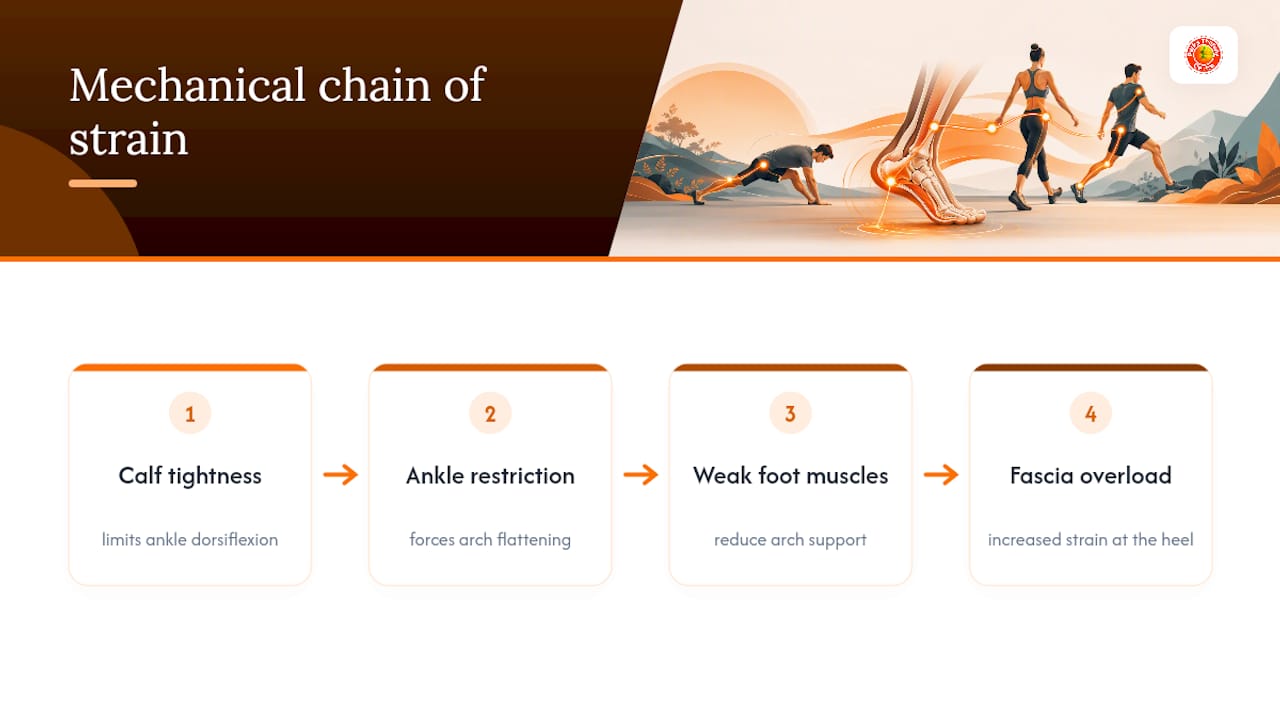
That is why an effective plantar fasciitis exercises programme never focuses on stretching or strengthening in isolation. Stretching the calf reduces the pulling force transmitted down to the heel. Strengthening the arch muscles gives the fascia mechanical backup, so it stops absorbing the full load of standing and walking on its own. Add to this the everyday risk factors, standing occupations, sudden increases in running mileage, tight footwear, or a higher body weight, and it becomes clear why addressing flexibility and strength together produces better results than either approach alone.
NHS and hospital patient information consistently frames conservative care, stretching, strengthening, and activity changes, as the sensible first step before considering injections or surgery, and that sequencing reflects how the condition actually resolves in most people.
How do you stretch for plantar fasciitis correctly?
Stretching is where most home programmes go wrong, not because the exercises are difficult, but because people rush the hold times or skip the fascia-specific stretch altogether. A structured home programme of targeted plantar fascia and calf stretching, performed with proper holds several times a day, reduces pain for most patients within weeks.
1. Gastrocnemius (calf) stretch Stand facing a wall with your hands flat against it. Step the affected foot back, keeping the knee straight and the heel flat on the floor. Lean forward from the ankle, not the hips, until you feel a stretch through the upper calf. Hold for between twenty and thirty seconds, repeat multiple times, and do this several times daily.
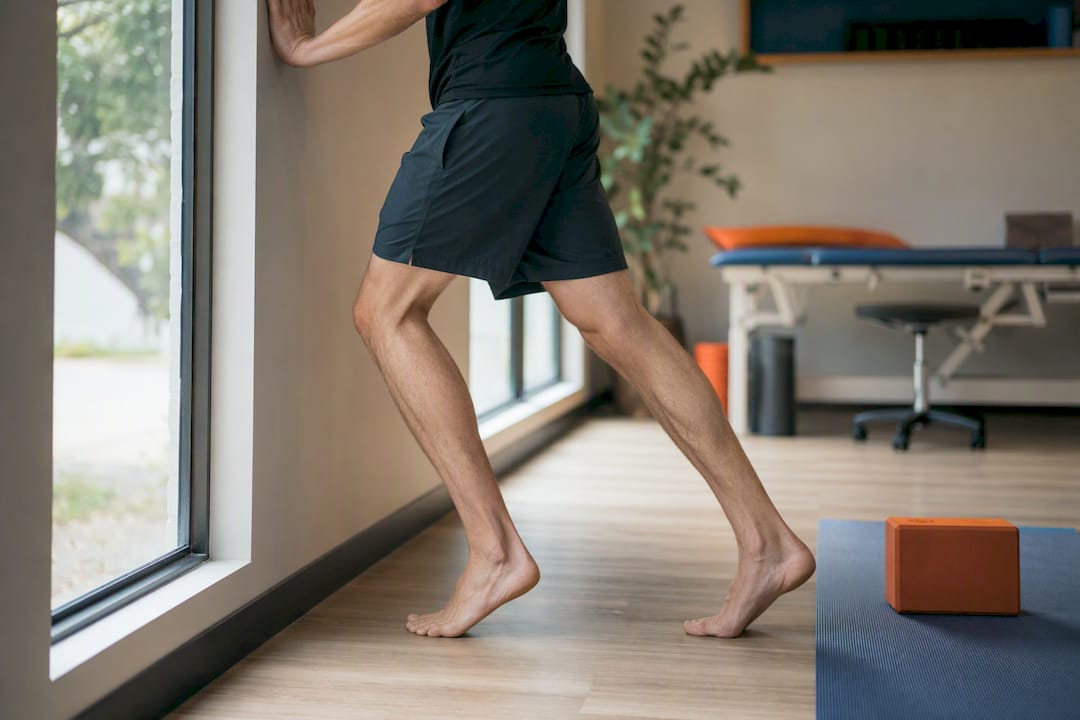
2. Soleus stretch Same starting position, but bend the back knee slightly while keeping the heel down. This shifts the stretch lower, into the soleus muscle, which often carries just as much tightness as the gastrocnemius but gets ignored. Same dosage: 20 to 30 seconds, three repeats, two to three times a day.
3. Plantar fascia-specific stretch Sit down and cross the affected foot over the opposite knee. Grip the base of the toes and pull them back towards the shin until you feel tension along the arch. A plantar fascia-specific stretching programme performed consistently improves outcomes in people with chronic symptoms, and the technique works best when you use your free hand to feel the fascia tighten under the arch like a guitar string being tuned. If you cannot feel that tension, you are pulling the wrong tissue.
4. Towel stretch (seated variant) Loop a towel around the ball of the foot and gently pull it towards you with the knee straight, useful first thing in the morning before your feet touch the floor. This targets the same structures as the seated toe pull but suits people who find the crossed-leg position uncomfortable.
- Warm up briefly with ankle circles before stretching cold tissue.
- Hold each stretch for 20 to 30 seconds, never bouncing into the end range.
- Repeat three times per stretch, two to three sessions daily.
- Check technique using the guitar-string cue on the fascia stretch.
- Stop immediately if you feel sharp, shooting, or worsening pain rather than a normal stretching sensation.
Pro Tip: Most people under-dose the fascia stretch by skipping it at the two moments that matter most, the first step out of bed and the first step after sitting for a while. Doing it at those specific times, rather than only during a scheduled "exercise session", makes a measurable difference to morning pain.
What strengthening exercises support the arch and lower leg?
Stretching loosens the structures pulling on the fascia; strengthening gives the arch the muscular support to stop relying on the fascia for load-bearing in the first place. Both matter, but strengthening is the piece home programmes most often skip, usually because the moves feel too subtle to seem worthwhile.
- Towel scrunches: sit with a towel flat under your foot, then scrunch it towards you using only your toes. Do two to three sets of 10 to 15 scrunches, and you should feel the arch working, not just the toes.
- Marble pickups: pick up small objects with your toes and place them in a bowl, a slower variation that builds the same intrinsic foot strength with more precise control. Ten to 15 pickups per set, two to three sets.
- Arch lifts (doming): keep your toes flat on the floor and try to lift the arch without curling the toes, a subtle movement that trains the muscles supporting the fascia directly. Start with five second holds for 10 repeats and progress to longer holds as control improves.
- Calf raises: begin with both feet, rising onto the toes and lowering slowly, two to three sets of 10 to 15. Progress to single-leg raises once double-leg feels easy, and only add weight, such as a loaded backpack, once single-leg control is solid.
- Toe walking and heel walking: walk 10 to 15 metres on your toes, rest, then walk the same distance on your heels. This functional progression trains the calf and shin muscles together and translates directly to normal gait mechanics.
Build these into a routine gradually rather than attempting every exercise at full volume on day one, and treat consistent light strengthening as more valuable than occasional hard sessions.
How does self-massage and mobility work help plantar fasciitis?
Rolling and mobility drills sit alongside stretching rather than replacing it, easing tension in the fascia and surrounding tissue so the stretches themselves become more effective.
- Roll the arch of your foot over a tennis ball or a rigid foam roller for one to two minutes, starting with light pressure and increasing gradually as tolerance improves.
- Try the frozen bottle technique, rolling the arch over a chilled water bottle, which combines the mechanical release of rolling with the anti-inflammatory benefit of cold, particularly useful after activity or in the evening.
- Perform ankle circles, ten each direction, and dorsiflexion mobility drills (rocking the knee forward over a bent ankle while keeping the heel down) to improve the ankle range that so often limits recovery.
- Avoid aggressive rolling or deep massage during a flare of acute inflammation, when the heel is hot, swollen, or acutely painful to touch, and seek an assessment instead of pushing through it.
Pro Tip: Keep a frozen water bottle in the freezer specifically for this. Rolling on it for a few minutes after a long day on your feet takes seconds to set up and reliably calms evening flare-ups more than static icing alone.
How should you progress the routine and avoid common mistakes?
Progression is about small, deliberate increases, not sudden leaps once the pain starts to ease.
- Follow a simple daily structure: stretches on waking, stretches again after any long period of sitting, and one dedicated strengthening session later in the day.
- Progress strengthening by increasing reps first, then moving to single-leg variations, then adding load, following roughly a 10 to 20% increase in volume or intensity at a time rather than doubling up out of impatience.
- Avoid the most common mistakes: walking barefoot on hard floors, wearing unsupportive shoes around the house, doing the exercises sporadically instead of daily, and returning to running or high-impact sport before the fascia has settled.
- Choose footwear with firm arch support, a deep heel cup, and a moderate heel-to-toe drop, and wear it consistently through the day, not just during formal exercise sessions, since consistent supportive footwear throughout the day has a noticeably large effect on how quickly symptoms settle.
- Expect meaningful improvement within four to eight weeks of consistent conservative care, a timeline reflected across multiple clinical patient resources, provided the programme is followed properly rather than in occasional bursts.
Anyone managing a related condition alongside this, such as flattened arches contributing to the strain, may find it useful to compare notes against a structured flat feet exercise plan, since the underlying strengthening principles overlap closely.
When should you see a clinician about heel pain?
Home exercises resolve most cases of plantar fasciitis, but certain signs mean you should not wait out the full six to eight week window. Seek prompt review for progressively worsening pain, pain that wakes you at night, numbness or tingling spreading into the foot, sudden swelling, redness suggesting infection, or an inability to bear weight on the foot at all.
If you have followed a consistent stretching and strengthening programme for six weeks with no improvement, it is worth booking in with a GP, physiotherapist, or podiatrist rather than persisting alone. A clinician can assess your gait and footwear, tailor the exercise progression to your specific movement pattern, fit orthotics where needed, apply manual therapy to stubborn tight tissue, and refer you onward for imaging or specialist input if the picture does not fit straightforward plantar fasciitis.
How does clinic-based physiotherapy add to home exercises?
A clinical assessment picks up what a mirror and a printed exercise sheet cannot. A physiotherapist checks your walking pattern, footwear fit, calf flexibility, and foot strength side by side, then adjusts the programme to the specific weaknesses driving your pain rather than a generic routine.
Parks Therapy Centre has provided multidisciplinary musculoskeletal care since 1986, with physiotherapy, podiatry, and sports injury treatment delivered across several Bedfordshire and Buckinghamshire clinics.
- Gait and footwear assessment to identify mechanical contributors home stretching cannot fix alone
- Hands-on manual therapy to release stubborn calf and fascia tightness faster than stretching alone
- Custom orthotic fitting where structural support is genuinely needed
- Insurance cover accepted alongside private appointments, and further reading available through the practice's own guidance on foot pain
If six weeks of consistent home exercise has not shifted your symptoms, that is the natural point to book an assessment rather than persisting with a routine that is not being adjusted to your specific case.
What actually moves the needle with plantar fasciitis
Most advice on plantar fasciitis treats stretching as the whole answer, and that is where the conventional wisdom falls short. Stretching alone loosens tight tissue, but it does nothing to build the arch strength that stops the problem recurring the moment you return to normal activity. The programmes that work combine both, and the strengthening half is consistently the part people skip because towel scrunches and arch domes feel too subtle to bother with.
The other underrated factor is timing, not volume. Doing the fascia stretch properly at the two moments it matters most, the first step in the morning and the first step after sitting, achieves more than adding extra sessions elsewhere in the day. Footwear consistency matters just as much as any single exercise: wearing supportive shoes only during a formal "exercise session" and going barefoot the rest of the time undoes much of the benefit.
If home care has not shifted things after six weeks, that is not a sign the exercises failed. It is usually a sign the mechanics behind the pain need a professional eye.
Get a professional foot assessment if home exercises stall
Parks Therapy Centre gives you a faster route to answers than continuing to guess at home: a podiatry or physiotherapy assessment identifies the specific mechanical cause of your heel pain in one visit, rather than weeks of trial and error with generic stretches.
The centre's multidisciplinary team, working across clinics in Bedfordshire and Buckinghamshire since 1986, offers gait analysis, custom orthotic fitting, and hands-on manual therapy alongside supervised rehabilitation plans built around your specific movement pattern. Both private payment and insurance cover are accepted. If you have worked through a consistent home programme for several weeks without real improvement, or the pain is bad enough that you need hands-on treatment now rather than later, book a podiatry or physiotherapy assessment through the Parks Therapy Centre website to get a tailored plan in place.
Frequently asked questions
How long does it take for plantar fasciitis exercises to work? Most people notice meaningful improvement within four to eight weeks of consistent daily stretching and strengthening. Sporadic effort, doing the routine only when pain flares, extends that timeline considerably.
Can I do plantar fasciitis exercises every day? Yes, daily practice is recommended. Stretches suit two to three sessions a day, while strengthening exercises like towel scrunches and calf raises work well as one focused session daily, ideally not immediately after intense activity.
What is the best shoe for plantar fasciitis? Look for firm arch support, a deep heel cup, and a moderate heel-to-toe drop, whether for walking or running shoes. Wearing supportive footwear consistently through the day matters as much as the specific brand or model.
Should I stretch before or after getting out of bed? The seated towel stretch works well before your feet touch the floor, since the fascia tightens overnight and that first step is often the most painful moment of the day.
Do I need orthotics for plantar fasciitis? Not always. Many people improve with stretching, strengthening, and supportive footwear alone. Orthotics help when a podiatry assessment identifies a specific structural cause, such as excessive pronation, that home exercises cannot fully address.
This article is general information, not a substitute for advice from a qualified doctor. Consult a qualified healthcare professional about your own circumstances before acting on anything here.
Sources
- Plantar fasciitis Exercises - United Lincolnshire Hospitals
- Plantar Fascia-Specific Stretching Program For Plantar Fasciitis
- 3 simple steps to beat plantar fasciitis heel pain | Yale Medicine
- 5 plantar fasciitis stretches, from a PT | HSS