

TL;DR:
- Physiotherapy is a regulated healthcare profession focused on restoring movement, reducing pain, and promoting independence after injury or illness. Aspiring physiotherapists must complete an HCPC-approved degree or apprenticeship, gaining extensive clinical experience over several years. The career offers diverse specialisms, settings, and progression paths, with steady demand and competitive pay in the UK.
Physiotherapy is a clinical profession focused on restoring movement, reducing pain, and helping people regain independence after injury, illness, or surgery. If you are considering this path, the immediate practical step is to apply for an HCPC-approved pre-registration degree or a Level 6 degree apprenticeship. Here is what to know before you apply:
- Regulator: The Health and Care Professions Council (HCPC) sets the standards; registration is legally required to practise.
- Professional body: The Chartered Society of Physiotherapy (CSP) supports members throughout their careers with guidance, CPD resources, and a career framework.
- Main employer: The NHS is the largest employer of physiotherapists in the UK, though private practice and sports settings are growing sectors.
- Standard training: A full-time BSc typically takes three years; clinical placements are substantial and include extensive supervised practice.
- Alternative route: A degree apprenticeship typically takes around four years and combines university study with paid employment.
Table of Contents
- What do physiotherapists actually do each day?
- What specialisms and settings can you work in?
- How do you become a physiotherapist in the UK?
- How long does training take, and what does it cost?
- Do you need to register with the HCPC?
- What skills and qualities do employers look for?
- How does your career develop after qualification?
- What can you expect to earn as a physiotherapist?
- Where do physiotherapists work?
- How do you find an accredited course and apply?
- Is physiotherapy a good career choice?
- Key takeaways
- A practitioner's perspective
- Useful sources
What do physiotherapists actually do each day?
The daily work of a physiotherapist centres on four core activities: assessing patients, planning treatment, delivering hands-on therapy, and educating patients to manage their own recovery. Most clinicians also maintain detailed records and attend multidisciplinary team meetings, particularly in hospital settings.
A typical day in an NHS outpatient clinic might begin with reviewing the caseload, followed by back-to-back appointments covering musculoskeletal assessments, post-operative rehabilitation, and exercise prescription. A ward-based physiotherapist might start with a respiratory patient on a surgical ward, move to a stroke rehabilitation session, and finish with a discharge planning meeting. Community physiotherapists often travel between patients' homes, care homes, and GP practices within a single shift.
Key duties across most roles include:
- Patient assessment: taking a history, observing movement, and identifying functional limitations.
- Treatment planning: setting goals with the patient and selecting appropriate interventions.
- Hands-on therapy: manual techniques, mobilisation, soft tissue work, and electrotherapy where indicated.
- Exercise prescription: designing and progressing rehabilitation programmes tailored to the individual.
- Patient education: explaining conditions, self-management strategies, and injury prevention.
- Recordkeeping: maintaining accurate clinical notes in line with HCPC standards.
The biopsychosocial approach is central to modern physiotherapy practice, meaning clinicians consider psychological and social factors alongside physical ones. The role is physically active and emotionally demanding. Caseloads can be high, and supporting patients through chronic or progressive conditions requires genuine resilience.
What specialisms and settings can you work in?

One of the strongest arguments for physiotherapy as a career is the sheer variety of clinical areas available. Choosing a specialism shapes your training priorities, the additional qualifications you may pursue, and the type of employer you are likely to work for.
Core specialisms:
- Musculoskeletal (MSK): the most common specialism, covering back pain, joint problems, and post-surgical rehabilitation in outpatient clinics and private practice.
- Neurological: working with patients following stroke, spinal cord injury, Parkinson's disease, or multiple sclerosis, typically in hospitals or community settings.
- Respiratory: supporting patients with chronic obstructive pulmonary disease, post-COVID conditions, or critical illness on wards and in ICUs.
- Paediatrics: treating children with developmental conditions, cerebral palsy, or orthopaedic problems, often in specialist children's hospitals or community clinics.
- Sports physiotherapy: managing acute injuries and supporting performance for amateur and professional athletes. Parkstherapycentre's sports physiotherapy services illustrate the breadth of this work in a private clinic context.
- Women's health: pelvic floor rehabilitation, antenatal and postnatal care.
- Mental health: supporting patients where physical and psychological needs intersect.
Settings range from NHS acute hospitals and community clinics to GP practices, private clinics, sports clubs, schools, care homes, and occupational health departments. Private practice offers clinical autonomy and often higher hourly rates, though it also brings administrative responsibility and variable income.
Pro Tip: Volunteer or work as a physiotherapy assistant in the setting that matches your target specialism before you apply. Targeted experience with, say, an amateur rugby club or a neurological rehabilitation unit carries far more weight with admissions tutors than generic healthcare volunteering.
How do you become a physiotherapist in the UK?
Three main routes lead to HCPC registration. Each suits a different stage of life and financial situation.
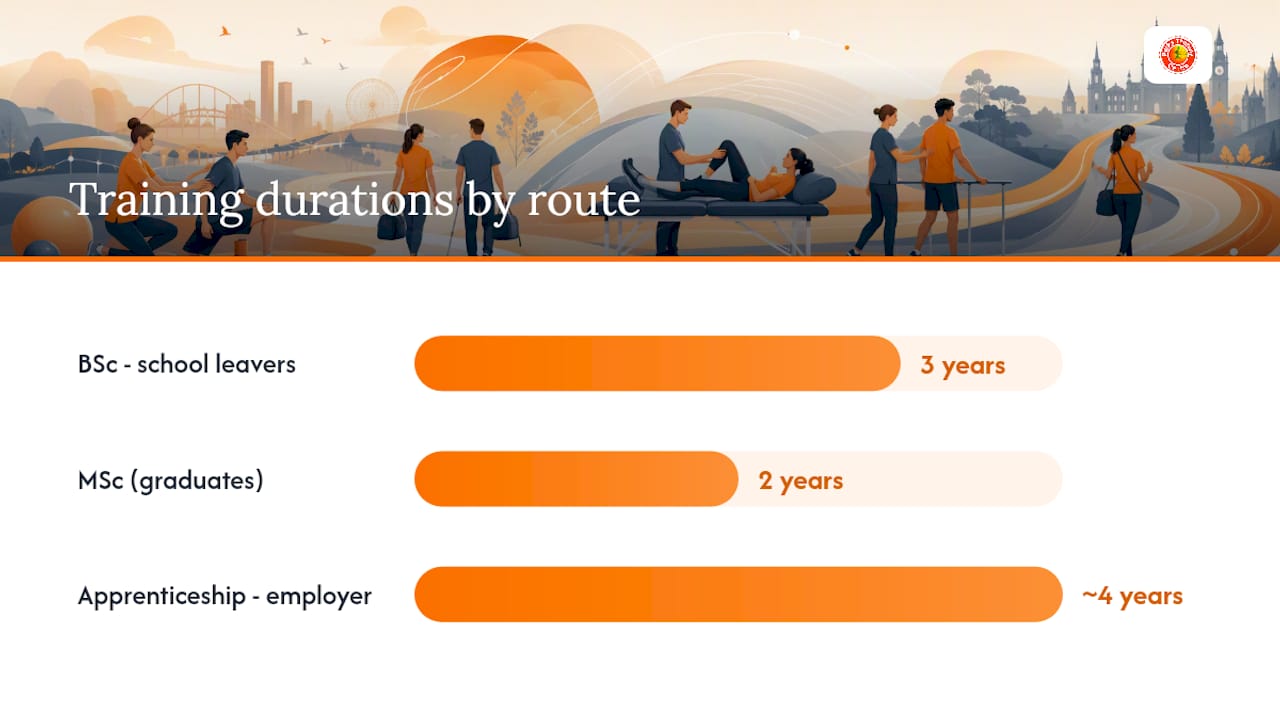
| Entry route | Duration | Typical entry requirements | Funding model | Best suited to |
|---|---|---|---|---|
| Undergraduate BSc (pre-registration) | 3 years full-time | A levels (biology preferred) or equivalent; work experience | Student loan; some NHS support available | School leavers and career-changers without a degree |
| Accelerated MSc / graduate entry | 2 years full-time | Relevant first degree (e.g. sport science, biology) | Student loan | Graduates wanting a faster route |
| Level 6 degree apprenticeship | ~4 years | Employer sponsorship; A levels or equivalent | Employer and government funded; no tuition fees | Those who want to earn while they train |
Application steps for the BSc route:
- Research HCPC-approved courses and attend open days.
- Secure relevant work experience (volunteering, assistant roles, shadowing).
- Apply through UCAS, typically by the January deadline.
- Prepare for interviews and selection days, which often include group tasks and patient scenario discussions.
- Accept an offer and confirm DBS clearance and occupational health checks before starting.
For the degree apprenticeship, the process differs: you find an employer willing to sponsor you, then apply jointly for the apprenticeship and the linked university programme. Competition for apprenticeship places is growing, so early research into NHS trusts and private providers offering this route is worthwhile. More detail on physiotherapy qualifications is available for those comparing routes.
How long does training take, and what does it cost?
Training timelines depend on the route you choose, but all paths include a significant clinical placement component.
- BSc (Hons) Physiotherapy: three years full-time, with clinical placements woven throughout all years.
- Accelerated MSc: typically two years for graduates with a relevant first degree.
- Degree apprenticeship: around four years, combining university attendance with paid work in a clinical setting.
Clinical placements are not passive observation. They are graded, supervised rotations where students deliver hands-on care and are assessed on clinical competence. Students undertake substantial supervised practice across their programme, and the physical and time demands of placement weeks are considerable.
Funding options:
- Student loans cover tuition and living costs for BSc and MSc routes.
- Some eligible students may receive at least £5,000 a year in additional NHS support, depending on their circumstances.
- Degree apprentices have tuition funded by their employer and the government, and they receive a salary throughout.
- Bursaries and hardship funds vary by university; check directly with your chosen institution.
Timeline from application to registration:
- Year 1: UCAS application submitted; offer accepted; DBS and occupational health clearance completed.
- Years 1–3 (BSc): university study and clinical placements.
- Final year: complete degree assessments and sign-off on clinical competencies.
- Post-graduation: apply to the HCPC for registration.
- Registration granted: eligible to apply for Band 5 NHS posts or equivalent private roles.
Do you need to register with the HCPC?
Yes, without exception. HCPC registration is a legal requirement before you can practise as a physiotherapist in the UK. Graduating from an accredited course is the prerequisite; registration follows qualification.
HCPC registration is not optional. Practising as a physiotherapist without it is unlawful. Before applying to any course, verify that it appears on the HCPC's approved programme register. An unaccredited degree will not lead to registration, regardless of its academic quality.
The Chartered Society of Physiotherapy (CSP) is the professional body and trade union for physiotherapists in the UK. CSP membership is separate from HCPC registration and is not legally required, but it offers substantial practical benefits:
- Access to the CSP career framework and CPD resources.
- Professional indemnity insurance for student and qualified members.
- Representation in pay negotiations and policy discussions.
- Guidance on ethical practice, scope of practice, and professional standards.
To verify whether a course is HCPC-approved, search the HCPC's online register of approved programmes. The CSP also signposts accredited courses on its website. Both checks take minutes and could save you years of misdirected effort.
What skills and qualities do employers look for?
Clinical knowledge matters, but employers consistently prioritise communication and interpersonal skills alongside technical competence. A hands-on, calm, and empathetic approach is cited repeatedly as a differentiator between effective and merely adequate clinicians.
Skills employers assess at interview and on placement:
- Communication: explaining complex conditions clearly to patients of all ages and backgrounds.
- Clinical reasoning: forming and testing hypotheses about a patient's presentation and adapting treatment accordingly.
- Manual handling: safe and effective use of hands-on techniques, which requires physical stamina over a full working day.
- Empathy and emotional resilience: supporting patients through pain, frustration, and slow progress without absorbing their distress.
- Organisation: managing a caseload, prioritising urgent cases, and maintaining accurate records under time pressure.
- IT literacy: using electronic patient record systems, telehealth platforms, and outcome measurement tools.
On your application, evidence these skills through specific examples: a volunteering role where you adapted communication for a patient with cognitive difficulties, or an assistant post where you observed clinical reasoning in action and reflected on it. Reflective logs, particularly those structured around a recognised model such as Gibbs' Reflective Cycle, demonstrate self-awareness that admissions panels value.
Pro Tip: At selection days, interviewers are watching how you interact with other candidates as much as how you answer questions. Listening actively, building on others' points, and staying calm under pressure are all being assessed. Prepare a specific example of a time you supported someone through a difficult situation.
Physical fitness is a practical consideration too. Physiotherapy involves prolonged standing, manual handling, and moving between clinical areas. Candidates who have thought about their own physical health and stamina tend to sustain the role more comfortably long-term.
How does your career develop after qualification?
The CSP career framework structures professional development around four pillars: clinical practice, leadership, education, and research. The framework is not a ladder with a single top rung; it is a map of interacting domains that clinicians can engage with at any career stage.
Most newly qualified physiotherapists begin in rotational NHS posts, which provide structured exposure to respiratory, neurological, and musculoskeletal care in sequence. This generalist foundation is intentional. Even those who know they want to specialise in sports or paediatrics benefit from understanding how other systems interact with their area of interest.
Common progression routes:
- Specialisation: moving from rotational posts into a specific clinical area, often supported by postgraduate certificates or diplomas.
- Advanced practice: taking on extended scope roles, including independent prescribing, diagnostic imaging referral, or first-contact practitioner posts in GP practices.
- Consultant roles: senior clinical leadership positions combining complex case management, service development, and research.
- Education: moving into university lecturing or clinical education roles, often alongside part-time clinical work.
- Research: contributing to clinical trials, service evaluations, or academic partnerships.
- Portfolio careers: mixing clinical sessions with private practice, sports club work, or digital health projects.
Placement hours matter beyond graduation. Students who exceed 1,000 hours of supervised clinical practice during training enter the workforce with a measurably stronger clinical foundation. Treat every placement as a job interview for the sector you want to work in.
Career paths are increasingly non-linear, with many physiotherapists moving between NHS, private, and community settings across their working lives. The CSP recommends integrating all four pillars throughout your career, not just in formal training. Even a clinician in private practice benefits from engaging with research and taking on mentoring responsibilities.
Pro Tip: Keep a CPD portfolio from day one of your career. Employers and the HCPC expect evidence of ongoing learning; starting early means you are never scrambling to reconstruct a year's worth of development at renewal time.
What can you expect to earn as a physiotherapist?
Pay in the NHS follows the Agenda for Change (AfC) pay framework. Graduate physiotherapists typically start at Band 5. With experience and specialisation, progression to Band 6 and Band 7 is standard; advanced and consultant practitioners reach Band 8 and above.
Overview of NHS pay structure:
- Band 5: entry-level graduate posts; the starting point for most newly qualified physiotherapists.
- Band 6: specialist or senior clinician roles, often reached after two to four years of post-qualification experience.
- Band 7: advanced practitioners, team leads, and those with significant specialist expertise.
- Band 8a and above: consultant practitioners, clinical leads, and those with extended scope responsibilities.
Check current AfC pay scales directly on the NHS Employers website before making financial plans. Pay bands are subject to annual review and vary slightly by region, particularly in London where a high-cost supplement applies.
Private practice and locum work typically offer higher hourly rates than equivalent NHS posts, but income is variable and clinicians bear their own insurance, administration, and pension costs. Locum physiotherapy is a realistic option for experienced clinicians seeking flexibility, though it is rarely advisable as a first post straight from qualification.
Common benefits in NHS roles include a defined-benefit pension scheme, generous annual leave entitlement, access to training and CPD funding, and staff health and wellbeing programmes.
Where do physiotherapists work?
The range of employers is broader than most prospective students realise. NHS trusts account for the majority of posts, but the independent and third sectors are substantial.
- NHS acute hospitals: ward-based and outpatient roles across all major specialisms; rotational posts common for new graduates.
- NHS community services: home visits, community clinics, and intermediate care teams supporting discharge from hospital.
- GP practices and primary care networks: first-contact physiotherapy roles, a growing area following NHS England's primary care expansion.
- Private clinics: MSK, sports, and rehabilitation services; Parkstherapycentre operates across Bedfordshire and Buckinghamshire as an example of a multidisciplinary private provider.
- Sports clubs and academies: professional and semi-professional sport, from football academies to athletics clubs.
- Charities and hospices: palliative care, neurological charities, and disability organisations.
- Schools and special educational needs settings: paediatric and developmental roles.
- Armed forces: military physiotherapy, supporting serving personnel and veterans.
- Occupational health: workplace rehabilitation and injury prevention for corporate clients.
- Non-traditional roles: health policy, digital health platforms, and clinical education are valid options for those who want to move beyond direct patient care.
How do you find an accredited course and apply?
A structured approach saves time and avoids the costly mistake of enrolling on an unaccredited programme.
- Verify HCPC approval for every course you consider, using the HCPC's register of approved programmes.
- Check CSP signposting for additional quality indicators and course listings.
- Attend open days at universities offering physiotherapy degrees; ask specifically about placement providers and pastoral support.
- Secure targeted work experience before applying: assistant physiotherapist roles, volunteering with relevant patient groups, or shadowing in a clinical setting.
- Apply through UCAS for undergraduate BSc programmes; the main deadline is typically in January for September entry.
- Prepare your personal statement around clinical experience, motivation, and evidence of the skills listed in Section 7.
- Prepare for interviews by practising patient scenario questions, ethical dilemmas, and group discussion tasks.
- Gather references from academic tutors and clinical supervisors or employers who can speak to your suitability.
For the degree apprenticeship route, the application process runs through individual employers rather than UCAS. Research NHS trusts and private providers in your area who offer the apprenticeship, and contact their workforce development teams directly.
If you have a non-traditional background:
- Access courses and foundation years exist for applicants without standard A levels.
- Mature applicants with relevant healthcare experience are welcomed by many programmes.
- Graduate entry MSc routes are specifically designed for those with a relevant first degree who want a faster path to qualification.
Is physiotherapy a good career choice?
Physiotherapy offers high patient contact, genuine clinical variety, a clear regulatory framework, and recognised progression routes. The demand for physiotherapists in the UK is steady and is expected to grow as the population ages and long-term conditions become more prevalent.
Pros:
- Direct, meaningful impact on patients' quality of life.
- Variety of specialisms and settings across a career.
- Clear professional regulation and protected title.
- Multiple progression routes, including advanced practice and leadership.
- Growing opportunities in primary care, digital health, and sports.
Cons:
- Physical demands: prolonged standing, manual handling, and active clinical work throughout a shift.
- Emotional labour: supporting patients through chronic pain, disability, and slow recovery.
- Caseload pressure: NHS settings can involve high patient volumes and administrative burden.
- Shift patterns: hospital roles may include weekends and bank holidays.
Job prospects are positive. The shift towards community-based care, the expansion of first-contact physiotherapy in GP practices, and the sustained demand from an ageing population all support long-term career stability. Private practice and sports physiotherapy continue to grow as sectors.
Pro Tip: Work-life balance in physiotherapy is manageable but requires active attention, particularly in the first two years of practice. Build a support network of peers, use clinical supervision, and treat your own physical health as a professional priority, not an afterthought.
Key takeaways
Physiotherapy as a career requires an HCPC-approved qualification, strong interpersonal skills, and a commitment to clinical placements that typically exceed 1,000 hours before you qualify.
| Point | Details |
|---|---|
| Registration is mandatory | HCPC registration is legally required to practise; verify course approval before applying. |
| Three main entry routes | BSc (3 years), accelerated MSc (2 years for graduates), or degree apprenticeship (~4 years, employer-funded). |
| Placements are substantial | Students typically exceed 1,000 hours of supervised clinical practice during training. |
| NHS starting point | Graduate physiotherapists begin on Agenda for Change Band 5; progression follows experience and specialisation. |
| Career paths are flexible | The CSP four pillars support clinical, leadership, education, and research development at every stage. |
A practitioner's perspective
The aspect of physiotherapy that surprises most newly qualified clinicians is not the clinical complexity. It is the relational depth of the work. Patients do not simply present with a shoulder problem or a neurological condition; they arrive with fears, expectations, and histories that shape how they respond to treatment. The clinicians who thrive earliest are those who have already developed the habit of listening carefully before they start problem-solving.
From a provider perspective, the most valuable thing a prospective physiotherapist can do before applying is spend time in a real clinical environment, not just to observe, but to notice what the work actually feels like hour by hour. Local clinics, NHS community teams, and sports clubs in Bedfordshire and Buckinghamshire are often willing to accommodate motivated volunteers or observers. That direct exposure, combined with a clear understanding of the current standards shaping the profession, gives applicants a grounded and credible account of their motivation, which is what admissions panels and employers are genuinely looking for.
Physiotherapy career paths are no longer linear, and that is a strength, not a complication. A clinician might spend five years in NHS MSK, move into sports physiotherapy, take on a clinical educator role, and later develop a private practice. Each transition builds on the last. The CSP framework exists precisely to help clinicians navigate those moves with intention rather than drift.
Useful sources
The following primary and authoritative sources support the information in this guide. Verify HCPC course approval directly before applying to any programme.
- NHS Health Careers: Physiotherapist: covers entry routes, training, pay bands, and registration requirements for the UK.
- National Careers Service: Physiotherapist: practical overview of the role, skills, and degree apprenticeship route.
- Health and Care Professions Council (HCPC): the regulator; use the approved programmes register to verify any course before applying.
- Chartered Society of Physiotherapy (CSP): career framework, CPD resources, course signposting, and professional guidance.
- CSP Career Framework 2024: the four pillars of practice and how they apply across career stages.
- NHS Employers: Agenda for Change pay scales: current pay band information; check here for up-to-date salary figures before making financial plans.