
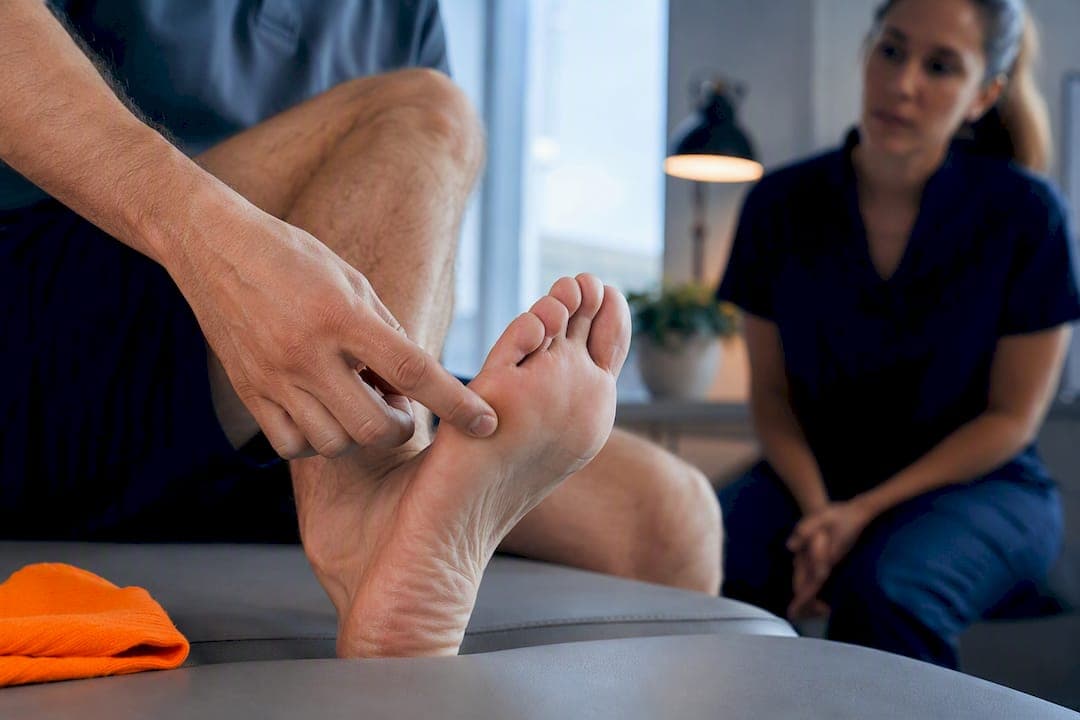
If you have sharp, burning pain in the ball of your foot, often between the third and fourth toes, with a feeling of a pebble underfoot, these are classic signs of Morton's neuroma. Try wide, low-heeled shoes straight away, and if the pain, numbness or tingling persists beyond a few weeks or stops you walking normally, book an assessment with a GP or podiatrist.
TL;DR:
- Narrow, high-heeled shoes are the primary cause of Morton's neuroma, especially in middle-aged women, due to repeated forefoot compression.
- Symptoms often start as occasional, improving with shoe removal, but can become persistent and interfere with walking if untreated.
- Conservative treatment with wide shoes, metatarsal pads, and activity modifications usually relieves symptoms within a few weeks, avoiding the need for injections or surgery.
- A clinical assessment involves pressing on the affected webspace, eliciting Mulder's click, and considering ultrasound or MRI if the diagnosis is unclear or atypical.
- Delaying professional evaluation beyond two to six weeks of persistent symptoms reduces non-surgical treatment effectiveness and limits future options.
Table of Contents
- What are the symptoms of Morton's neuroma?
- What happens during a Morton's neuroma assessment?
- What causes Morton's neuroma and who gets it?
- When should you see a doctor about foot pain?
- How do you manage symptoms yourself at first?
- What treatments work for Morton's neuroma?
- How Parkstherapycentre supports people with forefoot pain
- Ready to get your foot pain properly assessed?
- Why symptom recognition matters more than people think
- Sources
- FAQ
What are the symptoms of Morton's neuroma?
The pain has a distinct character. Patients describe it as stabbing, shooting, burning, or like an electric shock running through the forefoot. It sits in the ball of the foot, most often in the space between the third and fourth toes, though the second and third interspace is affected occasionally too.
The pebble or marble sensation is the detail most patients mention first, that persistent feeling of something lodged inside the shoe that isn't actually there. Alongside it, many people notice pins-and-needles, patches of numbness, or cramping in the toes themselves.
Symptoms follow a clear pattern:
- Worse when standing, walking or running, especially in narrow or high-heeled shoes
- Often eases when you remove your shoe and rub the forefoot
- May start as an occasional twinge and become more constant if left unaddressed
- Can radiate into the adjoining toes as irritation increases
Early on, the pain tends to come and go. Left untreated, symptoms can become persistent and start interfering with everyday activity rather than just tight shoes or long runs.
What happens during a Morton's neuroma assessment?
A clinician will usually ask about when the pain started, what footwear you wear most, and whether certain activities (walking, running, standing at work) bring it on. That history alone often points strongly towards the diagnosis.
Physical examination looks for specific signs:
- Tenderness when pressing directly into the affected webspace
- Pain reproduced by squeezing the forefoot from side to side (mediolateral compression)
- Mulder's click, a palpable or audible click when the metatarsal heads are compressed together, caused by the thickened nerve tissue shifting between the bones
Diagnosis is usually clinical, meaning history and examination are often enough. Ultrasound or MRI come into play for atypical presentations, and an X-ray may be ordered simply to rule out a stress fracture or arthritic change rather than to confirm the neuroma itself.
What causes Morton's neuroma and who gets it?
The nerve becomes irritated when it's repeatedly compressed between the metatarsal heads, and footwear is usually the main driver.
- Narrow, pointed or high-heeled shoes squeeze the forefoot and push the metatarsal heads together
- Instability at the metatarsophalangeal joints, along with individual differences in forefoot shape, can make certain people more prone to nerve irritation
- Repetitive loading from running or long periods on your feet adds further mechanical stress
- The condition is more common in middle-aged adults and disproportionately affects women, a pattern most researchers link to footwear choices
Correcting the mechanical contributors, not just calming the nerve, tends to give the most lasting relief.
When should you see a doctor about foot pain?
Some symptoms warrant prompt professional input rather than a wait-and-see approach.
- Book an appointment if pain is limiting how far or how long you can walk
- Seek assessment if numbness or tingling is spreading or getting worse over time
- Get checked if a fair self-care trial (several weeks) brings no meaningful change
- Arrange urgent review if you can't bear weight on the foot, notice a visible deformity, or numbness progresses rapidly
A first appointment typically covers a detailed history and examination, and may lead to a referral for imaging, a steroid injection, or a structured conservative plan depending on what's found.
How do you manage symptoms yourself at first?
Conservative, footwear-led changes work for a large share of people and cost nothing beyond a shoe swap.
- Switch to shoes with a wide toe box and a low heel; avoid pointed or narrow styles entirely during a flare
- Try a metatarsal pad or supportive insole, positioned just behind (proximal to) the metatarsal heads rather than under them, since placement changes whether it actually offloads the nerve
- Cut back temporarily on high-impact activity, and use short courses of over-the-counter anti-inflammatories or ice massage for flare-ups
- Give it several weeks and track whether things are genuinely improving before deciding on next steps
Pro Tip: A metatarsal pad placed even a centimetre too far forward does nothing for the nerve. Feel for the hard ridge of the metatarsal heads with your fingers, then position the pad just behind that ridge, not under it.
If symptoms haven't shifted meaningfully within that window, it's time to involve a clinician rather than persisting alone.
What treatments work for Morton's neuroma?
Treatment escalates in stages, and most people never need surgery.
- Conservative care first: footwear changes, metatarsal pads and orthoses remain the foundation, and NHS guidance recommends exhausting these before considering injections or surgery
- Corticosteroid injections offer short to medium-term relief for many patients but aren't curative, and clinicians often use ultrasound guidance to place them accurately
- Sclerosing (alcohol) injections are an option in some clinics, with more variable evidence behind them
- Surgery (decompression or neurectomy) is reserved for cases that don't respond to conservative measures
Reported success rates for surgical neurectomy are high in carefully selected patients, though removing the nerve typically causes permanent numbness in the affected toes, a trade-off worth discussing properly before agreeing to it. The realistic picture: many people settle with non-surgical care, and surgery remains a fallback rather than a first move.
How Parkstherapycentre supports people with forefoot pain
A multidisciplinary physiotherapy, podiatry and related therapies centre has a long track record in assessing exactly this kind of forefoot pain. A podiatry assessment can examine your gait, footwear and forefoot mechanics directly, complementing whatever your GP has already advised.
Services relevant to suspected neuroma symptoms include:
- Podiatry assessment to examine foot mechanics and footwear fit
- Physiotherapy assessment and treatment for related biomechanical issues
- Image referral where further investigation is needed
Bring your usual footwear and a note of when the pain started; it helps the clinician build a clearer picture from the first visit.
Ready to get your foot pain properly assessed?
Guesswork isn't a strategy when forefoot pain is affecting how you walk. A proper assessment identifies whether footwear, biomechanics or nerve irritation is driving your symptoms, and sets a plan rather than leaving you cycling through shoe changes indefinitely. Parkstherapycentre's physiotherapy and podiatry assessments start at £76 for a Physiotherapy Assessment, with podiatry and imaging referral options listed on the same pricing page. Booking early tends to shorten the whole process.
Why symptom recognition matters more than people think
We see a recurring pattern at the clinic: people tolerate the pebble sensation for months, assuming it's a passing shoe problem, before mentioning it to anyone. By the time they book an appointment, the nerve has often been irritated long enough that footwear changes alone aren't quite enough.
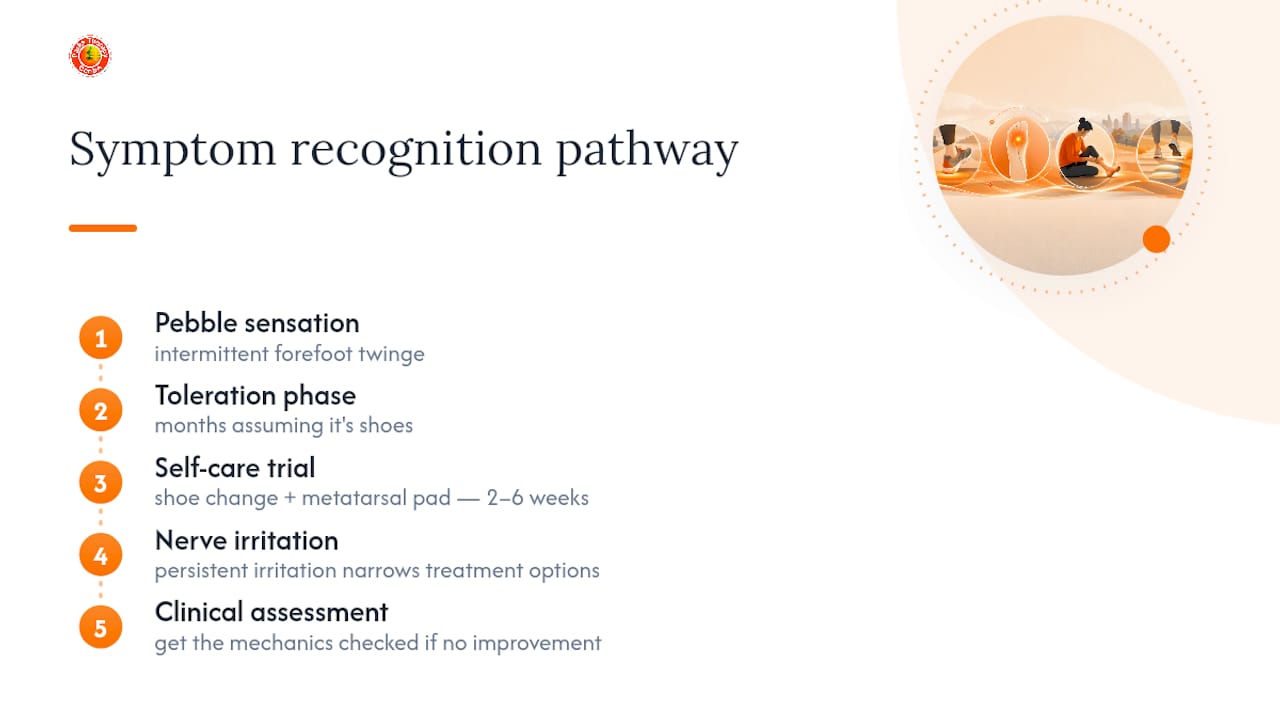
That delay is understandable. Forefoot pain is easy to blame on a bad pair of shoes, and early symptoms genuinely do come and go. But the interval between "occasional twinge" and "constant ache that changes how you walk" is exactly where conservative treatment works best. Waiting past that window doesn't make surgery inevitable, but it does narrow your options and stretch out recovery.
The practical takeaway is simple: treat two to six weeks of self-care as a genuine trial with an endpoint, not an open-ended holding pattern. If a shoe change and a metatarsal pad haven't shifted things by then, get the mechanics checked properly rather than guessing at a different insole.
— Ivan
This article is general information, not a substitute for advice from a qualified doctor. Consult a qualified healthcare professional about your own circumstances before acting on anything here.
Sources
- Morton neuroma - StatPearls - NCBI Bookshelf
- Morton's neuroma | NHS
- Morton neuroma - Symptoms and causes | Mayo Clinic
- Morton's neuroma - MedlinePlus
FAQ
What is the best cure for Morton's neuroma?
There is no single "cure" that works for everyone. Conservative care, wide shoes, metatarsal pads and activity changes, resolves symptoms for many people, while corticosteroid injections and surgery remain options for cases that don't respond.
Will a Morton's neuroma go away on its own?
Mild cases sometimes settle once footwear and activity triggers are removed, but established neuromas rarely disappear completely without some form of intervention. Persistent symptoms beyond a few weeks of self-care warrant a proper assessment.
Does walking help Morton's neuroma?
Walking itself isn't harmful, but walking in tight or unsupportive shoes tends to aggravate symptoms by compressing the nerve further. Switching to supportive, wide-toed footwear usually makes walking more comfortable rather than something to avoid.
What is the pinch test for Morton's neuroma?
The pinch, or squeeze, test involves compressing the forefoot from side to side while pressing into the affected webspace. It can reproduce the pain and sometimes trigger Mulder's click, a palpable click caused by the irritated nerve shifting between the metatarsal bones.