
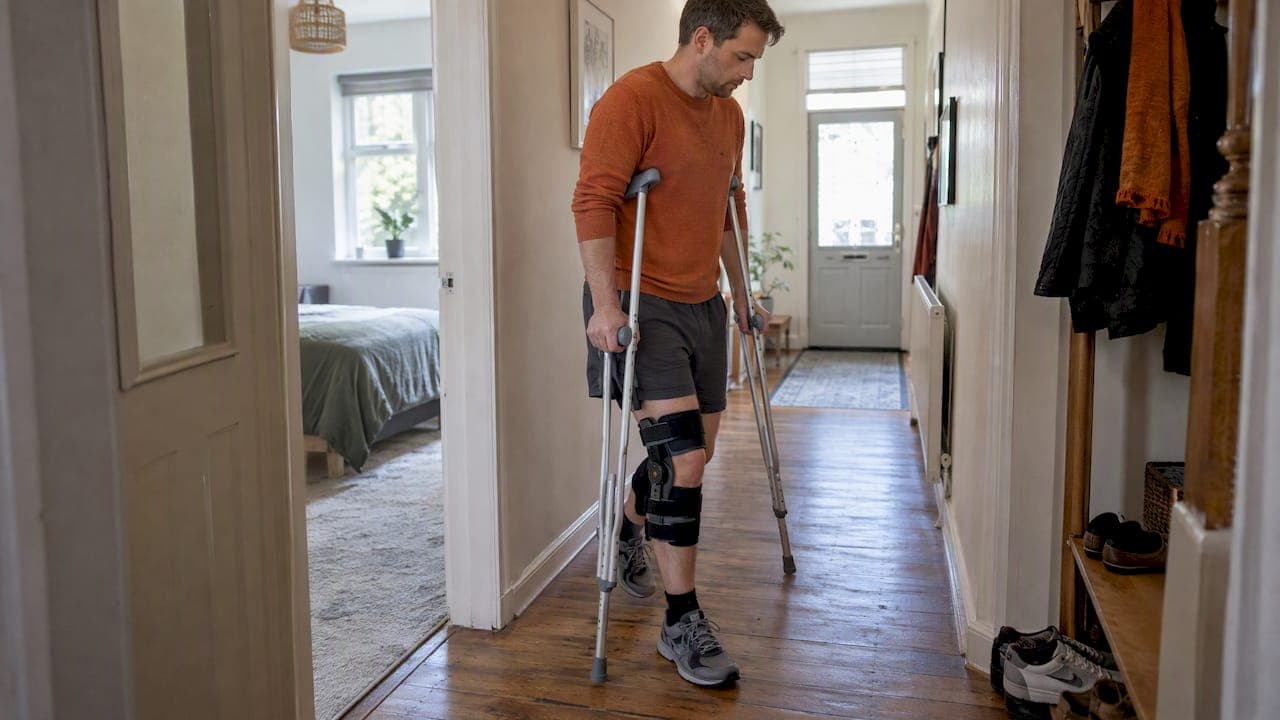
Most MCL sprains heal without surgery. The first 48 to 72 hours call for PRICE (Protection, Rest, Ice, Compression, Elevation), followed by structured, physiotherapy-guided exercise that rebuilds motion, strength and control in stages. Recovery generally spans several weeks to several months depending on severity, and return to sport depends on how your knee performs, not on a date on the calendar.
TL;DR:
- For 48 to 72 hours, follow PRICE, ice for 15 to 20 minutes every two to three hours, and begin gentle motion when tolerable.
- Grade 1 injuries may allow athletes back within 10 to 14 days, but return requires full motion, no swelling, matched strength, and controlled cutting.
- Add resistance only after motion is comfortable and swelling settles; increase load by roughly 10% weekly, and reduce it if swelling returns the next morning.
- Seek same day care if you cannot bear weight, the knee is grossly unstable, or your foot becomes numb, tingling, cold, or pale.
- Arrange a clinical review within five to seven days if pain or swelling fails to improve, or the knee still gives way during ordinary walking.
Table of Contents
- Symptoms and grading: what severity means for your recovery
- The first 48 to 72 hours: exact steps to calm swelling and pain
- A three-phase rehabilitation programme: exercises that rebuild your knee
- How long recovery takes: judge readiness by function, not by date
- Red flags: when to get a professional review
- Reducing re-injury risk as you return to activity
- How we approach MCL sprains at Parks Therapy Centre
- Why rushing back to sport undoes good rehab
- Book a physiotherapy assessment for your knee
- FAQ
- Sources
Symptoms and grading: what severity means for your recovery
An MCL sprain typically causes pain along the inner knee, swelling, tenderness over the ligament, and a feeling of reduced movement or mild give when you twist or pivot. Many people recall a specific moment, often a blow to the outside of the knee or an awkward twist, when the pain started.
Clinicians grade MCL injuries by severity, and the grade shapes what recovery looks like:
- Grade 1: Ligament fibres are stretched but intact; mild tenderness, minimal swelling, and walking is usually possible.
- Grade 2: Partial tearing with more noticeable swelling, bruising, and a sense of looseness when the knee is stressed sideways.
- Grade 3: A complete tear with marked instability; the knee may feel like it will give way during normal movement.
Grade 1 and grade 2 injuries make up the majority of MCL sprains and typically respond well to non-surgical care, though a systematic review of non-operative MCL rehabilitation notes that protocols vary across clinical settings. MCL injuries sometimes occur alongside ACL or meniscus damage, particularly after higher-force twisting injuries, which is one reason persistent instability warrants a clinical look.
The first 48 to 72 hours: exact steps to calm swelling and pain
What you do immediately after injury has a real bearing on comfort and the pace of early healing. The NHS guidance on sprains and strains recommends the PRICE approach for the first two to three days:
- Protection: Limit weight-bearing if it is painful, and consider a brace or crutches for support.
- Rest: Avoid activities that stress the knee sideways, but do not stay completely still.
- Ice: Apply an ice pack wrapped in a cloth for around 15 to 20 minutes every two to three hours.
- Compression: Use a supportive bandage to help control swelling without cutting off circulation.
- Elevation: Keep the leg raised above hip height when resting.
One important detail from NHS guidance: gentle, active range-of-motion work should begin as soon as it can be done without excessive pain, since waiting too long risks stiffness in the joint.
Avoid heat, alcohol, running or massage of the injured area during this early phase, as each can increase swelling or bleeding into the joint. Over-the-counter pain relief such as paracetamol can help with discomfort; always check with a pharmacist if you take other medication. If walking is painful, crutches for a few days are sensible, and a hinged knee brace can add confidence and side support while the ligament settles.
A three-phase rehabilitation programme: exercises that rebuild your knee
Structured, progressive loading is what turns a sprained MCL into a reliable knee again. Recovery tends to move through three overlapping phases.
Phase 1: restore motion and switch the muscles back on. The goal here is pain-free range of movement and gentle activation of the thigh muscles.
- Heel slides: Lying down, slide your heel toward your bottom and back, 10 to 15 repetitions, two to three times daily.
- Quad sets: Tighten the thigh muscle with the leg straight, hold for five seconds, repeat 10 times.
- Straight leg raises: Lift the straightened leg to hip height, lower slowly, building to three sets of 10.
Work within mild discomfort only, never into sharp pain, and progress when a movement feels consistently easy.
Phase 2: build strength and load tolerance. Once motion is comfortable and swelling has settled, add resistance and functional loading.
- Glute bridges and mini-squats rebuild hip and quadriceps strength without heavy knee stress.
- Step-downs from a low step challenge control through bend and extension.
- Stationary cycling at low resistance is a useful low-impact conditioning option.
Increase load gradually, roughly 10% more resistance or repetitions per week, and back off if swelling returns the next morning. Our home exercise guidance covers technique cues that apply well to this stage.
Phase 3: proprioception, balance and sport-specific preparation. This phase reintroduces the demands of real activity: balance challenges, hopping drills, and eventually cutting and pivoting movements. According to patient guidance from an NHS trust, twisting and change-of-direction work should be the last elements reintroduced, built on a foundation of neuromuscular control drills.

Pro Tip: If you are older or less mobile, swap step-downs and hopping drills for sit-to-stand repetitions and single-leg balance holds against a wall, which load the same muscles with far less joint stress.
No gym access is no barrier: bodyweight squats, resistance bands, and stairs at home can substitute for most equipment-based exercises in this programme.
How long recovery takes: judge readiness by function, not by date
Healing times vary by grade and by individual factors such as age, fitness and how closely the rehab programme is followed. Grade 1 injuries often allow athletes to return within 10 to 14 days, while grade 2 injuries follow a more variable course and depend on meeting strength and stability benchmarks rather than a fixed number of weeks. Grade 3 injuries generally take longest and are managed individually.
Rather than counting days, functional criteria from NHS patient guidance set the bar for returning to sport:
- Full, pain-free range of motion in the knee.
- No swelling after activity.
- Strength in the injured leg matching the uninjured side.
- Stability and confidence during jumping, hopping and cutting movements.
A typical staged progression moves from walking without a limp, to brisk walking and straight-line jogging, to agility drills, and finally to full training before a return to competitive play.
Red flags: when to get a professional review
Most MCL sprains do not need urgent care, but certain signs call for prompt assessment.
- Seek same-day care if you cannot bear any weight, the knee feels grossly unstable, or you notice numbness, tingling or a cold, pale foot.
- Book a GP or physiotherapy review within five to seven days if pain and swelling are not improving, or if the knee still gives way during normal walking.
- Flag new symptoms months later, such as stiffness or a firm lump near the ligament; this can indicate a Pellegrini-Stieda lesion, a late complication where bone forms near the injury site.
A clinical review typically includes testing the ligament under gentle sideways stress and checking for associated injury. Imaging or a specialist referral may follow when instability, locking or a suspected combined injury is present.
Reducing re-injury risk as you return to activity
Rehabilitation is not finished once pain disappears. Patients who stop a programme early, before completing strength and balance work, carry a higher risk of re-spraining the same ligament.
- Continue balance and proprioception work even after returning to sport; our balance exercise guide offers a simple weekly structure.
- Choose supportive, well-fitted footwear for your sport, and avoid worn-out trainers with little lateral grip.
- Reintroduce twisting, pivoting and cutting movements gradually, never as the first activity back.
Pro Tip: Sleep, balanced nutrition and cutting back on alcohol all support tissue healing, while smoking is well known to slow recovery from soft tissue injury.
How we approach MCL sprains at Parks Therapy Centre
In clinic, assessment starts with a hands-on examination of ligament stability, swelling and movement, followed by an individualised rehabilitation plan rather than a generic exercise sheet. Where imaging would change management, we support referral and results review alongside the rehab programme. Since 1986, our physiotherapy team has worked across Bedfordshire and Buckinghamshire, accepting major health insurance plans and building NHS-aligned guides, such as our meniscus tear rehab approach, that reflect the same phased thinking we apply to MCL injuries.
Why rushing back to sport undoes good rehab
The knee injuries we see going wrong are rarely the ones where someone rested too long. They are the ones where cutting and pivoting returned before the muscles around the knee were ready to control that movement. Pain settling is not the same as the ligament being load-ready, and that gap is where re-injury lives. If you are unsure whether your knee has cleared that bar, a physiotherapy assessment settles it far better than guesswork.
— Ivan
Book a physiotherapy assessment for your knee
We offer hands-on assessment and a tailored rehabilitation plan rather than a one-size-fits-all programme, so your exercises match your grade, your sport and your timeline. For a sprained MCL, our Physiotherapy Assessment establishes the ligament's stability and sets your phased plan from there.

What this looks like in practice:
- A Physiotherapy Assessment examines ligament stability, swelling and movement before any plan is set.
- A Physiotherapy Treatment session progresses your exercises as your knee improves.
- An Image Assessment and Image Referral Letter support cases where imaging would change the plan.
| Service | Price |
|---|---|
| Physiotherapy Assessment | £76 one-off |
| Physiotherapy Treatment | £67 one-off |
| Image Assessment | £76 one-off |
| Image Referral Letter | £10 one-off |
Bring a note of when the injury happened, how it occurred, and any imaging you already have, and book your assessment to get a plan built around your knee.
This article is general information, not a substitute for advice from a qualified doctor. Consult a qualified healthcare professional about your own circumstances before acting on anything here.

FAQ
What are the symptoms of a torn LCL ligament?
An LCL (lateral collateral ligament) injury causes pain and tenderness on the outer side of the knee, often with swelling and a sense of instability when the knee is stressed inward. It differs from an MCL sprain mainly in location, since the LCL sits on the opposite side of the joint.
How long are you out with an MCL sprain?
Recovery depends heavily on grade: grade 1 injuries often allow return to sport within 10 to 14 days for athletes, while grade 2 sprains follow a more variable course. Readiness is judged by function, meaning full motion, matched strength and stable movement during jumping and cutting, not by a fixed date.
How to strengthen knee ligaments?
Ligaments themselves do not strengthen through exercise, but the muscles supporting the knee, particularly the quadriceps, hamstrings and glutes, can be trained to reduce strain on the ligament. Progressive strengthening and balance work, built up gradually, are the main tools for protecting the knee against future sprains.
What exercises should I avoid if I have an MCL sprain?
Avoid twisting, pivoting and cutting movements early in recovery, since these place direct sideways stress on the healing ligament. Heavy squatting, lateral lunges and contact sport drills should wait until a clinician confirms your strength and stability meet return-to-sport criteria.
Can an MCL sprain heal without physiotherapy?
Mild grade 1 sprains sometimes settle with basic rest and home exercise, but structured physiotherapy improves the chances of regaining full strength and stability before returning to sport. Our Physiotherapy Assessment can confirm whether supervised rehab would help in your specific case.
Sources
- Sprains and strains - NHS
- Shedding light on the non-operative treatment of the forgotten side of the knee: rehabilitation of medial collateral ligament injuries—a systematic review
- Medial collateral ligament (MCL) sprain - patient leaflet (SFH NHS leaflet)
- Medial collateral ligament knee injury - NBK431095 (NCBI Bookshelf)