
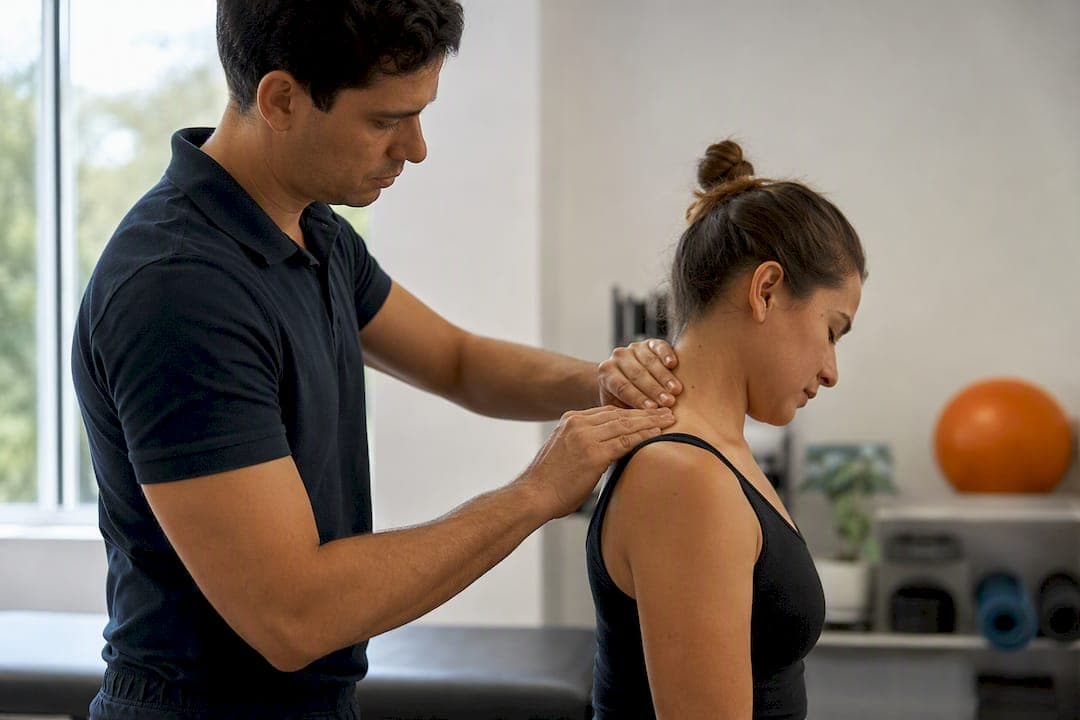
Yes, for muscular and tension-related neck pain, massage commonly reduces pain and improves movement. It works best on tight, overworked muscles rather than nerve or joint problems, and the relief is usually short-term unless paired with exercise and posture changes. If your pain came with numbness, fever, or a recent injury, see a clinician before reaching for a massage ball.
TL;DR:
- Frequent massage sessions, ideally twice a month, significantly improve pain levels and movement in muscular neck pain cases.
- Short-term relief is common after a single session, but sustained improvements require regular treatments combined with movement and posture correction.
- Self-massage should target specific muscle groups, use proper pressure, and be part of a broader strategy that includes heat, gentle movement, and ergonomic adjustments.
- Red flags such as fever, numbness, weakness, or injury require immediate medical assessment rather than self-treatment or massage.
- A structured, clinician-led plan over 4 to 6 weeks offers better long-term results than sporadic massage sessions alone.
Table of Contents
- How does massage for neck pain actually work?
- Self-massage techniques for the muscles that cause most neck pain
- When self-massage isn't enough: clinic treatment and red flags
- How often should you have a massage for neck pain?
- Neck massage safety: what not to press and common mistakes
- What a clinician-backed 4 to 6 week neck pain plan looks like
- What happens during a professional neck massage session
- How to prepare for a neck massage session
- Why the "spa massage" mindset undersells what neck pain treatment can do
- How Parks Therapy Centre can help you build a plan that lasts
- Sources
How does massage for neck pain actually work?
Massage doesn't repair tissue damage. It changes how your nervous system and muscles behave in the minutes and days after treatment, and that's precisely why the relief feels so immediate.
Pressure on tight muscle fibres increases local blood flow, which helps clear the metabolic waste that builds up in a muscle held in a shortened, guarded position for hours at a desk. Sustained pressure also appears to reduce resting muscle tone, essentially telling an overactive muscle it's safe to switch off. There's a neurological angle too: touch and pressure signals travel along faster nerve fibres than pain signals do, competing for the same processing space in the spinal cord. This is the "gate control" effect, and it's a large part of why a firm hand on a sore trapezius can feel like relief within seconds, even before any tissue change has had time to occur. Massage also nudges the nervous system towards a parasympathetic state, lowering cortisol and encouraging the kind of relaxation that itself reduces muscle guarding.
The research backing this is genuinely useful, but it comes with caveats worth taking seriously. A Cochrane review of massage for mechanical neck pain found short-term improvements in pain and tenderness across the trials it examined, but rated most of that evidence as low or very low quality, and it found no reliable data on long-term effectiveness. That doesn't mean massage doesn't work. It means the trials measuring it were often small or poorly controlled, so nobody can say with confidence how long benefits last without repeated sessions.
What the numbers say about consistency: A longitudinal study of 127 people receiving medical massage across multiple occupational groups found that those having two sessions a month brought their pain scores down to roughly 1 to 2 out of 10 by the end of the study, compared with 3 to 4 out of 10 for people having just one session a month. Everyone started at a similar pain level, around 7 out of 10. The gap between those two groups is the clearest evidence available that frequency, not just the act of having a massage, drives the outcome.
What this means in practice:
- Expect noticeable short-term relief after a single session, particularly for tension-type stiffness.
- Don't expect one massage to "fix" chronic neck pain permanently. It won't, and no honest therapist will promise that.
- Regular, spaced sessions outperform occasional ones for sustained improvement.
- Massage works best as part of a plan that includes movement and posture correction, not as a standalone fix.
Massage is a legitimate short-term tool with a growing evidence base, but it's one piece of a larger strategy rather than the whole solution.
Self-massage techniques for the muscles that cause most neck pain
Four muscle groups cause the majority of everyday neck stiffness: the suboccipitals at the base of the skull, the upper trapezius across the shoulders, the levator scapulae running diagonally from neck to shoulder blade, and the sternocleidomastoid (SCM) at the front and side of the neck. Each needs a slightly different approach.
1. Suboccipital release (base of the skull)
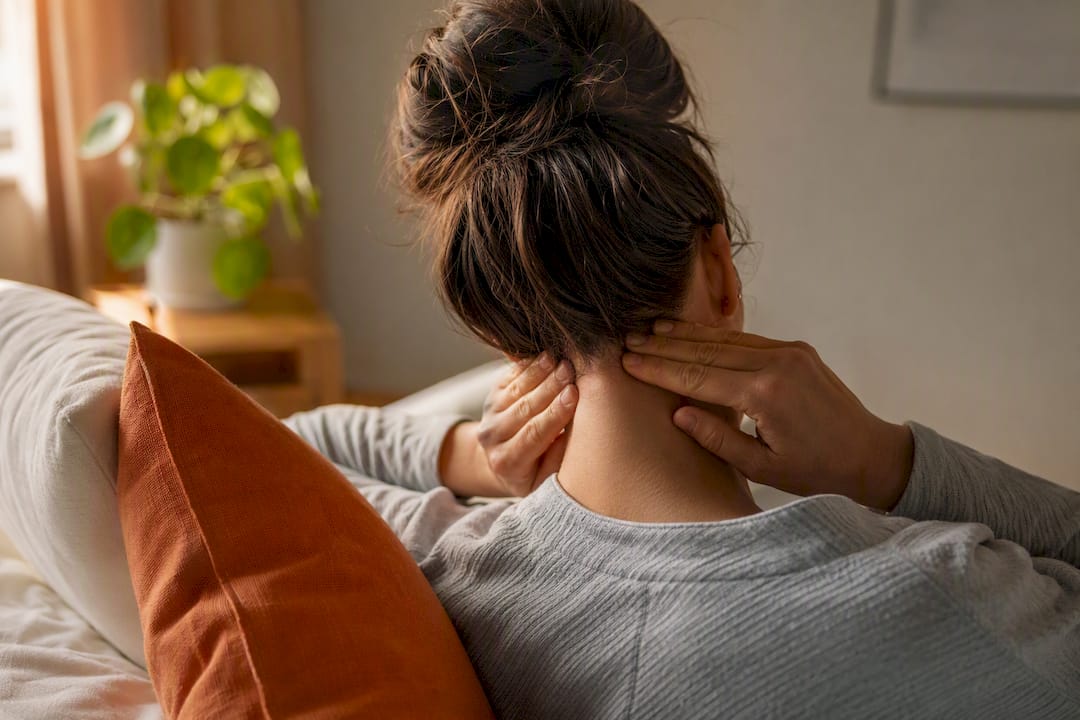
Sit or lie with your head supported. Find the ridge where your skull meets your neck, roughly finger-width above the hairline. Hook your fingertips (or a small massage ball placed against a wall or the floor) into that groove on both sides of your spine, not directly on the bone. Apply gentle upward pressure, as if lifting your skull slightly off your neck, and hold for 5 to 10 seconds. Breathe slowly through each hold; a slow exhale often deepens the release. Repeat 5 to 8 times, working slightly outward each time to cover the full width of the muscle group.
2. Upper trapezius trigger points
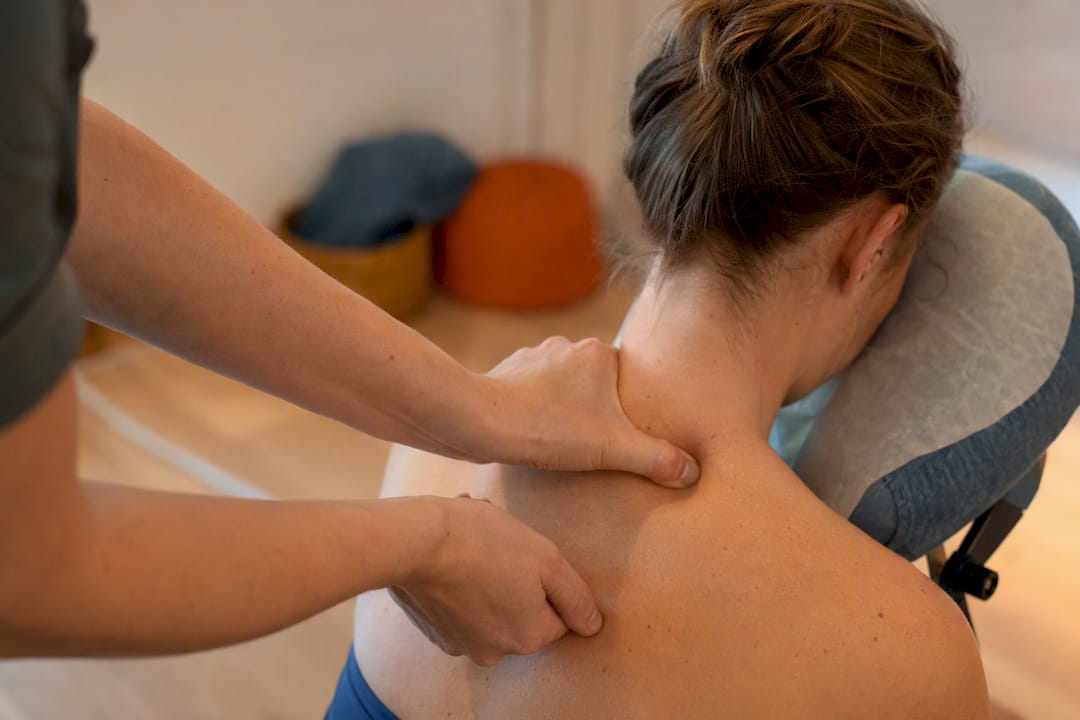
This is the muscle that bunches into a hard "knot" when you're stressed or have spent hours looking down at a screen. Reach across your body with the opposite hand and find the tender band running from the base of your skull towards your shoulder tip. Press with your fingertips or thumb until you find a distinctly tender spot, then hold steady pressure, not digging deeper, for 5 to 10 seconds. This sustained-hold approach matches what's commonly recommended for muscle knots: repeated pressure cycles rather than one long, hard press. Release, move slightly, and repeat 5 to 10 times along the muscle's length.
3. Levator scapulae cross-fibre release
This muscle sits deeper and more towards the shoulder blade, and it's often the real culprit behind pain that feels like it's "under the shoulder blade" rather than in the neck itself. Tilt your head slightly away and down from the sore side to put mild tension on the muscle. Using your fingertips, work in short strokes across the width of the muscle fibres rather than along their length; this cross-fibre friction tends to release stubborn tightness better than straight stroking. Thirty seconds to a minute per session is usually enough.
4. SCM and side-of-neck circular friction
The SCM runs diagonally from behind your ear down to your collarbone, and it's one of the few neck muscles safe to work on the front of the neck, provided you stay lateral to the windpipe and avoid pressing on the carotid artery area (more on that safety point shortly). Use your fingers in small, gentle circular motions along the muscle belly, never pressing hard or holding a static deep point here. This muscle responds better to lighter, longer strokes than to the firm holds used elsewhere in the neck.
Pro Tip: Warm the area for two to three minutes with a heat pack before self-massage. Warm muscle tissue yields to pressure far more readily than cold tissue, so you'll get a deeper release with less discomfort.
Judging pressure and knowing when to stop
The goal is to reproduce a familiar, dull ache, never sharp or shooting pain. A useful home-safety rule is to hold pressure for 5 to 10 seconds and repeat the cycle 5 to 10 times, stopping immediately if symptoms spread, tingle, or if numbness appears anywhere down the arm. That spreading pattern usually signals nerve irritation rather than simple muscle tightness, and self-massage isn't the right tool for it.
Afterwards:
- Apply gentle heat for 15 to 20 minutes to encourage continued blood flow.
- Move your neck through slow, pain-free ranges (nodding, gentle rotation) rather than staying still.
- Avoid vigorous exercise or heavy lifting for a few hours if the area feels tender.
- Note how you feel the next morning; genuine muscular tightness typically feels looser, while nerve-related pain often feels unchanged or worse.
If a spot doesn't respond after several honest attempts over a week or two, that's useful information in itself. It usually means the problem needs hands more skilled than your own, or an assessment to rule out something structural.
When self-massage isn't enough: clinic treatment and red flags
Some neck pain needs a clinician's eyes and hands before anyone reaches for a massage ball. The Harvard Health guidance on neck pain red flags is unambiguous on this point.
Seek urgent medical assessment if your neck pain comes with:
- Fever, particularly alongside neck stiffness that makes it hard to lower your chin to your chest.
- Numbness, tingling, or weakness spreading down an arm or into your hand.
- Sudden, severe pain following a fall, collision, or whiplash-type injury.
- Loss of bladder or bowel control, or difficulty with balance and coordination, which can indicate spinal cord involvement.
None of those are massage territory, and no amount of self-treatment substitutes for that assessment.
For everyone else, a physiotherapist or clinical massage therapist brings tools that go beyond what you can do to yourself. Medical massage delivered by a trained physiotherapist typically combines several techniques rather than relying on one: sustained trigger-point pressure on the suboccipitals and upper trapezius, myofascial release across broader areas of tightness, and hands-on manual therapy to restore joint movement that muscle tightness alone can't explain. Many clinics also introduce dry needling for stubborn trigger points that haven't responded to manual pressure, and pair every hands-on session with a home exercise plan, because the evidence consistently shows that manual therapy paired with movement outperforms manual therapy alone.
What a typical first appointment covers: expect a thorough assessment of your posture, movement range, and muscle tenderness before any hands-on work begins. That assessment matters because pain that presents identically in the neck can have very different root causes, from a stiff thoracic spine forcing the neck to overwork, to a desk setup pushing your head forward for eight hours a day. Practitioners often plan the first month as an assessment followed by 2 to 3 targeted sessions, then reassess and adjust the plan based on progress. If you're dealing with pain that radiates down an arm rather than staying local to the neck, a tailored exercise programme for nerve-related symptoms is often more appropriate than massage alone.
How often should you have a massage for neck pain?
Frequency matters more than most people assume. The clearest signal in the research comes from that same longitudinal study: participants having medical massage twice a month brought pain down to roughly 1 to 2 out of 10, while those having it once a month settled around 3 to 4 out of 10, despite starting from a similar baseline. That's not a marginal difference; it's the gap between "occasional ache" and "genuinely comfortable."
For planning purposes:
- A typical clinical session runs 30 to 60 minutes, depending on whether it's focused work on the neck alone or a broader session covering shoulders and upper back too.
- A realistic trial period is 3 to 6 sessions spread across 4 to 8 weeks, long enough to judge whether the approach and the practitioner suit you.
- Self-massage at home can happen daily in short bursts (5 to 10 minutes), and works best as a bridge between clinical sessions rather than a replacement for them.
- Combining massage with simple workplace changes, monitor height, chair support, screen breaks, extends the benefit far longer than massage alone. A clinician-backed plan for desk-related neck pain covers this ground in more detail.
Think of frequency the way you'd think about a stretching habit: consistency beats intensity almost every time.
Neck massage safety: what not to press and common mistakes
Certain areas of the neck simply aren't safe territory for massage, self-administered or otherwise. Never press directly on the front-centre of the throat or the carotid sinus area (roughly where you'd feel a pulse just below the jawline on either side); compressing this can affect blood pressure and heart rate. Avoid pressing directly on the bony vertebrae themselves rather than the muscle beside them, and skip quick, jerky movements anywhere near the neck, particularly with any tool.
If you use a percussive massage device, professionals recommend starting at the lowest speed setting, limiting time on any single spot to 10 to 20 seconds, and never letting the device head make direct contact with the spine or the sides of the throat.
- Never press the carotid sinus or the front of the throat.
- Avoid direct pressure on cervical vertebrae; work the muscle beside the bone, not on it.
- Start percussive tools on the lowest setting and cap each spot at 10 to 20 seconds.
- Skip sudden, jerky movements, especially with a device in hand.
Pro Tip: If a spot feels genuinely better within a day of treatment, don't stop there. Clinicians frequently see people quit as soon as short-term relief kicks in, only for the same tightness to return within a week, because the underlying pattern (poor posture, weak supporting muscles, stress-driven tension) never actually changed.
What a clinician-backed 4 to 6 week neck pain plan looks like
A structured plan beats a single session every time, and it doesn't need to be complicated. Most physiotherapists build something close to this:
- Week 1: Full assessment, ruling out red flags and identifying which specific muscles and movement patterns are driving the pain.
- Weeks 1 to 4: One to two clinical massage or manual therapy sessions per fortnight, alongside daily self-massage at home and a short set of posture exercises.
- Weeks 4 to 6: Reassessment. Pain and range of movement are compared against the baseline, and the plan is adjusted, fewer clinical sessions if things are improving well, more targeted work if a specific area is lagging.
Between sessions, the small habits matter more than people expect: 10 to 15 minutes of heat before bed, gentle neck rotations every hour at a desk, and a monitor set at eye level rather than looking down. Clinicians repeatedly flag one avoidable error, stopping treatment the moment relief appears, which tends to invite the same tightness straight back within days. A scheduled review, rather than an "as needed" approach, is what actually sustains the improvement.
What happens during a professional neck massage session
A typical clinical session for neck pain runs 30 to 60 minutes and follows a fairly consistent structure, whether you're seeing a physiotherapist or a clinical massage therapist. It opens with a brief check-in on how your neck has felt since the last visit or, for a first appointment, a fuller assessment of posture, movement range and tender points.
The hands-on portion usually starts broader and works inward: general warming strokes across the shoulders and upper back to raise blood flow, before narrowing to specific tight areas like the upper trapezius or suboccipitals. Sustained pressure holds on trigger points typically last 20 to 60 seconds, longer than most people manage on themselves, because a trained therapist can maintain even, controlled pressure without their hand tiring. Myofascial release, slower, broader strokes intended to ease tension across a wider sheet of tissue, often follows the more targeted trigger-point work.
Towards the end, many therapists incorporate gentle passive stretching or ask you to move your neck through its range while they assess for improvement compared with the start of the session. Most sessions close with a handful of exercises to practise at home and a note on when to book the next appointment. If dry needling forms part of the treatment, it's usually introduced only after manual work, and only for trigger points that haven't responded to pressure alone.
How to prepare for a neck massage session
A little preparation makes a real difference to how much benefit you get from a session, and it takes only a few minutes.
Hydration matters more than people expect. Muscle tissue that's mildly dehydrated feels stiffer and tenderer under pressure, so drinking water in the hours before an appointment, rather than arriving having had only coffee, makes deep work considerably more comfortable.
Posture in the run-up also shapes the session. If you've spent the whole day hunched over a screen right before your appointment, your neck muscles arrive already guarded and tight, which can make the first few minutes of treatment feel more uncomfortable than necessary. A short walk or a few gentle neck rotations beforehand helps the muscles arrive slightly warmed and less defensive.
The environment should be one where you can actually relax: loose or removable clothing around the collar and shoulders, a room that's warm enough that you're not tensing against the cold, and enough time built in afterwards that you're not rushing straight back to a stressful task. Tensing against a cold room or a tight deadline undoes a good portion of the relaxation response massage is meant to trigger.
Finally, mention any recent injuries, headaches, or numbness before the session starts. A good therapist adjusts pressure and technique based on that information, and it's the same detail a clinician would want to know if you were booking a fuller assessment.
Why the "spa massage" mindset undersells what neck pain treatment can do
Most advice on massage for neck pain treats it like a spa indulgence: something pleasant you do occasionally, with no real structure and no clear endpoint. That framing undersells the evidence. The research on twice-monthly versus once-monthly sessions shows a genuine, measurable gap in outcomes, not a marginal preference. Treating massage as an occasional treat rather than a scheduled part of a recovery plan is probably the single biggest reason people cycle through relief and relapse for years without resolving anything.
The conventional wisdom also overstates what massage can do alone. It's a genuinely useful tool for muscular and tension-related pain, backed by decent short-term evidence, but weak on anything long-term unless it's combined with movement and posture correction. Readers searching for relief techniques should prioritise consistency and combination over finding the "perfect" technique. A structured few weeks of scheduled sessions, home self-massage, and small workplace adjustments will outperform months of sporadic, well-intentioned massage sessions that never add up to a plan.
— Ivan
How Parks Therapy Centre can help you build a plan that lasts
Reading about suboccipital release and trigger-point holds only gets you so far when the problem is a muscle you genuinely can't see or reach properly yourself, or when self-massage keeps producing the same short-lived relief. Parkstherapycentre gives you what a massage ball can't: a clinician who assesses why your neck keeps tightening in the first place, then builds a plan around it rather than treating each visit as an isolated fix.
At your first appointment, expect a proper assessment of posture, movement range, and the specific muscles driving your pain, not just twenty minutes of pressure on sore spots. The team works across multiple clinic locations, accepts private pay and health insurance, and treats everything from tension-type neck stiffness to nerve-related pain that needs a different approach entirely. Wear loose, comfortable clothing around the collar and bring details of any previous injuries or ongoing conditions, so the physiotherapist can tailor pressure and technique from the first session rather than the third.
If your neck pain has been managed with occasional massage and nothing more, book an assessment through Parks Therapy Centre and find out what a structured, clinician-backed plan actually looks like.
This article is general information, not a substitute for advice from a qualified doctor. Consult a qualified healthcare professional about your own circumstances before acting on anything here.
Sources
- Effectiveness of Medical Massage in Reducing Neck Pain Among Multiple Occupational Groups: A Longitudinal Study
- Massage for mechanical neck disorders (Cochrane review)
- When to seek immediate medical attention for neck pain — Harvard Health
- Knot in neck: Causes, symptoms, and tips to relieve the pain — Healthline
- What are muscle knots and how do I get rid of them? — Cleveland Clinic