
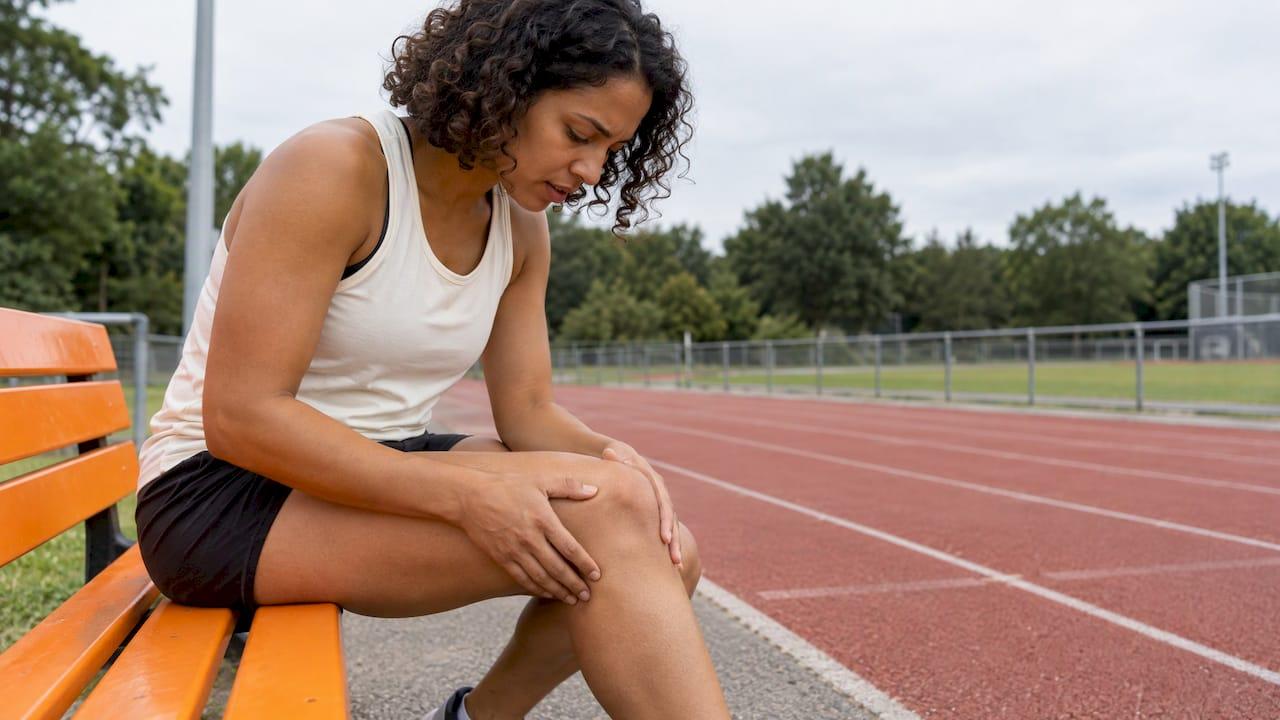
Knee swelling after running means extra fluid has collected in or around the joint. It can come from simple overuse irritation, such as runner's knee, or from a more specific injury or condition. For a mild, gradual swelling, most runners should rest the knee from aggravating activity, use ice for short spells and avoid heat at first. A knee that is badly swollen, has changed shape, locks, gives way or is hot and red needs prompt medical advice. This guide explains the likely causes, what to do in the first days, when you can run again and when to see a physiotherapist.
TL;DR
- Swelling is excess fluid in or around the knee, and it can follow overuse, injury or an underlying condition.
- For the first few days, rest the knee from painful activity, use ice wrapped in a cloth for up to 20 minutes at a time, and avoid heat.
- Call NHS 111 if the knee is badly swollen, changed shape, locks, gives way, or is hot and red with a fever.
- If swelling has not eased after a week or two of sensible home care, get it checked by a GP or physiotherapist.
- Return to running gradually, and only once the knee is no longer swelling or painful during normal daily activity.
Table of Contents
- Why your knee swells after a run
- Common causes in runners
- What to do in the first few days
- Knee swelling: ice or heat?
- When to get urgent medical help
- How long does knee swelling last?
- When can you run again?
- What a physiotherapist does for a swollen knee
- Book a knee assessment
- FAQ
- Sources
Why your knee swells after a run
A swollen knee happens when excess fluid collects in or around the knee joint, which clinicians call an effusion. The Mayo Clinic notes that this may follow trauma, overuse injuries or an underlying disease or condition. That range is why the same symptom can mean very different things for two runners.
The joint produces a small amount of lubricating fluid all the time. When something irritates the lining of the joint, or a structure inside it is damaged, the body produces more. You may notice a puffy look around the kneecap, a tight feeling when you bend the knee, or a knee that looks larger than the other one when you compare them side by side.
Timing gives useful clues:
- Swelling that builds slowly over hours after a run often points to irritation from repeated loading.
- Swelling that appears within an hour of a twist, fall or awkward landing suggests an injury to something inside the joint and needs more caution (see the red flags below).
- Swelling that keeps returning even with modest mileage suggests something is not settling and is worth assessing.
Common causes in runners
Runner's knee
The NHS describes runner's knee as knee pain during running with many causes, such as swelling under the kneecap. It is the most common reason runners notice an achy, sometimes puffy knee, particularly around or behind the kneecap. The Robert Jones and Agnes Hunt Orthopaedic Hospital (RJAH) lists swelling as a possible symptom of anterior knee pain, alongside pain at the front of the knee that is worse with running, stairs or sitting for long periods.
Tendon irritation
The NHS lists tendonitis as a cause of pain between the kneecap and shin, often brought on by repetitive running or jumping. Tendons respond badly to a sudden jump in mileage, hills or speed work, and the area can look slightly puffy and feel tender to press.
Bursitis
Bursae are small fluid-filled sacs that cushion the knee. The NHS describes bursitis as warm and red, and worse with kneeling or bending. It can develop without an obvious injury.
Damage inside the joint
The NHS links a torn ligament, tendon, meniscus or cartilage damage with an unstable knee that gives way or cannot fully straighten. These injuries often follow a twist or a bad landing, and swelling can be quick.
Underlying conditions
The Mayo Clinic lists osteoarthritis, rheumatoid arthritis, infection, gout, pseudogout, bursitis, cysts and tumours among the underlying causes of fluid build-up. Most runners with a puffy knee do not have one of the serious ones, but swelling with no clear running-related explanation is a reason to be assessed rather than guessed at. If you have a diagnosis of knee arthritis, our guide to physiotherapy for knee osteoarthritis explains what treatment usually involves.
Bleeding into the joint
The NHS notes that bleeding in the joint causes swelling, warmth and bruising, and is more likely if you take anticoagulants. If you are on blood thinners and your knee swells, speak to a healthcare professional promptly rather than waiting.
What to do in the first few days
For a mild swelling with no red flags, a simple plan works for most people.
- Protect the knee. Stop the activity that provokes it. RJAH advises adapting aggravating activity until symptoms settle rather than stopping everything, so gentle walking and daily movement are usually fine if they do not hurt.
- Use ice sensibly. See the next section for timings.
- Compress and elevate. For a sprain or strain, NHS guidance on the first two to three days uses the PRICE approach: protection, rest, ice, compression and elevation. A light elastic bandage that is snug but not tight, and a rest with the leg raised, can help the knee feel more comfortable.
- Avoid the wrong things. The same NHS page advises avoiding heat, alcohol and massage in the first couple of days to help prevent swelling.
- Keep a note. Write down when the swelling started, what you were doing, and whether it is getting better or worse. A physiotherapist will find this very useful.
If the knee is sore and you want to keep your legs working while it settles, our friends in the strength community have a practical piece on strength training with knee pain, including how to apply ice. Whatever you do, stay within what the knee tolerates without increasing swelling the next day.
Knee swelling: ice or heat?
In the first days after a run that has left your knee swollen, ice is the better choice and heat is best left alone.
Ice. The NHS advises an ice pack or frozen peas wrapped in a tea towel on the knee for up to 20 minutes, repeated every 2 to 3 hours, and says never to put ice directly on the skin. RJAH suggests a slightly shorter 10 to 15 minutes on protected skin. Either fits the same principle: short sessions, a cloth barrier, and a break between sessions.

Heat. The American Academy of Pediatrics' parent site explains that heat increases circulation and can ease muscle spasm, but it may increase swelling and inflammation, so it should not be used after physical activity or straight after an acute injury. The same page says there is no need to switch to heat after 48 hours or to alternate between ice and heat for an acute injury. Once the swelling has gone and you are left with stiffness, many people find warmth comfortable, but that is a different stage from the swollen knee itself.
A note on differing advice. Some NHS musculoskeletal guidance takes a more cautious line on a fresh injury: it recommends protecting the knee and restricting movement for one to three days and suggests that icing a new injury may hinder natural healing, so it can be avoided if you prefer. In practice, the points all sources agree on are to rest the knee from provoking activity, never to apply heat early, and never to apply ice directly to bare skin. If ice makes you uncomfortable, or you have reduced skin sensation, leave it out and focus on rest and elevation.
| Situation | Usually helpful | Best avoided |
|---|---|---|
| Swelling after a run, first 2 to 3 days | Rest from aggravating activity, wrapped ice for up to 20 minutes, light compression, elevation | Heat, alcohol, massage on the area |
| Swelling gone, knee feels stiff | Gentle movement, gradual return to normal activity | Sudden return to hard running |
| Hot, red, swollen knee with fever | Urgent medical advice | Self-treating at home |
When to get urgent medical help
Most swollen knees settle with home care, but some need prompt attention. The NHS advises getting advice from NHS 111 now if:
- the knee is very painful
- you cannot move it or put weight on it
- it is badly swollen or has changed shape
- it locks, gives way or painfully clicks
- it is red or hot and you have a very high temperature
NHS musculoskeletal guidance also advises urgent treatment or emergency care if there is large swelling that appeared within an hour of an injury, a snap, grinding or popping noise at the time, or you cannot put weight on the leg. A hot, red knee with a fever may be an infection, which needs treating quickly. These are the situations where a rapid assessment, and sometimes imaging, matters more than any home remedy.
How long does knee swelling last?
There is no single answer, because it depends on the cause. The NHS says knee pain can often be treated at home and that you should start to feel better within a few days. A mild overuse swelling often follows that pattern. A sprain or strain takes longer: the NHS says that after two weeks most will feel better, but severe ones can take months to return to normal.
Use these checkpoints:
- Within a week: the NHS advises that if the pain is not severe, you should stop running and get it checked if it does not go away after a week.
- After two weeks of home care: NHS musculoskeletal guidance advises speaking to a GP or physiotherapist if it has not improved, if pain is stopping normal activities, keeps coming back, or you have giving way or locking.
- After a month: RJAH advises seeking GP or physiotherapy advice if pain is not better after at least a month or other symptoms develop.
A knee that swells every time you run is telling you the load is more than it can currently handle. Waiting for it to go away on its own, then repeating the same run, is the most common reason a two-week problem turns into a two-month one.
When can you run again?
The NHS says that how soon you can run again depends on the cause and severity, and that a GP or physiotherapist can advise. For a diagnosed sprain or strain, the NHS suggests avoiding strenuous exercise such as running for up to 8 weeks to reduce the risk of further damage. RJAH recommends a gentle and gradual return after adapting activity.
Sensible markers that the knee is ready to start building back up:
- No swelling at rest, and no puffiness the morning after activity
- Full bend and straightening, similar to the other knee
- Pain-free walking, stairs and single-leg standing
- No giving way or catching
Then start with short, flat, easy runs on alternate days, and add distance before speed. Our guide to returning to running after injury sets out the stages in more detail. If you want to reduce the chance of a repeat, our article on knee injury prevention for active adults covers strength, load management and footwear habits.
Runners who have shin pain as well as knee symptoms may find our shin splints treatment plan relevant, since both often follow a rapid increase in training.
What a physiotherapist does for a swollen knee
A physiotherapy assessment aims to find out why the knee swelled, not only to settle the swelling. A typical first appointment covers:
- History: your running volume, recent changes, previous injuries and how the swelling behaves through the day.
- Examination: looking at swelling and range of movement, testing the ligaments, tendons and meniscus, and checking how the hip, knee, ankle and foot work together.
- Diagnosis and plan: an explanation of the likely cause, advice on how much running is appropriate now, and a progressive exercise programme.
- Next steps: where the findings suggest it is needed, a referral for imaging.
For many runners, the programme centres on building strength in the thigh, hip and calf muscles and gradually reloading the knee. For some, low-impact conditioning such as Pilates helps keep fitness and control while the knee settles; see our article on Pilates for knee pain for a six-week structure.
If an assessment suggests that a tendon is the problem, shockwave therapy is one of the treatments we can discuss as part of a wider rehabilitation plan.
Our perspective
We have treated runners at Parks Therapy Centre since 1986, and the pattern is familiar. Someone notices a puffy knee after a long run, ices it, rests for a day or two, and starts again. When the swelling returns, they assume it is just part of running.
In our view, a knee that swells repeatedly deserves a proper assessment early. The swelling is a signal, and the useful question is what is overloading the joint: a sudden rise in mileage, weak hip and thigh muscles, a change of footwear, or something inside the joint that needs a closer look.
Our multidisciplinary team is designed to answer that question in one place. A physiotherapist can assess and treat the knee, and where it helps, we can arrange a diagnostic imaging referral quickly rather than leaving you waiting. Pilates, sports massage and shockwave therapy sit alongside physiotherapy, so your plan can fit what your knee actually needs rather than a single approach.
Our aim is for you to understand your knee, return to running with confidence and stay there.
Ivan
Book a knee assessment
If your knee swelling has lasted beyond a week, keeps returning after runs, or is stopping you training, a physiotherapy assessment is the sensible next step. We see patients across clinics in Biggleswade, St Neots, Bedford and Milton Keynes, and we accept all major health insurance plans.

Our published prices are £76 for a physiotherapy assessment and £67 for a follow-up physiotherapy treatment session. If your clinician recommends imaging, an image assessment is £76 and an image referral letter is £10. You can see every service on our prices page, or start from the Parks Therapy Centre homepage to book online. If the red flags above apply to you, contact NHS 111 or emergency services first.
FAQ
Why do my knees feel swollen after working out?
Swelling means extra fluid has built up in or around the joint, which may follow trauma, overuse or an underlying condition. After running, the cause is often irritation from repeated loading, such as runner's knee or a tendon problem. If it keeps happening, have it assessed.
Should I use ice or heat on a swollen knee?
Use ice first, wrapped in a tea towel, for up to 20 minutes every 2 to 3 hours. Avoid heat in the first couple of days because it may increase swelling. Once swelling has settled, warmth can ease remaining stiffness for some people.
Is it safe to keep running with a swollen knee?
No. Running on a swollen knee can make the underlying problem worse, so rest from running until the swelling settles. The NHS advises that if you stop running and the pain has not gone after a week, you should get it checked. Gentle walking and everyday movement are usually fine if they do not cause pain.
When should I see a GP or physiotherapist about knee swelling?
See someone straight away if the knee is badly swollen, locks, gives way or is hot and red with a fever. For milder swelling, seek advice if there is no improvement after about two weeks of home care, or if it keeps coming back. A physiotherapist can assess the cause and plan your return to running.
How long does knee swelling last after a run?
Mild swelling from overuse often starts to ease within a few days with rest and ice. A sprain or strain can take two weeks or longer to feel better, and severe ones take months. If it is not clearly improving, get it checked rather than waiting.
Sources
- Swollen knee - Symptoms and causes, Mayo Clinic
- Knee pain and other running injuries, NHS
- Knee pain, NHS
- Sprains and strains, NHS
- Anterior Knee Pain, RJAH
- Knee pain: early management, Musculoskeletal Matters
- Treating Sports Injuries with Ice and Heat, HealthyChildren.org
- Strength Training with Knee Pain