
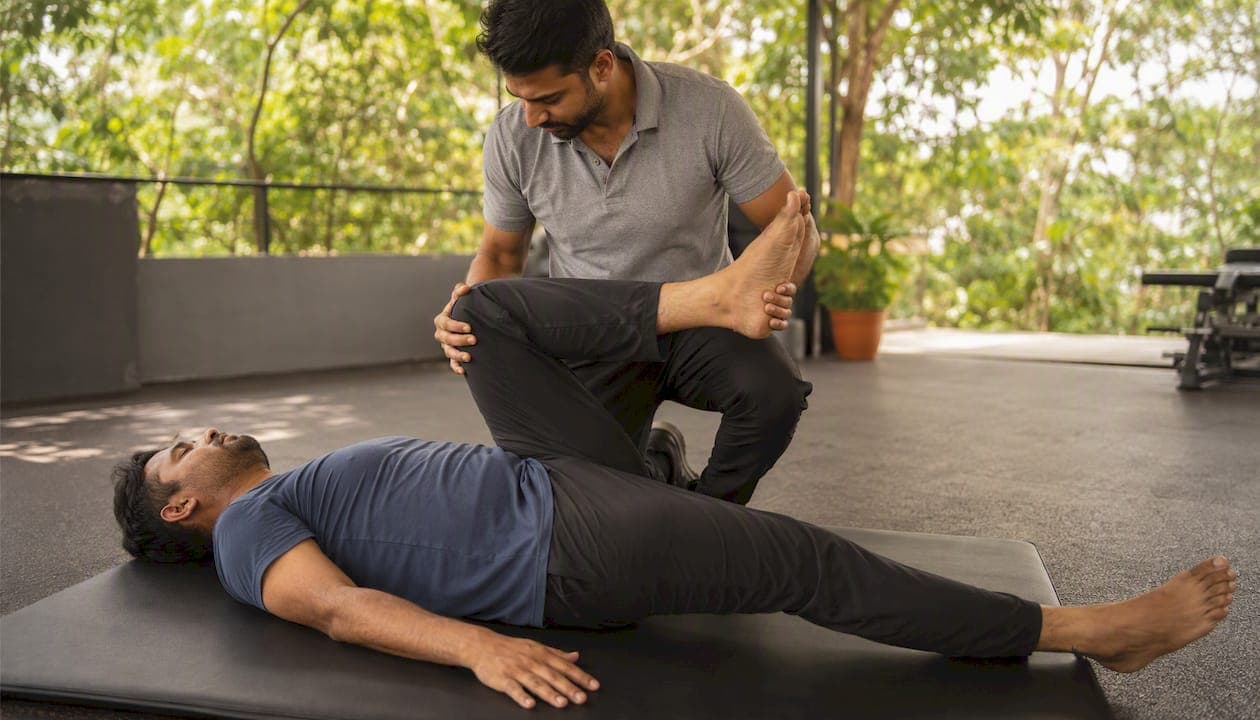
Most mild hip flexor strains recover within one to three weeks with relative rest, ice and gentle early movement. Moderate strains (Grade II) usually require a longer recovery period, while severe tears (Grade III) can take several months before a full return to activity is possible. The single most useful first step is to stop the aggravating activity, apply ice for 15–20 minutes every two to three hours during the first 48–72 hours, and keep moving within a pain-free range rather than resting completely.
Immediate first steps:
- Stop any activity that causes sharp pain in the front of the hip or groin
- Apply ice wrapped in a cloth for 15–20 minutes, up to four times daily for the first 48–72 hours
- Take paracetamol or an over-the-counter NSAID such as ibuprofen (if suitable for you) to manage pain and swelling
- Keep gentle, pain-free movement going — short walks and slow range-of-motion exercises are preferable to bed rest
- Avoid running, kicking, or any loaded hip flexion until pain settles
What to avoid in the first week:
- Avoid applying heat in the initial days after injury, as it may increase blood flow and worsen swelling.
- Do not return to sport or heavy training before completing a staged rehabilitation programme
| Grade | Description | Typical recovery window |
|---|---|---|
| Grade I (mild) | Minor microtears, minimal strength loss | 1–3 weeks |
| Grade II (moderate) | Partial tear, noticeable strength deficit | 4–8 weeks |
| Grade III (severe) | Complete or near-complete tear, possible avulsion | 3 months |
Key takeaways
Hip flexor strain recovery follows a predictable pattern when rehabilitation is phased correctly and return to activity is based on objective function rather than time alone.
| Point | Details |
|---|---|
| Grade determines timeline | Grade I strains typically resolve within a few weeks; Grade II strains require a longer recovery period; severe strains may take several months. |
| Early movement aids healing | Gentle, pain-free movement from day one supports fibre regeneration better than complete rest. |
| Rebuild the hip girdle | Glute, core and lumbar strengthening reduces reinjury risk more effectively than isolated hip flexor work. |
| Use objective return criteria | Return to sport when strength reaches 90% of the uninjured side and sport-specific movement is pain-free. |
| Parkstherapycentre offers supervised rehab | Assessment, phased rehabilitation and Pilates reconditioning are available across Bedfordshire and Buckinghamshire. |
Table of Contents
- What is a hip flexor strain and which muscles are involved?
- Symptoms, grading and red flags you should not ignore
- How clinicians diagnose a hip flexor strain and when imaging is needed
- What to do in the first 48–72 hours and during week one
- A progressive rehabilitation programme for hip flexor strains
- Realistic timelines and return-to-activity criteria
- When to see a GP, physiotherapist or specialist
- How to reduce recurrence risk and manage training load long term
- The clinical evidence: rebuild the hip girdle, not just the hip flexor
- A clinician's perspective on what actually matters during rehab
- Parkstherapycentre: expert assessment and rehabilitation for hip injuries
- Sources
What is a hip flexor strain and which muscles are involved?
A muscle strain is a partial or complete tear of muscle fibres or the musculotendinous junction — the point where muscle transitions into tendon. In the hip, several muscles work together to lift the thigh towards the trunk, and any one of them can be strained under sufficient load or speed.
The main hip flexor muscles are:
- Iliopsoas (iliacus and psoas major combined) — the primary hip flexor, running from the lumbar spine and pelvis to the lesser trochanter of the femur; the most commonly strained of the group
- Rectus femoris — the only quadriceps muscle that crosses the hip joint; particularly vulnerable during kicking or sprinting because it flexes the hip and extends the knee simultaneously
- Sartorius — a long, strap-like muscle running diagonally across the thigh; involved in hip flexion, abduction and external rotation
- Tensor fasciae latae (TFL) — assists hip flexion and abduction; connects into the iliotibial band
Strains most often occur during sudden acceleration, a powerful kick, or an unexpected overstretching movement — for example, slipping on a wet surface or lunging for a ball. They are common in football, athletics, martial arts and dance, but also occur in everyday settings such as tripping on a kerb or climbing stairs with a heavy load.
Symptoms, grading and red flags you should not ignore
Pain in the front of the hip or groin that sharpens during active hip flexion (lifting the knee) is the hallmark symptom. You may also notice tenderness when pressing on the muscle belly, visible bruising or swelling, and a reduced ability to walk normally or climb stairs without discomfort.
Grading in plain language
- Grade I — A small number of fibres are torn. Pain is present but mild, strength is largely preserved, and you can usually walk without a significant limp. Tenderness is localised and swelling is minimal.
- Grade II — A more substantial partial tear. Pain is moderate to severe on contraction, strength is noticeably reduced, and walking may be uncomfortable. Bruising often appears within 24–48 hours.
- Grade III — A complete or near-complete rupture, sometimes involving an avulsion (the tendon pulls away from the bone). Severe pain, marked swelling, an inability to contract the muscle against resistance, and significant functional loss are typical.
Red flags requiring urgent assessment
Seek urgent medical attention if you experience any of the following:
- Inability to bear weight on the affected leg
- A rapidly expanding haematoma (large, firm swelling that grows quickly)
- A palpable gap or defect in the muscle
- Suspected avulsion injury (sudden, severe pain at the bony attachment, common in adolescents whose growth plates are still open)
- Neurological symptoms such as numbness, tingling or weakness extending down the leg
- Severe swelling that does not settle within 24 hours
How clinicians diagnose a hip flexor strain and when imaging is needed
Clinical assessment usually provides sufficient information to diagnose a hip flexor strain and estimate its severity. A physiotherapist or GP will typically carry out the following:
- Inspection — looking for bruising, swelling, asymmetry or a visible muscle defect
- Palpation — pressing along the muscle belly and musculotendinous junction to localise tenderness
- Resisted hip flexion — asking you to lift your knee against the clinician's hand to assess strength and reproduce pain
- Range-of-motion testing — measuring passive and active hip flexion, extension and rotation
- Gait assessment — observing how you walk to identify compensatory patterns
When imaging is warranted
Imaging is not routinely needed for straightforward strains, but becomes useful in specific circumstances:
- Suspected avulsion fracture or proximal tendon rupture
- Large or expanding haematoma suggesting a significant tear
- Failure to improve after four to six weeks of appropriate conservative management
- Atypical presentation where hip joint pathology, a stress fracture or referred lumbar pain cannot be excluded clinically
Ultrasound is often the first-line imaging choice — it is widely available in the UK, relatively inexpensive and can assess the muscle in real time. MRI provides greater detail for complex or deep injuries and is preferred when surgical planning is under consideration.
Differential diagnoses to consider: hip joint pathology (labral tear, osteoarthritis), adductor or groin strain, iliopsoas bursitis, and referred pain from the lumbar spine or sacroiliac joint.
What to do in the first 48–72 hours and during week one
The priority in the first few days is to control pain and swelling while keeping the hip moving within a comfortable range. Prolonged immobilisation is counterproductive — early controlled mobilisation supports fibre regeneration and limits the muscle atrophy that sets back later rehabilitation.
Practical dos and don'ts:
- Do apply ice (wrapped in a cloth or tea towel) for 15–20 minutes every two to three hours for the first 48–72 hours
- Do take paracetamol (up to 1g, four times daily) or ibuprofen (400mg, three times daily with food) if appropriate for you — check with a pharmacist or your GP if you have any contraindications, including kidney problems, asthma or stomach ulcers
- Do use a compression bandage around the upper thigh if swelling is present, but not so tightly that it restricts circulation
- Do keep walking short distances at a comfortable pace — gentle movement is beneficial
- Do switch to heat (a warm pack for 15–20 minutes) after 72 hours to encourage blood flow and tissue healing
- Don't apply heat in the first 72 hours
- Don't massage the injured area in the acute phase — this can aggravate bleeding into the tissue
- Don't take NSAIDs for more than ten consecutive days without medical advice
If walking is very painful, using crutches short-term can help offload the hip and assist movement without a limp. Discuss this with a pharmacist, GP or physiotherapist if you are unsure.
Pro Tip: Gentle pain-free movement — such as lying on your back and slowly sliding your heel towards your buttocks — is more beneficial in the first week than complete rest. It keeps the healing tissue orientated correctly and reduces stiffness without stressing the repair.
A progressive rehabilitation programme for hip flexor strains
Rehabilitation works best when it follows a phased approach, with clear criteria for moving from one stage to the next. Rushing progression is the single most common reason for reinjury. Eccentric strengthening and neuromuscular control work are central to reducing recurrence risk and should feature from Phase 2 onwards.
Phase 1: protect and restore pain-free range (days 1–14, Grade I; days 1–21, Grade II)
The goal here is to reduce pain and swelling and restore comfortable, full-range hip movement without loading the healing tissue.
- Supine heel slides — lying on your back, slowly slide your heel towards your buttocks and back; 10 repetitions, two to three times daily
- Gentle standing hip flexor stretch — in a half-kneeling position, gently shift your weight forward until you feel a mild stretch at the front of the rear hip; hold 20–30 seconds, three repetitions
- Isometric hip flexion — sitting in a chair, press your knee upward against your own hand with no movement; hold five seconds, ten repetitions
Move to Phase 2 when: pain at rest is minimal, you can walk without a limp, and gentle stretching produces only a mild, comfortable pull.
Phase 2: strength and control (weeks 2–5, Grade I; weeks 3–8, Grade II)
Progressive strengthening, eccentric loading and core integration are the focus. Specific rehab exercises should be performed consistently and progressed gradually.
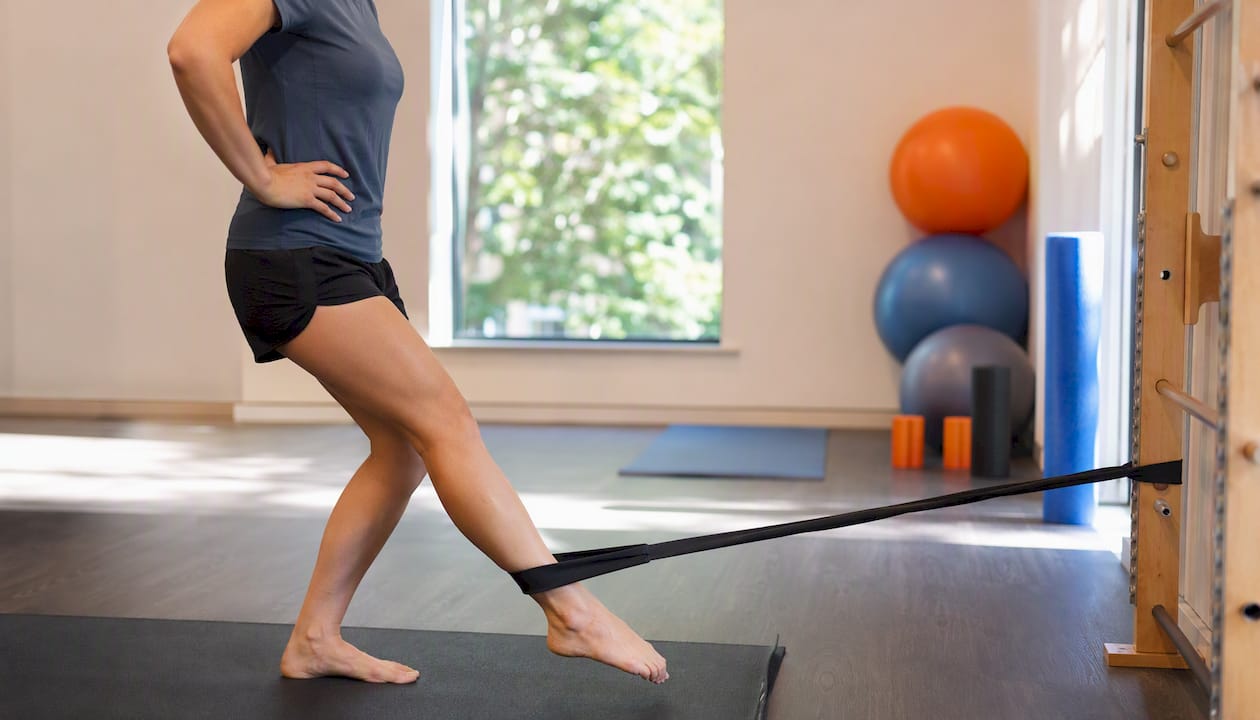
- Standing hip flexion with resistance band — attach a band at ankle height, stand tall and lift the knee to hip height; 3 sets of 12 repetitions
- Eccentric hip flexor lowering — from a raised knee position, slowly lower the foot to the floor over four seconds; 3 sets of 8 repetitions
- Glute bridges — lying on your back with knees bent, lift your hips until your body forms a straight line; 3 sets of 15 repetitions
- Dead bug — lying on your back, extend alternate arm and leg while keeping your lower back pressed to the floor; 3 sets of 10 repetitions per side
- Kneeling hip flexor stretch with posterior pelvic tilt — as in Phase 1 but actively tuck the pelvis under to deepen the stretch; hold 30 seconds, three repetitions
Move to Phase 3 when: you have full, pain-free range of motion, hip flexion strength is at least 80% of the uninjured side, and you can perform all Phase 2 exercises without pain.
Phase 3: functional and sport-specific loading (weeks 5–8+, Grade I; weeks 8–16+, Grade II/III)
Power, agility and sport-specific demands are reintroduced progressively.
- Walking lunges — controlled forward lunges, progressing to weighted lunges
- Single-leg Romanian deadlift — challenges hip stability and eccentric hamstring and glute strength simultaneously
- Resisted sprinting drills — using a resistance band or sled, beginning at 50–60% effort and progressing to full speed over two to three weeks
- Agility ladder drills — low-impact footwork patterns that restore neuromuscular coordination
Returning to full training before achieving symmetrical strength and pain-free sport-specific movement significantly increases the risk of reinjury. Objective testing, not the passage of time, should determine when an athlete is ready to return.
Pro Tip: Rather than focusing exclusively on the hip flexors themselves, prioritise glute, core and lumbar stabiliser strength. When these surrounding muscles are strong and well-coordinated, the hip flexors are less likely to be overloaded during high-speed or high-load activities.
For guided home exercise progressions, physiotherapy home exercises from Parkstherapycentre offer a practical starting point between clinic appointments.
Realistic timelines and return-to-activity criteria
Return-to-sport decisions should be based on objective functional criteria rather than time alone. A Grade I strain that heals in two weeks is not ready for full training if hip flexion strength remains 30% below the other side.
Objective criteria before returning to full activity:
- Full, pain-free range of hip flexion and extension
- Hip flexion strength within 90% of the uninjured side (measured by manual muscle testing or dynamometry)
- Ability to perform sport-specific movements (sprinting, cutting, kicking) without pain or compensation
- No pain during or after a graduated return-to-training session
Factors that can prolong recovery:
- Returning to loading too early
- Inadequate sleep and nutrition (protein intake in particular)
- Pre-existing hip stiffness or lumbar spine dysfunction
- High training volumes without adequate recovery periods
| Phase | Time window (Grade I / Grade II / Grade III) | Functional goals |
|---|---|---|
| Acute protection | Day 1–14 / Day 1–21 / Day 1–21 | Pain and swelling control, pain-free walking |
| Early rehab | Weeks 1–2 / Weeks 2–5 / Weeks 3–8 | Full range of motion, isometric strength |
| Progressive loading | Weeks 2–5 / Weeks 3–8 / Weeks 8–16+ | Eccentric strength, core integration |
| Return to activity | Weeks 3–4 / Weeks 6–8 / Weeks 8–16+ | Symmetrical strength, sport-specific function |
When to see a GP, physiotherapist or specialist
Most hip strains are managed non-surgically with physiotherapy, activity modification and appropriate pain control. Knowing which care pathway suits your situation saves time and reduces the risk of prolonged disability.
Decision guide:
- See a GP urgently if you cannot bear weight, have a rapidly expanding swelling, or suspect an avulsion fracture
- See a physiotherapist if pain and functional limitation persist beyond two to three weeks, or if you are unsure how to progress your rehabilitation safely
- See a specialist (orthopaedic surgeon or sports medicine physician) if imaging confirms a large tear or avulsion, or if conservative management over eight to twelve weeks has not restored adequate function
Treatment options
A physiotherapist will typically offer manual therapy to reduce pain and restore range, a progressive exercise programme, and education on load management. For persistent cases, a GP may refer for corticosteroid injection to reduce localised inflammation, though this is generally reserved for cases where pain is limiting rehabilitation progress rather than as a first-line treatment. Surgery is uncommon and is considered mainly for complete avulsions with significant bony displacement.
Accessing care in the UK
- NHS physiotherapy: your GP can refer you, though waiting times vary considerably by region — often four to twelve weeks for a first appointment in many areas
- Private physiotherapy: typically available within days; Parkstherapycentre accepts most major health insurance plans and offers self-pay appointments across its Bedfordshire and Buckinghamshire clinics
- Self-referral: many NHS trusts now accept direct self-referral to physiotherapy without a GP appointment — check your local trust's website
If you are unsure whether your injury needs imaging or specialist review, a physiotherapy assessment is a reliable first step. A qualified physiotherapist can identify red flags, guide your rehabilitation and refer you onward if needed — without you needing to wait for a GP appointment first.
For a broader overview of physiotherapy for hip pain, Parkstherapycentre's clinical guide covers assessment and treatment pathways in detail.
How to reduce recurrence risk and manage training load long term
Reinjury is the most common complication of hip flexor strains, and it is largely preventable with consistent strength work and sensible load management. The hip girdle — glutes, core and lumbar stabilisers — needs to be strong enough to share the load that would otherwise fall entirely on the hip flexors.
Key prevention strategies:
- Perform progressive hip girdle strengthening (glute bridges, single-leg deadlifts, Copenhagen adductor exercises) two to three times per week as part of your regular training
- Warm up with dynamic movements (leg swings, hip circles, walking lunges) rather than static stretches before high-intensity activity
- Follow the 10% rule for training load increases — do not increase weekly mileage, session intensity or volume by more than 10% in any given week
- Monitor muscle soreness: persistent soreness lasting more than 48 hours after a session is a signal to reduce load before the next
- Include cross-training (swimming, cycling, yoga-based mobility work) during high-volume training blocks to reduce cumulative hip flexor stress; yoga for injury rehabilitation can be a useful adjunct for controlled mobility work
- Address movement deficits: limited hip extension range, weak glutes and poor lumbar control are the most common contributors to recurrence
For athletes, groin injury prevention strategies from Parkstherapycentre provide sport-specific guidance on load management and strength programming.
The clinical evidence: rebuild the hip girdle, not just the hip flexor
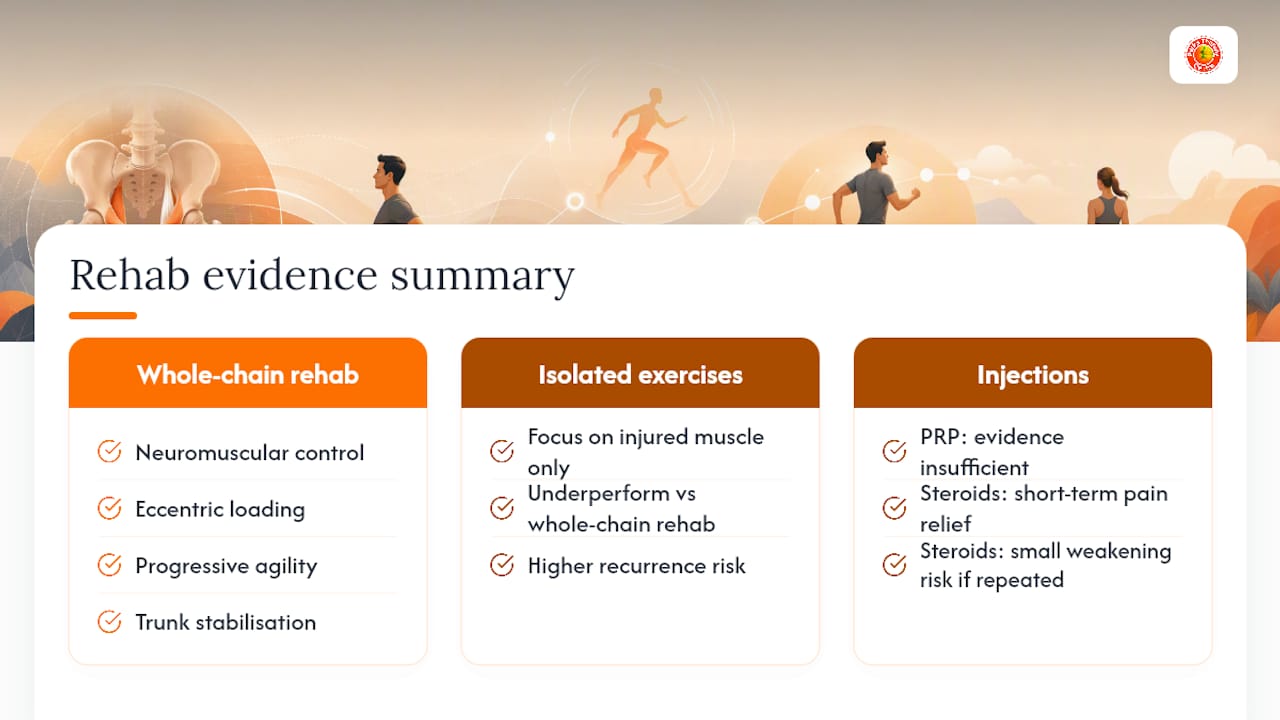
The strongest evidence in hip flexor strain rehabilitation points clearly towards neuromuscular control and eccentric loading as the most effective components of a recovery programme. JOSPT clinical guidance recommends progressive agility work, trunk stabilisation and eccentric strengthening over isolated muscle exercises, citing reduced reinjury risk as the primary rationale.
Rehabilitation that targets the whole kinetic chain — including the lumbar spine, sacroiliac joint, pelvis and hip girdle — consistently outperforms programmes that focus on the injured muscle in isolation. Addressing adjacent regions and restoring coordinated movement patterns is not optional; it is the mechanism by which recurrence is reduced.
Where evidence is more limited, practitioners should be cautious. Platelet-rich plasma (PRP) injections are sometimes offered for persistent muscle injuries, but the evidence base for their use in hip flexor strains specifically remains insufficient to recommend them as routine treatment. Similarly, corticosteroid injections may provide short-term pain relief but do not accelerate tissue healing and carry a small risk of further weakening the tendon if used repeatedly.
A physiotherapist structures assessment and progression around objective markers — pain scores, strength testing, range of motion and functional performance — rather than time alone. This approach, supported by musculoskeletal pain treatment evidence, reflects the current consensus that function-based criteria are more reliable predictors of safe return to activity than calendar weeks.
A clinician's perspective on what actually matters during rehab
The patients who recover well from hip flexor strains share one consistent trait: they follow a progressive plan and resist the urge to return to full training the moment pain settles. Pain disappearing is not the same as tissue healing. In a clinical setting, the most common pitfall is a patient who feels 80% better after two weeks, resumes full training, and returns four weeks later with a worse injury.
The practical priorities are straightforward. Protect the tissue in the first week, restore range of motion before adding load, and build strength from the ground up — starting with the glutes and core before reloading the hip flexors directly. Consistency with a modest daily exercise routine outperforms sporadic intense sessions every time.
Prognosis for Grade I and II strains is genuinely good. Most patients who follow a structured programme return to their previous activity level without long-term limitation. Grade III injuries and avulsions warrant early imaging and specialist review, but even these often resolve well with appropriate management. If you are not progressing as expected after four to six weeks of structured rehabilitation, that is the right time to seek imaging or specialist input — not a reason for alarm, but a signal to adjust the plan.
Parkstherapycentre: expert assessment and rehabilitation for hip injuries
Parkstherapycentre has been delivering specialist physiotherapy and sports injury rehabilitation across Bedfordshire and Buckinghamshire since 1986. For patients recovering from a hip flexor strain, the clinic offers a clear, supervised pathway from initial assessment through to full return to activity.
What the clinic provides:
- Comprehensive physiotherapy assessment to grade the injury and identify contributing factors
- A personalised, phased rehabilitation programme with progressive exercise prescription
- Pilates and reconditioning classes to rebuild hip girdle strength and movement control
- Acceptance of most major health insurance plans, with self-pay options available
- Appointments typically available within days, without the waiting times associated with NHS referral
At an initial assessment, a physiotherapist will examine your hip, assess strength and range of motion, and discuss your activity goals. From there, a structured plan is agreed — one that progresses at the right pace for your injury grade and lifestyle. To book an assessment or speak to the team, visit Parkstherapycentre and book online.
Sources
The following sources were used in preparing this article and are recommended for further reading:
- Hip flexor strain - aftercare: MedlinePlus Medical Encyclopedia
- Hamstring Injury - StatPearls - NCBI Bookshelf
- Journal of Orthopaedic & Sports Physical Therapy (JOSPT) clinical guide
- Hip Flexor Strain: Rehab Exercises
- Hip Strains - OrthoInfo - AAOS
- Checking your browser - reCAPTCHA
This article is general information, not a substitute for advice from a qualified doctor. Consult a qualified healthcare professional about your own circumstances before acting on anything here.