
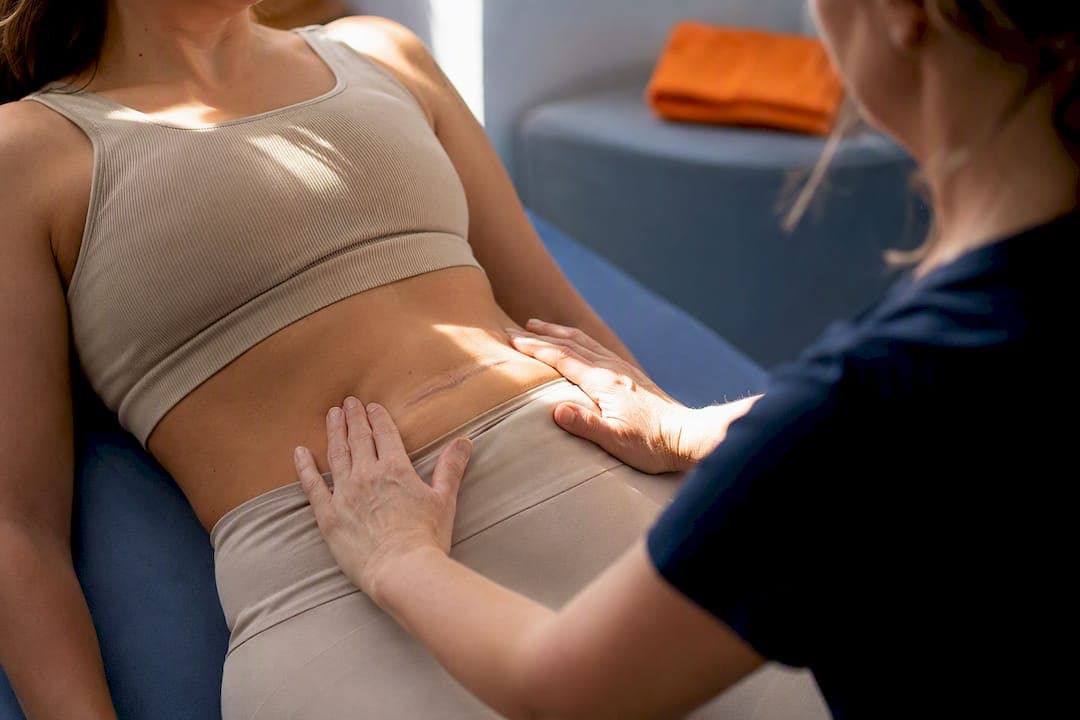
Yes, diastasis recti commonly occurs after a Caesarean section, and it is often more likely than after a vaginal birth. Many women see the gap narrow substantially within eight weeks with gentle movement, breathing work and pelvic floor activation. If separation persists beyond the early postpartum period, or you notice doming along the midline, a pelvic health physiotherapist should assess you.
TL;DR:
- Diastasis recti is more common after a Caesarean, with about 60% of women affected at six weeks postpartum and still present in 30 to 33% at one year.
- Scar tissue from surgery can restrict muscle gliding and alter abdominal mechanics, impacting recovery and exercise choices.
- Up to twelve weeks postpartum, gentle movement and specific physiotherapy techniques are recommended, avoiding high intra-abdominal pressure exercises and heavy lifting.
- Persistent separation, doming beyond twelve weeks, or functional issues like back pain should prompt referral for professional physiotherapy assessment.
- Proper recovery includes phased exercises, scar mobility work after six weeks, and avoiding activities that cause bulging or strain until full healing.
Table of Contents
- Why a C-section changes recovery: surgery, scar tissue and abdominal mechanics
- Signs, safe self-checks and myths to avoid
- Recovery timeline: practical phase-by-phase guidance
- What to avoid and practical red flags
- Progressive exercise plan: safe early moves through to advanced return to activity
- When to seek specialist physiotherapy or consider surgical opinion
- How The Parks Therapy Centre supports postpartum recovery after a C-section
- Book a physiotherapy assessment for your recovery
- Sources
- FAQ
Why a C-section changes recovery: surgery, scar tissue and abdominal mechanics
A Caesarean birth involves cutting through skin, fascia and the abdominal wall to reach the uterus, and that surgical trauma changes how your core heals compared with a vaginal delivery. The tissue layers beneath the visible scar, including the fascia that forms the linea alba, need time to knit back together, and scar tissue can form adhesions that restrict how neighbouring muscles glide against one another. A study of 534 women found that Caesarean delivery is an independent risk factor for diastasis recti, with prevalence around 60% at six weeks postpartum and 30 to 33% at twelve months.
When scar tissue restricts normal gliding, the abdominal muscles can recruit differently than they did before pregnancy, and the body may compensate by relying more heavily on the back or hips. This has a direct effect on exercise choice during recovery.
- Any movement that spikes intra-abdominal pressure, such as straining or breath-holding, places extra load on a linea alba that has not finished healing.
- Exercises need to protect the scar and deeper fascia while still encouraging the abdominal wall to reconnect and function normally.
Understanding this surgical layer is what separates generic postpartum advice from a plan built specifically for C-section recovery.
Signs, safe self-checks and myths to avoid
A simple self-check can tell you a good deal about how your abdominal wall is recovering. Lie on your back with your knees bent, feet flat on the floor, and lift your head slightly while feeling along the midline above and below your belly button.
- Place two fingers at the midline and note how many finger-widths fit into any gap you feel.
- A gap wider than two fingers, or roughly 2.5 centimetres, is considered a significant separation worth monitoring.
- Watch for doming or coning, a visible ridge or bulge along the midline when you lift your head or shift your weight, since this shows the tissue is struggling to manage pressure rather than simply confirming a wide gap.
Doming matters more than gap width alone. A narrow gap that domes under load can be a bigger functional concern than a wider gap that stays flat and controlled. Sit-ups and crunches tend to worsen doming because they load the midline directly while raising intra-abdominal pressure, and waist trainers do not address the underlying muscle coordination, so they are not considered a genuine fix for the separation itself.
Pro Tip: Film yourself from the side during your self-check. Doming is often easier to spot on video than by feel alone.

Recovery timeline: practical phase-by-phase guidance
Recovery after a Caesarean unfolds in stages, and knowing what each stage asks of you helps you avoid rushing tissue that is not ready for load.
In the first zero to six weeks, the priority is protecting the wound and re-establishing basic breathing and pelvic floor coordination rather than chasing strength. Short, gentle walks support circulation without straining the incision.
- Practise diaphragmatic breathing and gentle pelvic floor squeezes several times a day, well within comfort.
- Avoid lifting anything heavier than your baby, and roll onto your side before sitting up from lying.
- Keep daily movement light and frequent rather than long and strenuous.
Between six and twelve weeks, once the external scar has typically closed, you can begin graded core reconnection: gentle abdominal bracing, controlled limb movements and light pelvic tilts, always checking for doming before adding load. This is also the point at which the external scar has usually healed, although the deeper abdominal tissues continue repairing for several more months.
From three to six months, functional loading increases if your control has stayed reliable through the earlier stages. This is when many women return to running, structured strength training or higher-impact activity, provided the abdominal wall manages pressure without doming or leaking symptoms.
Deeper tissue healing can continue for three to six months after the visible scar closes, so patience through this middle stretch matters as much as the exercises themselves. If separation and symptoms have not improved by twelve weeks, or you are still experiencing doming, back pain or bulging, referral to a pelvic health physiotherapist is the appropriate next step rather than continuing to wait.

What to avoid and practical red flags
Certain movements and habits slow healing or worsen separation, particularly in the early months.
- Avoid sit-ups, full crunches and any exercise that causes visible doming along the midline.
- Skip heavy lifting combined with breath-holding, and avoid uncontrolled twisting through the trunk.
- Lift objects close to your body rather than at arm's length, and roll to your side before getting out of bed.
- Avoid straining during bowel movements, and address constipation early if it develops.
Certain symptoms need prompt attention rather than a wait-and-see approach. Contact your GP or midwife if you notice an expanding bulge, worsening abdominal or back pain, wound redness, discharge or separation, or new or worsening incontinence. These signs point to something beyond routine recovery and deserve a proper assessment.
Progressive exercise plan: safe early moves through to advanced return to activity
A staged approach keeps you working within what your abdominal wall can currently control, rather than pushing for strength before pressure management is solid.
- Early stage (weeks one to six): diaphragmatic breathing, gentle pelvic floor squeezes, heel slides and pelvic tilts performed slowly, with no breath-holding.
- Intermediate stage (weeks six to twelve): transverse abdominis activation paired with slow limb movements, gentle bridging and modified planks on the knees, done in short sets and stopped the moment doming appears.
- Advanced stage (three months onward): functional tasks such as carrying a car seat, squatting to lift a toddler and eventually structured strength training or running, introduced gradually once control has stayed reliable across several weeks.
You are generally ready to progress when a movement stays flat and controlled at the midline for several consecutive sessions, symptoms such as heaviness or leaking do not appear, and effort feels proportionate rather than strained. If doming reappears at any stage, the appropriate response is to regress to the previous level rather than pushing through it, since research suggests exercise alone gives very low quality evidence of reducing the anatomical gap, even though it reliably improves function and symptoms.
Pro Tip: Progress load, not just repetitions. Adding a small amount of resistance under good control does more than adding sets to a movement that already domes.
Scar mobility work fits alongside this progression once the wound has fully closed, typically from six weeks. Gentle self-massage around the scar can reduce tethering and improve comfort, though it should start lightly and increase only as sensitivity allows. For readers wanting more detail on specific movements and clinic-tested progressions, our in-depth guide to diastasis recti treatment covers the exercise selection in more depth.
When to seek specialist physiotherapy or consider surgical opinion
Certain thresholds mean home management alone is no longer the right approach.
- A gap wider than two fingers alongside ongoing symptoms at twelve weeks warrants a pelvic health physiotherapy assessment.
- Persistent doming that does not resolve with regression, or functional limits such as being unable to lift your baby comfortably, are also referral triggers.
A pelvic health physiotherapy assessment typically includes a review of your birth history, a hands-on check of the separation and scar mobility, and an individually tailored exercise plan with follow-up to track progress. Most women improve through this conservative route, though some with severe, unresponsive symptoms may eventually discuss surgical options with a specialist once conservative rehabilitation has genuinely been given a fair trial.
How The Parks Therapy Centre supports postpartum recovery after a C-section
A multidisciplinary physiotherapy team experienced in pregnancy-related and postpartum care supports recovery after C-section. Appointments can be arranged through online booking.
A typical pathway starts with a physiotherapy assessment to check your separation, scar mobility and pelvic floor function, followed by a tailored exercise plan with progress reviewed at follow-up visits. This structured, in-person input complements the home strategies covered above, particularly when progress has stalled or doming persists past the early weeks.
— Ivan
Book a physiotherapy assessment for your recovery

If your separation has not settled with home exercises, or you simply want a professional check before progressing further, a physiotherapy assessment gives you a clear picture of where you stand and what to do next. The centre's physiotherapy assessment, treatment sessions and Pilates classes are all suited to different stages of C-section recovery, from an initial check to ongoing one-to-one rehab or group Pilates once you are ready for more structured strengthening.
- Book a physiotherapy assessment to have your separation, scar mobility and pelvic floor function reviewed.
- Bring notes on your symptoms, including when doming occurs and any scar discomfort, to your first visit.
- Consider a Pilates One-to-One session once your physiotherapist confirms you are ready for more targeted core work.
If recovery has stalled or symptoms are affecting daily life, book an assessment through the prices and booking page to get a plan suited to your stage of healing.
This article is general information, not a substitute for advice from a qualified doctor. Consult a qualified healthcare professional about your own circumstances before acting on anything here.
Sources
- PMC article reporting higher DRA prevalence after caesarean delivery
- Leeds Teaching Hospitals NHS Trust — Diastasis of recti (separation of stomach muscles)
- Systematic review: evidence for abdominal and pelvic floor muscle training in postpartum DRA
FAQ
How do you get rid of diastasis recti after a C-section?
Gentle breathing, pelvic floor activation and graded core exercises help most women see real improvement within the first eight weeks. If separation persists with doming or symptoms beyond twelve weeks, a pelvic health physiotherapist can tailor a plan to your specific case.
Does every Caesarean section cause diastasis recti?
Not every Caesarean results in diastasis recti, but Caesarean delivery is an independent risk factor, with prevalence around 60% at six weeks postpartum that typically falls over the following months. Individual healing varies with scar tissue, muscle tone before pregnancy and how recovery is managed.
How long does diastasis recti take to heal after a C-section?
Many cases improve substantially within eight weeks, while prevalence studies show separation can still be present in around 30 to 33% of women at twelve months. Deeper abdominal tissue continues healing for several months after the visible scar has closed.
What happens if diastasis recti is left untreated?
Untreated separation can contribute to ongoing back pain, reduced core function and a persistent midline bulge, and functional symptoms rarely resolve on their own once the early recovery window has passed. Some women with severe, unresponsive symptoms eventually explore surgical options after conservative physiotherapy has been genuinely tried.