

TL;DR:
- Cognitive behavioural therapy is a present-focused, skills-based approach that targets maladaptive thoughts and behaviors.
- Research confirms its effectiveness in reducing symptoms of depression, anxiety, and stress through active engagement.
Most people assume cognitive behavioural therapy is just talking about your childhood or revisiting painful memories. It isn't. CBT is a structured, present-focused approach that teaches you practical skills to change the way you think and behave right now. It's one of the most thoroughly researched psychological treatments available, and understanding what it actually involves can make the difference between seeking help and putting it off indefinitely.
Table of Contents
- Key takeaways
- What cognitive behavioural therapy is built on
- Core CBT techniques and how they work
- What the evidence actually says
- What to expect from CBT in practice
- My honest take on CBT and why people struggle with it
- Start your journey with Parkstherapycentre
- FAQ
Key takeaways
| Point | Details |
|---|---|
| CBT targets thoughts and behaviour | It changes maladaptive thinking patterns and behaviours rather than simply exploring past experiences. |
| Techniques are practical and learnable | Tools like thought records, behavioural activation, and graded exposure are skills you build through practice. |
| Research strongly supports it | A 2026 meta-analysis found significant reductions in depression, anxiety, and stress symptoms with CBT. |
| Behavioural practice is non-negotiable | Cognitive insight alone rarely produces lasting change; real-world exercises between sessions are what shift habits. |
| Digital CBT options now exist | NICE conditionally recommends internet-based CBT tools as first-line options for young people with mild to moderate anxiety. |
What cognitive behavioural therapy is built on
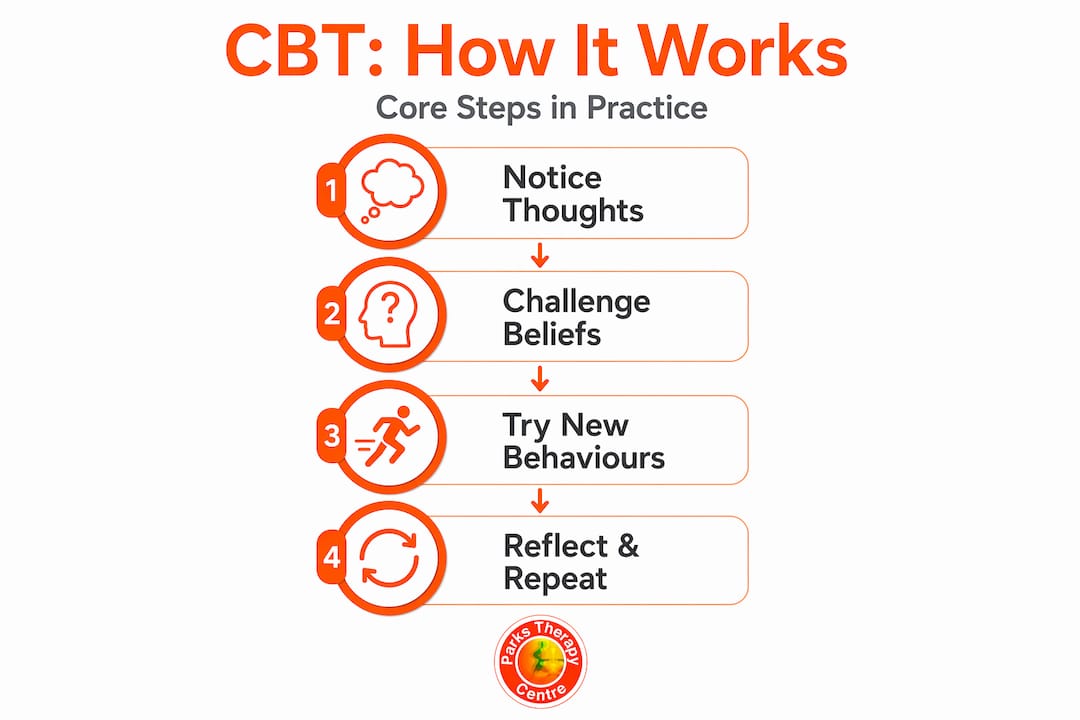
At its core, cognitive behavioural therapy addresses dysfunctional thoughts and converts them into more adaptive alternatives. The model rests on a deceptively simple idea: your thoughts, feelings, and behaviours are all connected. Change one, and the others begin to shift too.

Here's what that looks like in practice. Say you make a mistake at work and immediately think, "I'm incompetent and everyone will notice." That thought triggers anxiety, which leads you to avoid your colleagues, which reinforces the belief that something is wrong with you. CBT breaks that cycle by targeting it at the thought level first, then the behaviour.
Three key concepts sit at the heart of CBT theory:
- Negative automatic thoughts. These are the rapid, reflexive judgements that pop into your mind without invitation. They feel like facts but are often distortions.
- Core beliefs. These are the deep, often unconscious convictions you hold about yourself, others, and the world. Examples include "I am unlovable" or "The world is dangerous."
- Dysfunctional assumptions. These sit between core beliefs and automatic thoughts. They are the conditional rules you live by, such as "If I am not perfect, I am a failure."
What sets CBT apart from older forms of psychotherapy is its emphasis on the present. Rather than spending months unpacking your early years, CBT is skills-based and time-limited. Treatment typically runs for 6 to 20 sessions of 30 to 60 minutes, with clear goals set from the beginning. This structure makes it accessible, measurable, and compatible with how most people actually want to engage with therapy.
Core CBT techniques and how they work
This is where theory becomes something you can actually use. CBT techniques target dysfunctional thoughts and behaviours through specific, repeatable tools. Here are the most widely used ones:
- Thought records. You write down a distressing thought, identify the emotion it triggers, examine the evidence for and against it, and construct a more balanced alternative. Over time, this process becomes automatic.
- Cognitive restructuring. This builds on thought records by systematically challenging cognitive distortions such as catastrophising, all-or-nothing thinking, and mind-reading.
- Behavioural activation. Particularly useful for depression, this technique involves scheduling activities that bring a sense of achievement or pleasure, even when motivation is low. You act first; the mood often follows.
- Graded exposure. For anxiety, you create a hierarchy of feared situations and work through them from least to most anxiety-provoking, allowing your nervous system to habituate gradually.
- Problem-solving skills. You learn to break overwhelming problems into manageable steps and generate concrete solutions rather than ruminating.
- Role-playing. Useful for social anxiety and assertiveness issues, this technique lets you practise difficult conversations in a safe setting before facing them in real life.
- Relaxation techniques. These include controlled breathing, progressive muscle relaxation, and mindfulness. They are not standalone fixes but they reduce physiological arousal enough to make other CBT work more effective.
The homework element deserves special mention. Skipping behavioural practice leads to persistent maladaptive patterns even when you intellectually understand the concepts. What you do between sessions matters as much as the sessions themselves.
Pro Tip: Don't wait to feel ready before completing behavioural exercises. The feeling of readiness almost never precedes action in CBT. It follows it.
What the evidence actually says
CBT is not popular because it sounds sensible. It's popular because it reduces symptoms across depression, anxiety, and stress with striking consistency. A 2026 systematic review and meta-analysis produced some of the clearest numbers yet.
| Condition | Mean symptom reduction | Statistical significance |
|---|---|---|
| Depression | 1.017 | P < 0.001 |
| Anxiety | 1.013 | P < 0.001 |
| Stress | 1.209 | P < 0.001 |
For those dealing with more acute risk, the evidence is equally compelling. CBT shows better long-term efficacy than standard treatment for reducing suicidal ideation in people with depression, based on an analysis of 12 randomised controlled trials. The follow-up effect size was substantial, with a standardised mean difference of 6.98. That is not a marginal improvement.
"Matching format and intensity to individual problems is key rather than abandoning treatment early due to scepticism." — CBT effectiveness meta-analysis, 2026
NICE has also conditionally recommended five digital CBT tools for young people with mild to moderate anxiety or low mood. These platforms combine CBT principles with videos, games, and quizzes, making the approach more accessible to adolescents who might not engage with traditional therapy. This is not a watered-down alternative. These tools are practitioner-supported and built on the same theoretical foundations as face-to-face CBT.
Two caveats are worth naming honestly. CBT works best when you complete the homework, engage actively with your therapist, and attend consistently. Dropping out early or treating sessions as passive listening rarely produces the outcomes the research describes. The benefits of cognitive behavioural therapy are real, but they are conditional on engagement.
What to expect from CBT in practice
If you are considering starting CBT, knowing what a typical course looks like removes a significant barrier. Sessions are collaborative. Your therapist will not simply talk at you. Together, you set an agenda at the start of each session, review any homework from the previous week, introduce new concepts or techniques, and practise applying them.
There are a few things that genuinely improve your outcomes:
- Set specific goals early. "I want to feel less anxious" is a starting point. "I want to be able to attend social events without leaving early" is a goal CBT can actually work towards.
- Be honest about your homework. If you didn't complete an exercise, say so. Understanding why you avoided it is often more therapeutically useful than doing it would have been.
- Expect discomfort. Graded exposure is not comfortable. Confronting distorted thoughts can feel threatening at first. That discomfort is a sign the work is happening, not a sign something is wrong.
- Use digital options strategically. For younger people or those awaiting face-to-face treatment, internet-based CBT tools recommended by NICE can provide a useful entry point or supplement to in-person sessions.
Pro Tip: Treat your CBT homework the way you would a medical prescription. Skipping it occasionally might not feel significant, but consistent behavioural practice is what separates people who improve steadily from those who plateau.
A structured approach to healthcare, whether physiotherapy or psychological therapy, always produces better outcomes when the patient understands the rationale. Parkstherapycentre applies this principle across all its disciplines, and it holds just as true in CBT as it does in manual therapy.
My honest take on CBT and why people struggle with it
I've worked with and around structured therapy approaches for years, and the pattern I keep seeing is this: people understand CBT remarkably quickly. They grasp the thought-feeling-behaviour triangle in a single session. Then they go home, skip the thought record, and wonder why they don't feel better.
The problem isn't understanding. It's the assumption that understanding is enough. CBT asks you to do something genuinely difficult: act against the pull of your own avoidance. When you're anxious about social situations, every cell in your body tells you to stay home. Behavioural activation and graded exposure ask you to do the opposite. That friction is the therapy.
What I've learned is that people who do well in CBT share one trait: they treat themselves as active participants rather than patients waiting to be fixed. They complete the exercises not because they feel like it, but because they've accepted that feeling like it comes after, not before.
The other thing I'd push back on is the search for the perfect technique. Thought records, exposure hierarchies, problem-solving frameworks: none of them are magic in isolation. They work because they are repeated. Consistently. Over weeks. The research is clear on outcomes, but outcomes belong to people who stay with the process long enough to let the change compound.
If you're considering CBT, the question isn't whether it works. The question is whether you're willing to do the work.
— Ivan
Start your journey with Parkstherapycentre
Taking the first step towards better mental health is not always straightforward, but it doesn't need to be complicated either. Parkstherapycentre offers access to professional therapy services designed around your individual needs, whether you're managing anxiety, low mood, or persistent stress.
The team at Parkstherapycentre understands that finding the right support matters. From navigating your therapy options to booking your first appointment, the process is designed to be clear and accessible. If you've been considering CBT or simply want to understand what support is available to you, visiting Parkstherapycentre is the clearest next step. Professional guidance is closer than you think.
FAQ
What is cognitive behavioural therapy?
Cognitive behavioural therapy is a structured, evidence-based talk therapy that focuses on changing maladaptive thoughts and behaviours to reduce emotional distress. Unlike older psychotherapy models, it is present-focused and typically lasts between 6 and 20 sessions.
How does CBT work for anxiety?
CBT for anxiety uses techniques such as graded exposure and cognitive restructuring to help you systematically face feared situations and challenge distorted thinking. Over time, this reduces avoidance behaviour and lowers anxiety responses.
What are the main CBT techniques?
The core CBT techniques include thought records, cognitive restructuring, behavioural activation, graded exposure, problem-solving, role-playing, and relaxation exercises. Each targets a specific part of the thought-feeling-behaviour cycle.
Is there evidence that CBT works?
Yes. A 2026 meta-analysis found statistically significant reductions in depression, anxiety, and stress symptoms. CBT also shows better long-term results than standard treatment for reducing suicidal ideation in people with depression.
Can I do CBT without a therapist?
Digital and self-guided CBT options exist and are conditionally recommended by NICE for young people with mild to moderate anxiety. However, self-guided formats work best as supplements to or bridges towards face-to-face therapy, particularly for more severe presentations.