
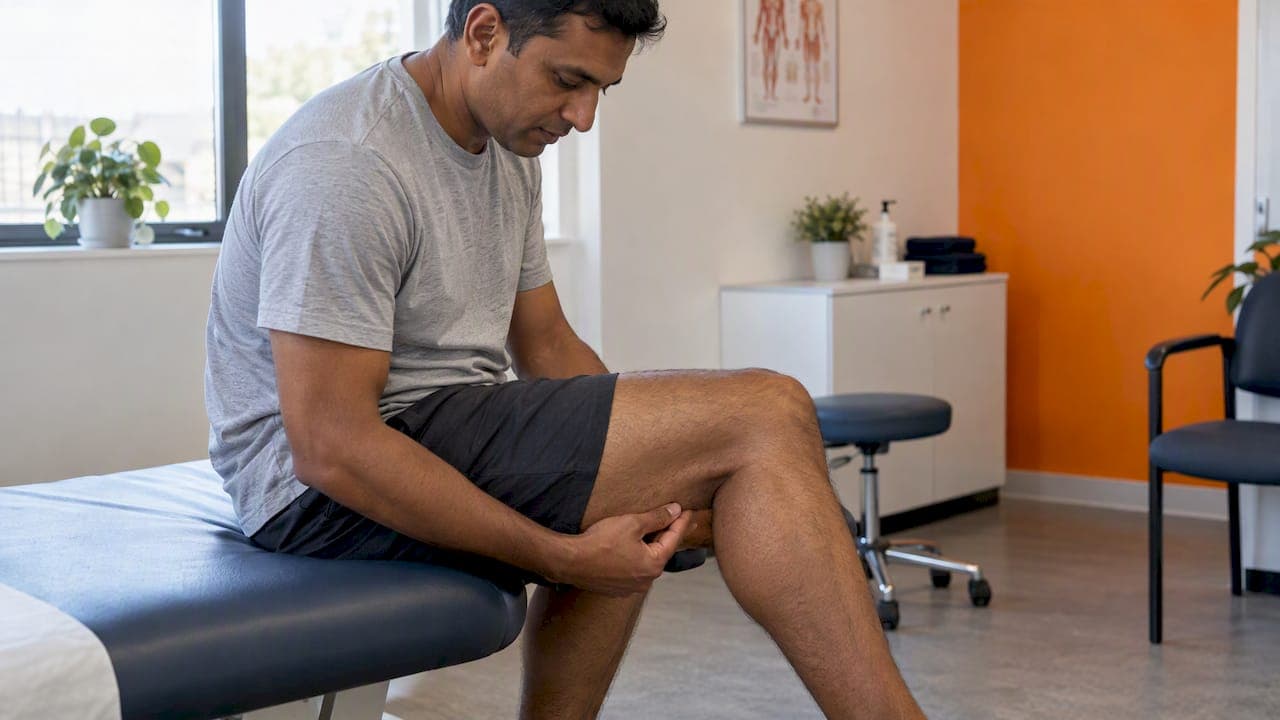
Most Baker's cysts are treated without surgery. The usual approach is to look after the knee, ease the pain and swelling, and treat whatever is causing the knee to produce extra fluid in the first place. The NHS says a Baker's cyst does not always need treatment and may improve when the underlying condition is dealt with. This guide explains the options in the order they are normally tried, what you can do at home, where physiotherapy fits, and which symptoms mean you should not wait.
TL;DR
- A Baker's cyst is a fluid-filled swelling behind the knee, usually caused by another knee problem such as arthritis or a cartilage injury.
- Treatment starts with rest, ice, painkillers and physiotherapy. Injections and drainage come next if needed. Surgery is rare.
- Treating the underlying knee problem is what most reduces the cyst, so a proper assessment matters more than treating the lump alone.
- Recovery can take a few months to a few years. A sudden painful, hot or red calf needs urgent medical help, because it can look like a blood clot.
- Any lump behind the knee that has not been diagnosed should be checked by a GP first.
Table of Contents
- What a Baker's cyst is and why it forms
- Get the lump checked first
- Can a Baker's cyst be treated without surgery?
- Self-care at home
- Physiotherapy for a Baker's cyst
- Injections and drainage
- When surgery is considered
- How long does a Baker's cyst take to go away?
- Our perspective
- Seeing a physiotherapist at Parks Therapy Centre
- Practical tips to protect the knee while the cyst settles
- FAQ
- Sources
What a Baker's cyst is and why it forms
A Baker's cyst, also called a popliteal cyst, is a fluid-filled lump at the back of the knee. It can feel tight when you straighten the leg fully or bend it deeply, and some people feel nothing but the lump itself.
The cyst is rarely the real problem. NICE guidance for clinicians states that in adults it is usually secondary to another condition: osteoarthritis, rheumatoid arthritis, or a soft-tissue injury such as a meniscal tear or ACL damage. The joint makes more fluid than usual, and that fluid collects behind the knee.
This explains why treatment aimed only at the lump often disappoints. If the knee stays irritated, the cyst has a reason to stay or come back.

Get the lump checked first
A lump behind the knee is not always a Baker's cyst. Other conditions can cause lumps in the same place, and the NHS advises seeing a GP for any lump that has not been explained. A GP may arrange an ultrasound or MRI scan to confirm what it is.
This matters for a second reason. A cyst that bursts can resemble a deep vein thrombosis (DVT), a blood clot in the leg, and the two need very different handling. Do not assume a painful calf is "just the cyst".
Symptoms that need urgent help
The NHS lists these warning signs:
- Urgent GP appointment or NHS 111: your leg pain or swelling suddenly gets worse, the leg becomes warm, bruised, red or darker in colour, or the swelling changes in feel.
- 999 or A&E: leg pain or swelling together with breathlessness or chest pain.
If any of these apply, stop reading and get help. Physiotherapy comes after a safe diagnosis, not before.
Can a Baker's cyst be treated without surgery?
Yes, and this is the normal route. The NHS lists painkillers, physiotherapy, a hydrocortisone injection into the knee and drainage of the fluid as the non-surgical options. It describes surgery, whether to remove the cyst or to repair damage inside the knee, as rare.
The American Academy of Orthopaedic Surgeons describes the same order of care. It starts with observation, cutting back on irritating high-impact activity and anti-inflammatory medicine. Corticosteroid injection and aspiration, often guided by ultrasound, follow. Operations are kept for painful symptoms that persist despite those measures, or for a cyst that keeps returning after repeated aspiration.
The stepped approach in summary:
| Step | What it involves | Typical purpose |
|---|---|---|
| 1. Self-care | Rest, ice, raising the leg, simple painkillers | Settle pain and swelling |
| 2. Physiotherapy | Assessment, movement and strengthening, load advice | Treat the knee behind the cyst |
| 3. Injection | Steroid injection into the knee joint | Calm inflammation in the joint |
| 4. Aspiration | Drawing off fluid, often with ultrasound | Reduce the cyst quickly |
| 5. Surgery | Rarely, to remove the cyst or repair the knee | Persistent or recurring problems |
Self-care at home
The NHS self-care advice is simple: rest the knee, use a wrapped ice pack for around 10 minutes at a time and repeat every few hours if needed, raise the leg on a pillow, and take painkillers such as ibuprofen or paracetamol.
A few practical points:
- Wrap the ice. Royal Berkshire NHS Foundation Trust advice says to use an ice pack wrapped in a towel for 10 to 30 minutes. Ice should never touch bare skin, and more than 30 minutes may damage it.
- Rest does not mean immobility. Short periods of relief from the aggravating activity help. Staying completely still for weeks tends to stiffen the knee and weaken the thigh muscles.
- Check painkillers suit you. Ibuprofen and similar anti-inflammatories are not right for everyone, including some people with stomach, kidney, heart or asthma conditions. Ask a pharmacist or GP if you are unsure.
Some people with arthritis in the knee also look into complementary options alongside medication. If you are curious about light-based approaches, this overview of red light therapy for arthritis covers the area, and your physiotherapist or GP can tell you how it fits with the rest of your plan.
Physiotherapy for a Baker's cyst
Physiotherapy is the treatment most people can start straight away, and it addresses the cause rather than the lump. Royal Berkshire NHS advice says physiotherapy may help by maintaining knee movement and strengthening the muscles around the knee.

What an assessment looks at
A good assessment asks why the knee is producing fluid. That means looking at:
- your history: a previous twist, a meniscal or ligament injury, known arthritis, or a recent increase in running, kneeling or stairs;
- how the knee bends and straightens, and whether it swells after activity;
- strength and control in the thigh, hip and calf;
- how you walk, squat and step;
- whether you need imaging or a GP or orthopaedic opinion before going further.
If the findings suggest the lump is not a simple cyst, or that a cartilage or ligament injury needs imaging, a physiotherapist will say so and arrange the next step.
Exercises: what to expect
People searching for Baker's cyst exercises often want a list. There is no single routine that suits everyone, because the right exercises depend on what is irritating your knee. In general, a physiotherapist is likely to build a programme from these groups:
- Gentle range of movement, such as sliding the heel towards the buttock and back, within comfort, to keep the knee moving.
- Thigh strengthening, such as controlled sit-to-stand or short-range squats, as pain allows.
- Hip and calf work, so the knee is not asked to cope alone.
- Gradual return to activity, increasing walking, cycling or impact in stages.
Two rules of thumb apply. Exercise should not sharply increase the swelling or tightness behind the knee the next day. And if a movement causes a pull or stretch feeling in the lump, ease off and tell your physiotherapist rather than pushing through. Our guide to managing knee pain gives more everyday strategies, and our article on home exercises for recovery explains how to structure a programme between appointments.
Injections and drainage
When self-care and physiotherapy are not enough, a doctor may suggest injecting the knee. Royal Berkshire NHS advice explains that treating the underlying knee problem can reduce cyst size, pain and swelling, and that a steroid injection for osteoarthritis may relieve pain and inflammation but may not stop the cyst returning.
That answers a common question: does cortisone help? It can calm the joint, and sometimes the cyst along with it. It is not a permanent fix when the cause remains.
Aspiration means drawing fluid out of the cyst with a needle, often under ultrasound. AAOS guidance lists it among the first-line, non-surgical options. These procedures are carried out by doctors, so if you think you need one, ask your GP or an orthopaedic or musculoskeletal specialist. A physiotherapist can help you reach that point sooner by identifying when it is worth asking.
When surgery is considered
Surgery is uncommon. AAOS says it may be considered when painful symptoms persist despite non-surgical treatment, or when the cyst keeps returning after multiple aspirations. The NHS also notes that repairing damage inside the knee is rarely needed. Where a torn meniscus or another structural problem is driving the fluid, that problem is what a surgeon would address, not the cyst alone.
For most people, the sensible question is not "can the cyst be cut out?" but "what is irritating my knee, and can we calm it?"
How long does a Baker's cyst take to go away?
Expect a long timeframe. The NHS says a Baker's cyst can take a few months to a few years to get better. If it ruptures, symptoms may be worse until the swelling goes down, which can take a few weeks.
That range is wide because recovery follows the knee. A cyst linked to a recent meniscal irritation may settle sooner than one linked to long-standing osteoarthritis. A realistic plan focuses on what you can control: keeping the knee moving, strengthening the muscles around it, pacing activity, and reviewing progress with a professional rather than watching the lump alone.
Our perspective
We have treated knee problems in Bedfordshire and Buckinghamshire since 1986, and the pattern we see with a Baker's cyst is consistent: people come in worried about the lump, but the answer sits inside the knee.
Three points guide how we approach it:
- Diagnosis before treatment. A lump behind the knee should be properly identified. If we see signs that point to a clot or something else, we send you to the right place the same day rather than treating.
- Treat the cause. We assess the knee, hip and the way you load them, then build rehabilitation around what we find. Pushing through exercises that flare the knee tends to slow things down.
- Use imaging sensibly. When a scan will change the plan, we can arrange an image referral, and we review the results with you afterwards so you understand what they mean.
Most people do not need anything dramatic. They need an accurate explanation, a graded programme and someone to adjust it as the knee responds.
— Ivan
Seeing a physiotherapist at Parks Therapy Centre
If you have had your lump checked and want help with the knee behind it, we can assess and treat you at our clinics in Bedfordshire and Buckinghamshire. We accept private payment and major health insurance plans, and you can book online.
Our published prices (2026) for the usual route are:
- Physiotherapy assessment: £76
- Physiotherapy treatment session: £67
- Image assessment: £76, with an image referral letter at £10 and an image results review at £67 if a scan is appropriate
See the full price list or book an appointment with us. If you have recently had knee surgery, our post-surgery knee strengthening guide explains how rehabilitation is staged.
Practical tips to protect the knee while the cyst settles
Some habits help whatever the cause:
- Keep walking within comfort. Gentle daily activity is usually better for a swollen knee than long rests.
- Avoid deep, repeated kneeling and heavy squatting while the back of the knee feels tight.
- Vary your day. Long periods sitting with a bent knee can feel worse, so stand and straighten the leg regularly.
- Choose low-impact exercise such as cycling or swimming if running flares the swelling, then build back up in steps.
- Keep a simple note of swelling and pain after activity. It helps a clinician see what the knee tolerates.
- Do not massage or press hard on the lump. It will not disperse the fluid and may irritate the area.
If swelling or pain ramps up suddenly, go back to the warning signs above rather than trying to manage it yourself.
FAQ
Can a Baker's cyst be treated without surgery?
Yes. The NHS lists painkillers, physiotherapy, a hydrocortisone injection and drainage as the non-surgical options, and describes surgery as rare. Most people are managed with self-care, physiotherapy and treatment of the underlying knee problem.
What is a lump on the back of my knee?
It may be a Baker's cyst, a fluid-filled swelling often linked to arthritis or a knee injury. Other conditions can also cause a lump there, so see your GP for an examination. They may arrange an ultrasound or MRI scan.
Does cortisone help a Baker's cyst?
A steroid injection into the knee may ease pain and inflammation, particularly where osteoarthritis is the cause. Royal Berkshire NHS advice says it may not prevent the cyst coming back, so it is usually combined with treatment of the underlying knee problem.
How long do Baker's cysts take to go away?
The NHS says it can take a few months to a few years. If a cyst ruptures, the swelling can take a few weeks to settle. Progress depends largely on how well the underlying knee condition is managed.
Sources
- Baker's cyst, NHS
- Baker's cyst, NICE Clinical Knowledge Summaries
- Baker's Cyst (Popliteal Cyst), OrthoInfo, AAOS
- Baker's cyst patient advice, Royal Berkshire NHS Foundation Trust
- Red light therapy for arthritis