
Adductor tendinopathy is treated mainly with progressive exercise, sensible changes to the activities that aggravate it, and time. Rest alone rarely fixes it, and massage or electrotherapy on their own do not address the tendon itself. Most people need weeks to months of structured loading, ideally guided by a physiotherapist who has first confirmed that the pain really comes from the adductor tendon and not from the hip, pubic bone or abdominal wall.
This guide explains how adductor tendinopathy differs from a strain, what treatment involves stage by stage, how much pain is acceptable during rehab, how long recovery takes and when to seek assessment. It also covers how hamstring tendinopathy is managed, because the two are often confused.
TL;DR
- Adductor tendinopathy is a gradual overload problem of the groin tendon. An adductor strain is usually a sudden injury. The early advice differs a little, but the later rehab overlaps.
- Exercise is the core of treatment. Passive treatments such as massage and electrotherapy do not address the structural nature of tendinopathy.
- Keep pain during exercise within the limits your clinician sets (NHS guidance suggests no higher than 3 or 4 out of 10) and make sure it settles quickly afterwards.
- Expect recovery to take months, not days. Persevering with the programme matters more than any single technique.
- See a physiotherapist if pain does not improve within a week or so, and seek urgent help if you suspect a tendon rupture.
Table of Contents
- What adductor tendinopathy is, and how it differs from a strain
- Who tends to get it
- Early management: the first days
- Exercise: the core of adductor tendinopathy treatment
- How much pain is acceptable?
- Adductor strain treatment: what changes
- Hamstring tendinopathy: how treatment differs
- Where a physiotherapist adds value
- How long does recovery take?
- Our perspective
- Book an assessment at Parks Therapy Centre
- FAQ
- Sources
What adductor tendinopathy is, and how it differs from a strain
The adductors are the group of muscles on the inner thigh. They pull the leg towards the midline and help stabilise the pelvis when you kick, change direction or run. Their tendons attach at the pubic bone, which is why pain in this area is often felt deep in the groin, high on the inner thigh or close to the pubic bone.
Tendinopathy is the term for a painful, overloaded tendon. It tends to build up over weeks as training load, kicking volume or sudden changes of direction outstrip what the tendon has adapted to. Typical features are:
- pain that comes on gradually rather than with a single "pinging" moment
- stiffness or soreness at the start of exercise that may ease as you warm up, then return afterwards
- tenderness where the tendon meets the bone
- pain when squeezing the knees together, kicking, sprinting or pushing off sideways
A strain is different in how it begins. It usually follows a specific moment: an overstretched leg while tackling, a slip, a sudden sprint. Pain is sharper, there may be bruising, and the injury is to the muscle or its junction with the tendon. Strains are the more common of the two, which is why the related query "adductor strain treatment" is searched far more often. The practical point is that the two can coexist, and a tendon that has been strained once and rushed back into training may become a tendinopathy.
If you want a fuller picture of the whole range of groin problems in sport, our complete athlete's guide to sports-related groin injuries covers them in more detail.
Who tends to get it
Adductor problems are most associated with sports that involve kicking, rapid acceleration and changes of direction: football, rugby, hockey, ice hockey and running sports. Common contributing factors include:
- a sudden rise in training volume or intensity, particularly after a break
- a recent groin strain that was not fully rehabilitated
- reduced adductor or core strength relative to the demands of the sport
- limited hip movement
- a lot of cutting, sprinting or kicking on hard or slippery surfaces
Non-athletes are not immune. A new walking or running programme, a sudden increase in gym work or a change in footwear can overload the same tendon.
Early management: the first days
In the first 48 to 72 hours after a groin injury, NICE guidance on sprains and strains recommends PRICE self-management (protection, rest, ice, compression and elevation), then starting active mobilisation and flexibility exercises as soon as you can tolerate them without excessive pain. This guidance is written for acute soft tissue injuries, so it fits a strain best. If you have a slowly built-up tendinopathy, the principle still applies in spirit: calm the pain by cutting back what provokes it, but do not stop moving altogether.
Practically, that means:
- Stop or reduce the activities that clearly make it worse, such as sprinting, kicking, sharp changes of direction and wide-legged stretches.
- Keep walking and doing everyday movement within comfortable limits.
- Avoid aggressive stretching of a sore groin. Pulling on an irritated tendon rarely helps.
- Do not push through sharp or worsening pain.
The same guidance says to consider medical review after 5 to 7 days if there is no expected improvement or symptoms get worse, and to seek emergency assessment if a tendon rupture or complete tear is suspected. A sudden snap, a visible defect, significant swelling or an inability to bear weight all warrant urgent medical attention rather than a wait-and-see approach.
Exercise: the core of adductor tendinopathy treatment
Exercise is considered the most vital component of tendinopathy treatment, and patient information from Leicestershire Partnership NHS Trust states that passive treatments such as massage and electrotherapy do not address the structural nature of the problem. That can feel counter-intuitive when the tendon is sore, but a tendon adapts to load: it needs to be asked to do a little more, in a controlled way, to become stronger.
NHS guidance on adductor-related groin pain describes staged rehabilitation that progresses as pain, endurance and strength allow. Examples include inner-thigh squeezes, strengthening and core stability exercises.

A typical progression
Your physiotherapist will tailor this, and the exact exercises depend on your sport, your current strength and what provokes your pain. As an outline:
| Stage | Aim | Typical content |
|---|---|---|
| 1. Settle | Reduce irritation, maintain movement | Relative rest from aggravating activity, gentle isometric inner-thigh squeezes, walking |
| 2. Load | Build tendon and muscle capacity | Progressive adductor strengthening, hip and glute work, core stability |
| 3. Strengthen | Increase load and time under tension | Heavier or longer-duration strengthening, single-leg and side-to-side work |
| 4. Prepare for sport | Restore speed and control | Running progression, change of direction, kicking drills |
| 5. Return | Full training and match play | Sport-specific, high-intensity movement without pain |
A 2023 clinical review on exercise and load management for groin pain describes adductor rehabilitation programmes with around six to ten exercises per session, progressive loading and substantial time under tension, ideally performed every other day. The same review stresses that rehab should be individualised to the athlete, the injury and the sport, and should target the specific impaired tissues.
The squeeze exercise, simply
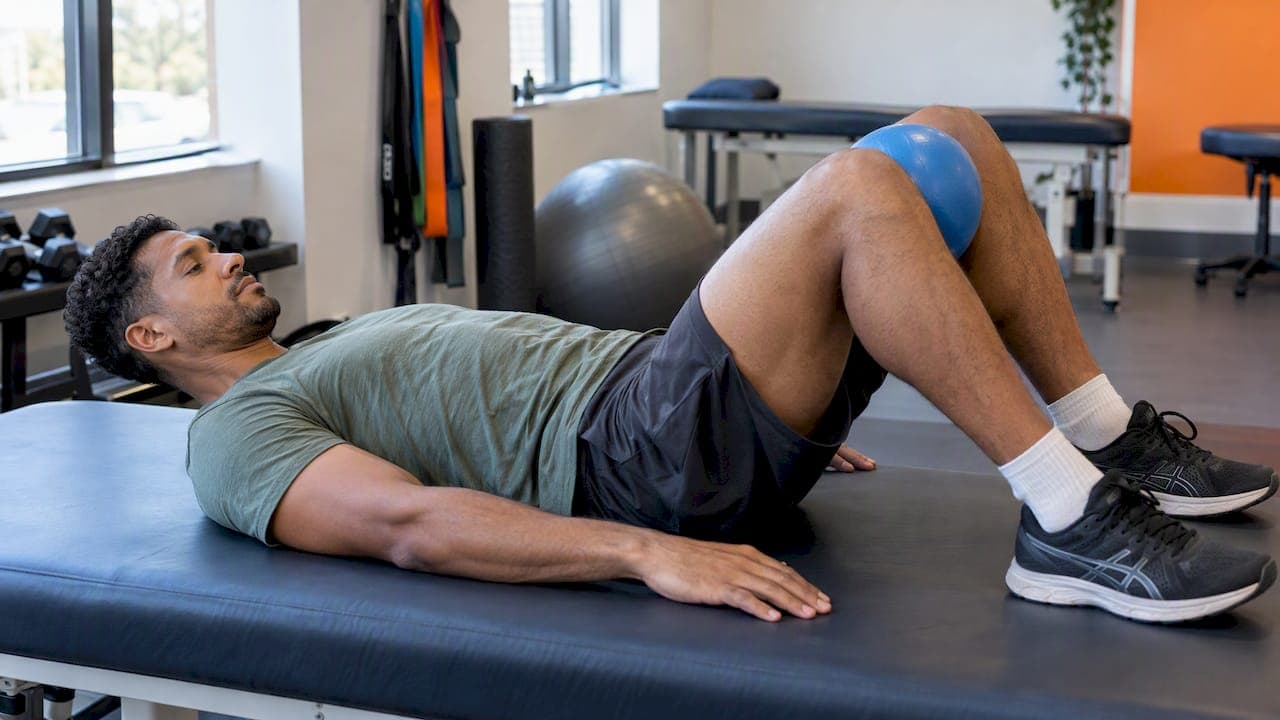
The inner-thigh squeeze is the best-known starting point. Lie on your back with your knees bent and a soft ball or rolled towel between them. Squeeze gently, hold, then release. Start with a comfortable effort and build duration and force over days and weeks rather than hammering it in the first session. Later stages use side-lying work, resistance bands and standing movements.
Do not forget the core and hips
The groin does not work in isolation. Weakness around the trunk, pelvis and glutes can leave the adductors doing extra work. Core and hip control work is a normal part of a good programme. If you want a simple set of sessions to build trunk control alongside your rehab, these core workouts for runners are short enough to fit around your physio exercises, though your clinician should confirm which movements suit your stage of recovery.
For a phased plan with explicit criteria for moving on, see our groin strain rehab guide.
How much pain is acceptable?
This is the question most people get wrong. Either they avoid all discomfort and never load the tendon enough, or they push through pain and flare it up.
NHS guidance gives workable limits:
- Adductor-related groin pain advice suggests keeping pain no higher than 3 or 4 out of 10 during exercise. It should settle quickly when you stop and not return later that day or the next day.
- NHS inform guidance on soft tissue injury uses a 0 to 5 out of 10 range, suggests reducing activity if pain goes above that, and says pain should ease quickly and be no worse the morning after.
A simple way to use this:
- Rate your pain during the exercise on a 0 to 10 scale.
- Check again 20 to 30 minutes later, and the next morning.
- If you stayed within range and the morning is no worse, you can progress gradually.
- If pain rose above range or the next morning is worse, drop back to the previous level for a few days.
Stiffness the following morning is the signal to read most carefully. It tells you how the tendon responded to the load.
Adductor strain treatment: what changes
Because many readers arrive wanting strain advice, here is how it differs. After an acute strain, the early focus is protection and calming the injury, then a quick return to gentle movement. Leeds Community Healthcare guidance on groin strain advises avoiding activities that worsen pain, then beginning gentle hip strengthening and range-of-motion exercises as pain allows, increasing from 3 sets of 10 repetitions to 3 sets of 20 as tolerated.
In practice:
- A mild strain may settle within a few weeks with simple guided rehab.
- A more significant strain needs a longer, staged return.
- A strain that lingers beyond the expected time, or recurs when you return to sport, may in truth be tendinopathy, which is when a proper assessment pays off.
Our article on the role of physiotherapy in groin recovery explains what happens in sessions for both.
Hamstring tendinopathy: how treatment differs
Proximal hamstring tendinopathy affects the tendon at the sitting bone (the ischial tuberosity) rather than the groin. Academic work on its rehabilitation and prevention describes it as a chronic overuse condition caused by mechanical overload and repetitive stretching, distinct from an acute hamstring strain. It also notes a shift in modern management: beyond tensile load, clinicians now consider the harmful effects of compression at the bony attachment.
That is the main practical difference. A 2024 review of tendinopathies around the hip describes management that starts with education to limit provocative loads such as deep hip flexion and prolonged sitting, then progressive strengthening of the hamstring and its helpers, including gluteus maximus. Early on it suggests reducing higher-speed running, altering exercises such as deadlifts, lunges and deep squats, and sitting on softer surfaces.
| Adductor tendinopathy | Proximal hamstring tendinopathy | |
|---|---|---|
| Where it hurts | Groin, inner thigh, near pubic bone | Buttock, at the sitting bone |
| Typical triggers | Kicking, sprinting, sudden direction changes | Sprinting, deadlifts, deep squats, long sitting |
| Early adjustments | Cut back kicking and sharp turning | Limit deep hip flexion and prolonged sitting |
| Rehab emphasis | Progressive adductor, hip and core loading | Progressive hamstring and glute loading, avoiding compression early |
The same principle runs through both: load the tendon progressively, not aggressively, and stay within pain limits.
Where a physiotherapist adds value
Self-guided rehab works for some people, but a physiotherapist helps most when:
- the diagnosis is unclear, because hip joint problems, pubic bone stress, hernias and nerve irritation can all produce groin pain
- pain has lasted longer than a few weeks
- you have tried resting and it returns each time you restart sport
- you need loads and progressions set to your sport rather than generic ones
- you want clear criteria for returning to training
An assessment looks at your history, hip and trunk movement, strength, and which movements reproduce the pain. If something suggests a problem beyond the tendon, a referral for imaging or a medical opinion can follow. Patients at Parks Therapy Centre can book an image assessment and referral letter where it is appropriate.
Other treatments sometimes used alongside exercise include sports massage for surrounding tight muscles, and, for some tendon problems, shockwave therapy. These are supports, not substitutes. The evidence is clearest for exercise, so any adjunct should sit within a progressive loading plan.
How long does recovery take?
NHS guidance is candid: adductor-related groin pain can take months to get better, and it is important to persevere with the exercises. Return to sport is gradual and guided by two things: symptoms resolving, and the ability to perform high-intensity, sport-specific movements without pain (Oxford University Hospitals NHS guidance).
A realistic mindset:
- Pain settling is the first sign of progress, but it is not the finish line.
- Strength and capacity need to be rebuilt before sprinting and kicking return.
- Returning too early is the most common reason groin problems recur.
To reduce the chance of repeat episodes, look at training load and strength work as well. Our groin injury prevention tips for athletes cover this.
Our perspective
In clinic, the most common story we hear is a footballer or runner who rested for two weeks, felt fine, went back to training and found the groin pain returned within a session or two. The tendon was calmer, but not stronger. We see that pattern often enough that we now explain it at the first appointment.
Our approach is to confirm the source of the pain first, then give a patient a programme they can do on their own, with clear pain limits and clear markers for progressing. We would rather see someone for a few well-planned appointments and a rehab plan they follow than for many sessions of passive treatment. Hands-on work and other therapies have a place, but exercise does the lasting work. As a multidisciplinary centre that has treated people in Bedfordshire and Buckinghamshire since 1986, we can also bring in acupuncture, sports massage, Pilates for trunk and hip control, or imaging referral when a case needs it.
— Ivan
Book an assessment at Parks Therapy Centre
If groin pain has lasted more than a week or two, or keeps returning when you go back to sport, an assessment is the quickest way to find out what is driving it. A physiotherapy assessment costs £76 and follow-up physiotherapy treatment is £67 (see our full price list). If imaging is advised, an image assessment is £76 and a referral letter is £10. Sports massage is £60 per hour, and one-to-one Pilates is £50 per class for building core and hip control. We accept major health insurance plans, and you can book online.
Visit Parks Therapy Centre to find your nearest clinic and book.
FAQ
Can adductor tendinopathy heal on its own?
Mild cases may settle if you reduce the provoking activity and keep the area moving. Many do not, because the tendon has not been strengthened and symptoms return when you restart sport. A structured exercise programme gives the best chance of lasting recovery.
Should I stretch a sore adductor?
Aggressive stretching of an irritated tendon rarely helps and can aggravate it. Gentle movement within comfortable range is usually fine. Your physiotherapist can tell you whether any stretching suits your stage.
Is it safe to exercise through groin pain?
Some discomfort is expected, but NHS guidance suggests keeping it no higher than 3 or 4 out of 10. It should settle quickly and not be worse the next morning. If it exceeds this, reduce the load and speak to a physiotherapist.
When should I see a doctor rather than a physio?
Seek urgent medical help if you suspect a tendon rupture or complete tear, for example after a sudden snap with marked weakness or a visible defect. Consider review if there is no improvement after 5 to 7 days or if symptoms are worsening.
Is hamstring tendinopathy treated the same way?
The principle of progressive loading is shared, but hamstring tendinopathy, felt at the sitting bone, also involves limiting deep hip flexion and prolonged sitting early on. A physiotherapist can confirm which tendon is involved before planning your rehab.
Sources
- NICE CKS: Sprains and strains management
- Leicestershire Partnership NHS Trust: A guide to your tendinopathy pain
- Oxford University Hospitals NHS: Adductor related groin pain
- Current Clinical Concepts: Exercise and load management of groin pain (PMC, 2023)
- NHS inform: Soft tissue injury advice
- Leeds Community Healthcare NHS: Groin strain
- Rehabilitation and Prevention of Proximal Hamstring Tendinopathy (ACSM, 2017)
- Current and future advances in practice: tendinopathies of the hip (PMC, 2024)