
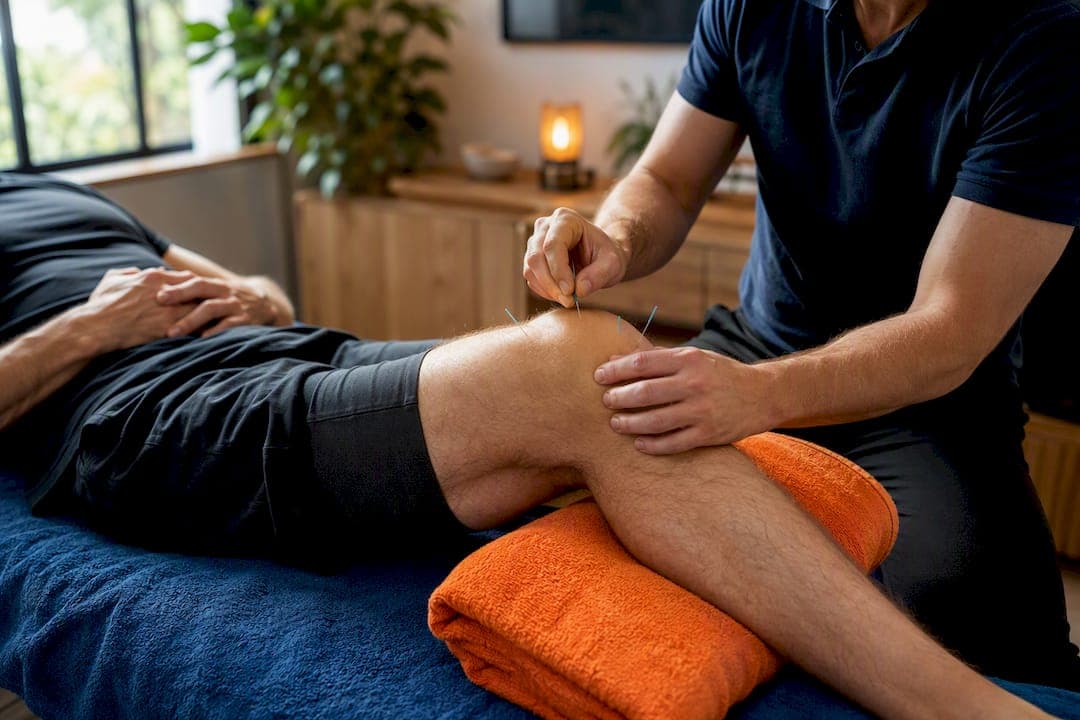
Acupuncture can reduce pain and improve function for many people with knee osteoarthritis, though the certainty of that evidence is variable and often graded low to very low. Electroacupuncture tends to outperform manual needling in trial data. It works best as a complement to physiotherapy and structured exercise, not as a replacement for urgent medical assessment when red-flag symptoms are present.
TL;DR:
- Electroacupuncture tends to produce larger and more consistent pain relief for knee osteoarthritis than manual acupuncture, especially with higher session doses.
- The evidence for acupuncture’s benefits has low to very low certainty, meaning results vary and may partly stem from placebo effects, expectations, or natural symptom fluctuations.
- Acupuncture’s pain relief can last three to six months, but it should be viewed as a complementary tool to physiotherapy, not a standalone cure.
- Individuals with advanced osteoarthritis, acute injuries, or certain health conditions should consult a healthcare provider before trying acupuncture, as some cases require urgent medical evaluation.
- Choosing a qualified practitioner with experience treating knee osteoarthritis, proper sterilization, and who emphasizes treatment planning improves safety and potential effectiveness.
Table of Contents
- What the research says about acupuncture for knee pain
- How is acupuncture delivered for knee pain?
- Who benefits most from knee acupuncture, and who shouldn't try it?
- What does a course of acupuncture treatment actually involve?
- Is acupuncture for knee pain safe, and what are the side effects?
- How does acupuncture fit alongside physiotherapy for knee pain?
- How do you choose a safe, qualified acupuncturist?
- A clinic's view on acupuncture and knee pain
- Why the "does it work?" framing misses the point
- Book acupuncture within a physiotherapy-led plan at Parkstherapycentre
- Sources
What the research says about acupuncture for knee pain
The strongest recent evidence comes from a systematic review and meta-analysis of 80 trials involving 9,933 participants, which found that acupuncture may reduce knee pain compared with sham needling, NSAIDs, and standard care. Electroacupuncture produced larger effect estimates than manual acupuncture in several of the chronic osteoarthritis subgroups analysed. That is not a small dataset. The large number of participants and trials gives this finding real weight, even before you factor in the certainty question.
And the certainty question matters. Researchers didn't rate this evidence highly. Most of the pooled analyses came back as "low" or "very low" certainty, which in research terms means the true effect could be meaningfully different from what the trials showed. This isn't a flaw unique to acupuncture research. It reflects genuine difficulty in blinding needle-based treatments (patients often know whether they're receiving real acupuncture versus a superficial sham), plus wide variation in how trials were designed, how many sessions patients received, and how outcomes were measured.
A BMJ Evidence-Based Medicine network meta-analysis reached a similar conclusion: clinically important effects on pain and function, but very low certainty overall. The same review flagged electroacupuncture and higher-dose protocols (more sessions, greater stimulation) as likely contributors to stronger, more consistent results. That's a useful clue for anyone deciding which style of treatment to pursue.
Statistic to note: Pooled data from 10 randomised controlled trials covering 3,221 participants found that functional improvements and pain relief can persist for 5 to 6 months after a course of acupuncture, compared with usual care or diclofenac in some trials. That's a meaningfully long window for a non-drug intervention.
Older evidence tells a consistent story. An NIH/PMC review of acupuncture and knee osteoarthritis summarised earlier trial data and found modest but real benefits for pain and function, even as it acknowledged the same certainty limitations seen in newer reviews.
What does "very low certainty" actually mean for you as a patient? It doesn't mean acupuncture doesn't work. It means researchers can't yet rule out that some of the measured benefit comes from factors other than the needling itself, such as the attention of a practitioner, expectation effects, or natural fluctuation in osteoarthritis symptoms. In practice, this translates to:
- A reasonable chance of modest-to-moderate pain relief, particularly with electroacupuncture
- Benefits that may last several months rather than being permanent
- A treatment worth trying alongside, not instead of, evidence-based physiotherapy
- Results that vary meaningfully between individuals, more so than with some pharmaceutical treatments.
For anyone weighing up acupuncture treatment for arthritis against other options, the honest summary is this: the signal is real, but it's not as clean as a single blockbuster statistic might suggest.
How is acupuncture delivered for knee pain?
Acupuncture for knee pain isn't a single technique. The style used can shape both the sensory experience and, according to some trial data, the likely outcome.
Manual acupuncture is the traditional approach: fine, sterile needles inserted at specific points around the knee, sometimes gently rotated or manipulated by hand, and left in place for roughly 20 to 30 minutes. Most people describe the sensation as a dull ache or heaviness rather than sharp pain.
Electroacupuncture adds a small electrical current to needles once they're inserted, delivered through a connected device at a low, controlled frequency. This is the modality that keeps outperforming manual needling in subgroup analyses, including the exploratory findings from the BMJ EBM review that pointed to electroacupuncture and higher-dose protocols as contributors to larger, more stable effects. Sessions feel similar to manual acupuncture but with a faint pulsing or tapping sensation at the needle site.
Dry needling overlaps with acupuncture technically (both use similar needles) but is typically framed around trigger points in muscle tissue rather than traditional Chinese medicine meridian points. Physiotherapists sometimes use dry needling specifically to address tight quadriceps or hip musculature contributing to knee strain.
Auricular acupuncture uses points on the ear believed to correspond to other body regions, including the knee. Evidence for this specific application in knee osteoarthritis is thinner than for local knee-point needling, so it tends to feature as an adjunct rather than a primary technique.
- Manual acupuncture: gentler stimulation, widely available, well-tolerated
- Electroacupuncture: added electrical stimulation, stronger trial signal for chronic knee osteoarthritis
- Dry needling: muscle-focused, often delivered by physiotherapists
- Auricular acupuncture: supplementary technique, limited standalone evidence for knee pain
Pro Tip: If you have chronic knee osteoarthritis and manual acupuncture hasn't moved the needle on your pain after several sessions, ask your practitioner directly whether electroacupuncture or a higher-frequency protocol might suit your case. Not every clinic offers electrostimulation as standard, so it's worth asking before you book.
Who benefits most from knee acupuncture, and who shouldn't try it?
The evidence base overwhelmingly concerns knee osteoarthritis and chronic, non-surgical knee pain. If your knee pain has been building gradually over months or years, particularly with stiffness, swelling, and reduced range of motion typical of osteoarthritis, you're in the population most of the research actually studied.
Acupuncture is not a sensible first-line sole therapy for suspected ligament tears, meniscal injuries, fractures, or a joint that's hot, swollen, and acutely painful (which can signal infection or gout and needs urgent medical review, not a course of needling). If your knee gave way suddenly during sport, locked, or swelled dramatically within hours, see a GP or physiotherapist for an assessment before considering acupuncture benefits for athletes as a recovery tool.
Certain factors call for extra caution or a conversation with your GP first:
- You take anticoagulant medication (warfarin, apixaban, and similar drugs increase bruising and bleeding risk at needle sites)
- You have a pacemaker or implanted electrical device (relevant specifically for electroacupuncture)
- You are pregnant, since some points are traditionally avoided in pregnancy
- You have a needle phobia significant enough to cause distress, in which case discuss coping strategies with a practitioner first
- You have a compromised immune system or skin infection near the knee
If you're unsure whether your knee pain fits the profile the evidence supports, a conversation with your GP or a physiotherapist before starting is the safer route. Getting a proper diagnosis first means any acupuncture you receive afterwards is targeting the right problem.
What does a course of acupuncture treatment actually involve?
Trials testing acupuncture for knee pain typically use a fairly consistent structure, which gives a realistic template for what to expect.
- Initial assessment. Most practitioners start with a full history, covering your knee symptoms, general health, medications, and any contraindications, before the first needles go in.
- Treatment course. Many of the trials behind the evidence above used weekly sessions over roughly 6 to 8 weeks, though some protocols run twice weekly for a shorter block.
- Early response window. Some patients report reduced pain within the first two to three sessions; others need the full course before noticing a meaningful shift. Trials generally measure outcomes at multiple points rather than assuming an instant effect.
- Reassessment. A good practitioner will check pain scores and functional markers (how far you can walk, how the knee copes with stairs, kneeling, or squatting) partway through the course, not just at the end.
- Maintenance decisions. Given that pooled trial data show benefits lasting up to 5 to 6 months in some cases, many people book occasional top-up sessions rather than an indefinite weekly schedule.
Cost context: Private acupuncture sessions in the UK commonly range in moderate cost per session, varying by clinic and region, with courses of multiple sessions typical for knee osteoarthritis. NHS access to acupuncture is inconsistent between areas, so it's worth checking directly with your GP practice or local integrated care board about current referral options, and confirming with your insurer whether acupuncture is covered under your policy before booking a course.
Is acupuncture for knee pain safe, and what are the side effects?
Acupuncture has a good safety record when performed with sterile, single-use needles by a properly trained practitioner. The NCCIH's safety summary and multiple trial reports across the reviews above describe adverse events as usually minor and short-lived.
Common, low-severity effects include:
- Small bruises at needle sites, particularly on people taking blood thinners
- Mild soreness or heaviness around the knee for a day or two afterwards
- Occasional lightheadedness or faintness, more common at a first session
- Minor bleeding spots where a needle has been removed
Serious adverse events, such as infection or organ injury from misplaced needling, are rare when modern sterile single-use needle protocols are followed correctly. The absolute incidence reported across large safety reviews is low, though "rare" doesn't mean "impossible," which is exactly why practitioner training and hygiene standards matter as much as the needling technique itself.
To reduce your own risk: choose a practitioner who works from a registered clinic, uses individually packaged sterile needles, and takes a full medical history before your first session, flagging anything relevant, including medications, pacemakers, and pregnancy. Stop treatment and seek medical attention if you notice spreading redness, fever, unusual swelling at a needle site, or any signs of infection rather than waiting for your next appointment.
How does acupuncture fit alongside physiotherapy for knee pain?
Acupuncture works best as one part of a broader plan rather than a standalone fix. Clinical experts generally recommend it as an adjunct within a multidisciplinary approach centred on exercise, strengthening, and activity modification, not as a replacement for that work.
The mechanism behind this pairing is fairly intuitive. Needling can reduce pain enough that patients tolerate therapeutic exercise more comfortably, particularly the quadriceps and hip abductor strengthening work that underpins most evidence-based knee osteoarthritis programmes. A patient too sore to complete their prescribed exercises gets far less benefit from physiotherapy than one whose pain has been brought down to a manageable level first.
This combined approach also shows up in sports medicine. A 2024 review on Western medical acupuncture use among athletes found generally positive perceptions among both clinicians and athletes, with acupuncture prescribed by a meaningful proportion of UK sports medicine practitioners as part of broader rehabilitation, not in isolation.
In practical terms, a combined pathway typically looks like:
- Acupuncture sessions timed to reduce pain ahead of strengthening or mobility work
- Progressive quadriceps and hip strengthening built into the same treatment plan
- Activity modification advice running alongside both, adjusted as function improves
- Regular reassessment so acupuncture is scaled back once exercise tolerance improves
Patients often manage their exercise programme better and stick with it longer when pain is under control early. That's the real value acupuncture adds, not as a cure, but as a bridge into the harder, more durable work of rehabilitation.
How do you choose a safe, qualified acupuncturist?
Credentials matter more in acupuncture than in many other therapies, partly because regulation in the UK is less centralised than for physiotherapy. A few checks before booking will save you trouble later.
- Check registration. Look for membership of a recognised professional body, such as the British Acupuncture Council or, for practitioners with a medical or physiotherapy background, the British Medical Acupuncture Society. Registration means adherence to hygiene, training, and continuing education standards.
- Ask about experience with knee osteoarthritis specifically. A practitioner who regularly treats knee pain will have a clearer sense of realistic timelines and which technique, manual or electroacupuncture, suits your presentation.
- Ask about needle sterility. Confirm they use individually packaged, single-use sterile needles as standard, not reused equipment.
- Ask whether they carry professional indemnity insurance. Any legitimate registered practitioner should hold this without hesitation.
- Ask how they'll measure progress. A practitioner who tracks pain scores or functional milestones across your course is applying the same logic the clinical trials use.
Red flags to walk away from include guarantees of a complete cure, pressure to commit to a long, prepaid course before a single assessment, clinics that can't confirm registration or insurance, or practitioners offering to diagnose conditions outside their scope, such as interpreting X-rays or replacing a GP's assessment of a swollen, acutely painful joint.
Pro Tip: Ask a prospective practitioner directly: "What would make you refer me back to my GP instead of continuing treatment?" A good answer, one that names specific red-flag symptoms, tells you they understand where acupuncture's role ends and medical assessment begins.
A clinic's view on acupuncture and knee pain
A multidisciplinary clinic has operated across Bedfordshire and Buckinghamshire since 1986, offering physiotherapy, acupuncture, and podiatry, among other services, under one roof with online booking and patient reviews. That structure matters for a treatment like acupuncture, because it rarely works best in isolation.
In practice, acupuncture within a physiotherapy-led pathway tends to follow the pattern the research supports: needling used to bring pain down to a manageable level, followed or accompanied by targeted strengthening and mobility work aimed at the underlying cause of the knee pain, whether that's osteoarthritis, patellofemoral strain, or post-injury stiffness. A patient referred internally between a physiotherapist and an acupuncturist at the same clinic avoids the gaps that can appear when these therapies are sought separately from unconnected providers.
None of this replaces a proper assessment. Knee pain has enough different causes, from meniscal tears to inflammatory arthritis to referred hip pathology, that a personalised evaluation should always come before deciding on acupuncture, physiotherapy, or a combination of both. What a multidisciplinary setting offers is the ability to adjust that plan as you go, rather than committing to one treatment path in isolation and hoping it's the right one.
Why the "does it work?" framing misses the point
Most conventional coverage of acupuncture for knee pain gets stuck arguing over whether it "works," as if that's a yes-or-no question. The research doesn't support that framing. It supports a more useful one: acupuncture, particularly electroacupuncture, produces a real but modest effect for many people with knee osteoarthritis, and that effect is more valuable as a tool for enabling exercise than as a treatment in its own right.
Where I think the conventional advice falls short is in treating acupuncture as a standalone decision, something you try instead of physiotherapy rather than alongside it. The trial evidence on durability, benefits lasting several months in pooled analyses, makes far more sense once you view it as pain control that buys you a window to do the harder rehabilitation work. Skip that second half and you're leaving most of the value on the table.
If you take one thing from this evidence, prioritise finding a practitioner who talks about acupuncture as part of a plan rather than the plan itself. That single question, asked before you book, tells you more than any single statistic in this article.
— Ivan
Book acupuncture within a physiotherapy-led plan at Parkstherapycentre
If the research above has left you weighing up acupuncture against other routes for your knee pain, One clinic offers acupuncture and physiotherapy delivered by the same multidisciplinary team, so pain relief and strengthening work happen as one coordinated plan rather than two disconnected appointments with different providers.
That matters most for chronic knee osteoarthritis, where the trial evidence consistently points to combined care outperforming needling alone. A physiotherapist and acupuncturist working from the same notes can adjust your plan session to session, scaling back needling as your strength improves or bringing it back in if a flare-up interrupts your exercise progress. For further context on integrating natural remedies for knee pain alongside movement-based approaches, resources on complementary therapies for chronic pain can offer useful additional perspective.
- Book an initial assessment or acupuncture session directly through the Parks Therapy Centre booking page
- Ask specifically about combined acupuncture and physiotherapy pathways for knee osteoarthritis when you call or book
Sources
The clinical claims in this article draw on a small set of higher-quality sources rather than general web consensus:
- Systematic review and meta-analysis (2024) — acupuncture and knee osteoarthritis
- Pooled RCT data showing durable improvements up to 5–6 months
- Clinical effect and contributing factors of acupuncture for knee osteoarthritis: systematic review and network meta-analysis (BMJ EBM)
- Acupuncture and osteoarthritis of the knee (PMC/NIH)
This article is general information, not a substitute for advice from a qualified doctor. Consult a qualified healthcare professional about your own circumstances before acting on anything here.